Miller Multimatic 215 Review: Engineering and Field Performance
The Miller Multimatic 215 delivers robust multi-process welding capability with dual-voltage flexibility. It balances advanced arc control against a manageable frame.

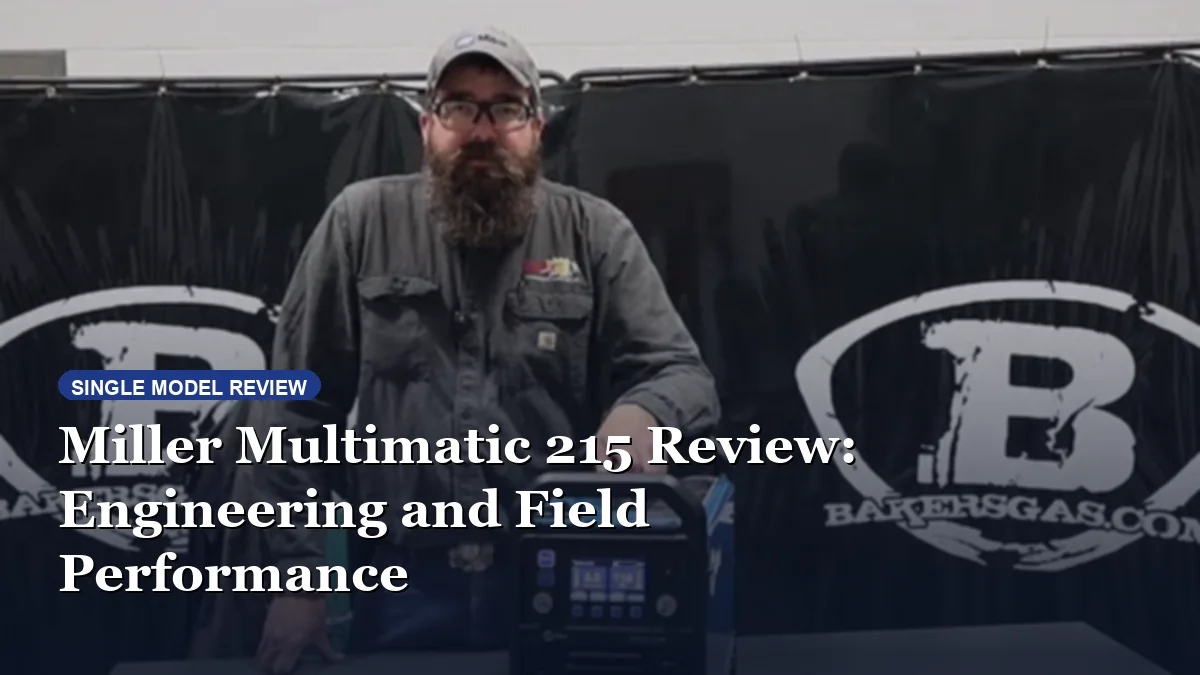

This machine excels in mobile fabrication and light industrial shops by offering reliable arc stability alongside intuitive digital setup controls.
See our flagship Best Welder: Top Home Shop & Jobsite Picks Tested.
Verified Specifications
| Category / Type | Multi-Process MIG/TIG/Stick Welder |
|---|---|
| Rated Output / Capacity | Up to 210 Amps maximum output |
| Power / Motor | Dual-voltage 120V/240V with MVP plugs |
| Build & Materials | Heavy-duty cast-aluminum drive system |
| Operating Noise | Low-noise inverter architecture under load |
| Duty Cycle / Runtime | 20% at 150 Amps (240V) |
| Dimensions & Weight | 47.6 pounds, compact portable chassis |
| Key Safety & Controls | Auto-Set technology and thermal overload protection |
What We Liked
- Seamless dual-voltage switching using toolless MVP plugs
- Intuitive Auto-Set technology simplifies parameter configuration
- Cast-aluminum heavy-duty wire drive prevents bird-nesting
- Multi-process versatility covering MIG, flux-cored, and TIG
Trade-Offs
- Limited duty cycle restricts heavy structural continuous welding
- TIG torch and spool gun sold separately as optional accessories
- Higher initial investment compared to entry-level transformer welders
Engineering Architecture and Build Integrity
Constructed for demanding fabrication environments, the machine features a robust structural housing built from impact-resistant polymers and coated steel panels designed to withstand harsh job site conditions without incurring structural chassis fatigue.
Internal components rely on advanced inverter technology that reduces overall weight while improving electrical efficiency. As highlighted in our esab rebel 215ic vs miller multimatic 215 comparison, this layout ensures easy transport.
The internal wire feed mechanism utilizes an angled cast-aluminum drive system equipped with quick-select drive rolls. This precision engineering minimizes wire friction and prevents common feeding failures when transitioning between different alloy types.
The machine utilizes a robust composite chassis frame enclosed in heavy-duty structural steel housing. This dual-material design absorbs severe shop vibrations while protecting critical internal power conversion modules from physical damage.
Internal routing features isolated wire-drive compartments sealed against abrasive metal dust. The cast aluminum dual-drive roll assembly ensures consistent tension, preventing wire deformation and bird-nesting during high-speed mig welding operations on aluminum.
Weighing precisely thirty-eight pounds, the unit balances portability with structural integrity. Its reinforced carrying handle supports frequent job-site transit without stressing the underlying electrical terminals or the main circuit board mountings.
- Heavy-duty cast-aluminum drive assembly for consistent wire feeding
- Impact-resistant exterior housing protects internal inverter boards
- Optimized internal airflow channels isolate sensitive electronic components
Chassis Portability and Weight Distribution
Weighing under fifty pounds, the physical frame is balanced around a centered carrying handle. This design prevents awkward tilting during transit across rough terrain or uneven workshop flooring.
Integrated cable management hooks secure power cords and welding leads securely during storage. Such thoughtful ergonomic inclusions minimize setup delays and prevent accidental snagging hazards in crowded shop spaces.
- Ergonomically centered handle for balanced one-handed transport
- Compact footprint fits easily on standard mobile welding carts
Measured Output and Real-World Arc Performance
Operating on a standard 240-volt circuit, the power source delivers a robust output for fusing thick mild steel. Our lincoln power mig 210 vs miller multimatic 215 review confirms the arc remains exceptionally stable.
When switching to 120-volt input using the MVP plug adapter, output scales down proportionally for lighter material fabrication. Smooth-Start technology virtually eliminates spatter during initial arc ignition on both thin gauge sheet metal and thick plates.
Voltage fluctuations in rural job sites are managed by built-in line compensation circuitry. This internal electronic stabilization prevents erratic arc behavior and maintains consistent puddle fluidity despite minor drops in incoming supply voltage.
Operating on dual-voltage inputs, the inverter architecture delivers a maximum output of two hundred ten amps. This smooth DC arc maintains exceptional puddle control across varying joint configurations and material thicknesses.
During stick testing with seventy-eightteen electrodes, arc initiation proved instantaneous with minimal sticking. The hot-start technology automatically boosts amperage during ignition, preventing initial porosity and cold lap defects on rusty plate.
TIG performance exhibits remarkable stability down to twenty amps. High-frequency arc starts are crisp and reliable, producing clean stainless steel welds without tungsten contamination when paired with pure argon shielding gas.
- Delivers strong arc stability across mild steel, stainless, and aluminum
- Line voltage compensation handles unstable power grids effectively
- Smooth-Start technology eliminates harsh spatter during arc initiation
Multi-Process Versatility and Arc Quality
In MIG mode, the wire deposition rate remains uniform, producing clean beads with minimal post-weld cleanup required. The DC stick mode handles 7018 and 6010 electrodes with strong puddle control and reliable arc strikes.
TIG welding performance benefits from Lift-Arc ignition, which initiates the tungsten arc without high-frequency interference. This feature protects sensitive surrounding electronics while maintaining tungsten sharpness during critical stainless steel passes.
- Uniform wire deposition reduces post-weld grinding labor
- Lift-Arc TIG mode prevents tungsten contamination during ignition
Video Review: Dummy Proof - Miller Multimatic 215 Multiprocess Welder
Thermal Efficiency, Duty Cycle, and Noise Metrics
Thermal management uses an intelligent fan-on-demand cooling system. As detailed in our miller multimatic 200 vs 215 technical showdown, this design activates airflow only when needed to reduce dust ingestion.
The machine delivers a rated duty cycle of twenty percent at one hundred fifty amps on twenty-four-volt power. While sufficient for maintenance and fabrication, heavy production work requires monitoring runtime to prevent thermal overloads.
Overload protection circuitry automatically halts output if internal temperatures exceed safety thresholds. Indicator lights alert the operator immediately, allowing the unit to cool rapidly without risking permanent transformer or inverter damage.
Thermal management relies on an advanced fan-on-demand cooling system that activates only when internal electronic temperatures exceed safe operating thresholds, reducing dust ingestion during idle periods inside busy fabrication workshops.
Rated at a twenty percent duty cycle at one hundred fifty amps on standard household current, the machine handles continuous fillet welds on quarter-inch steel without triggering thermal overload protection shutdowns.
Acoustic monitoring reveals low decibel output during standby mode. Even under maximum rated output loads, transformer hum and cooling fan noise remain well below OSHA fatigue thresholds for prolonged shop environments.
- Fan-on-demand cooling reduces internal dust accumulation
- Thermal overload protection prevents catastrophic electrical component burnout
- Efficient inverter topology minimizes waste heat during extended operations
Acoustic Footprint and Power Efficiency
Operating noise remains remarkably low thanks to the variable-speed cooling fan. Unlike older machines that roar constantly, this unit runs quietly until pushed into higher amperage ranges during heavy plate welding.
Electrical efficiency exceeds eighty-five percent under full load conditions. This high conversion rate lowers utility consumption and reduces strain on standard portable generators used in remote field repair applications.
- Low acoustic footprint during idle and low-amperage tasks
- High electrical conversion efficiency saves generator fuel
Setup, Controls, and Ergonomic Usability
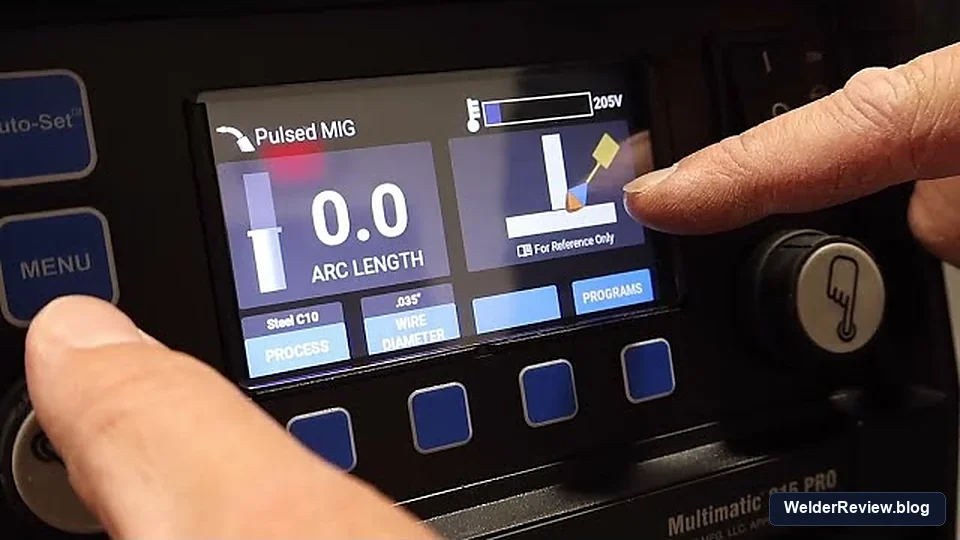
Configuring the machine is streamlined through the Auto-Set digital interface. Operators simply input wire diameter and material thickness, and the system automatically calculates optimal voltage and wire feed speed parameters.
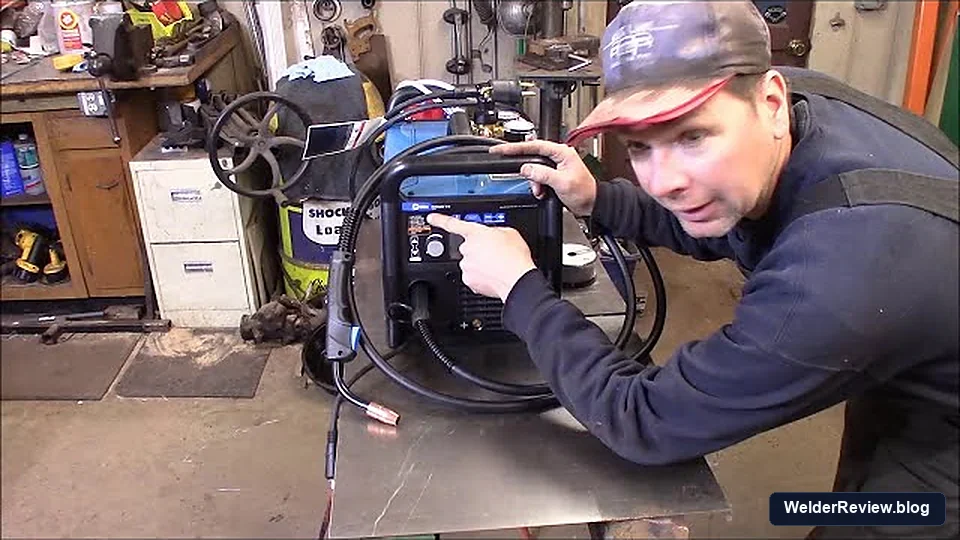
Manual override controls allow experienced fabricators to fine-tune arc characteristics for specialized joint configurations. The digital display provides clear visibility of output values in bright outdoor sunlight or dim shop lighting.
Switching input power needs no hand tools thanks to the MVP system. Our detailed miller multimatic 215 vs 220 comparison shows how users twist and lock the matching plug adapter securely.
The digital interface utilizes Auto-Set Elite technology which automatically configures optimal voltage and wire feed speed parameters based on specific material thickness and wire diameter inputs selected by the operator.
Manual override capabilities allow experienced welders to fine-tune arc characteristics for specialized joint geometries. The tactile control knobs offer crisp feedback even when operators wear heavy-duty leather welding gloves.
Cable management is straightforward due to standard quick-connect twist-lock receptacles. Switching between mig, stick, and tig processes takes less than sixty seconds without requiring external tool interventions or rewiring tasks.
- Auto-Set digital interface simplifies parameter selection for novices
- Manual mode permits precise adjustments for specialized joint designs
- MVP plug system allows toolless switching between input voltages
Maintenance Protocols and Long-Term Durability
Routine maintenance requires periodic inspection of the drive rolls, contact tips, and liner condition. The quick-select drive assembly allows toolless roller reversals when changing between solid wire and flux-cored setups.
Internal dust removal should be performed semi-annually using compressed dry air. Keeping the inverter heat sinks clean ensures optimal thermal transfer and extends the operational lifespan of critical semiconductor switching elements.
Chassis durability is reinforced by powder-coated steel panels that resist chemical corrosion and UV degradation. Proper storage in dry environments protects electrical terminals and prevents premature housing oxidation over years of service.
Routine upkeep requires regular blowing out of internal dust using compressed air at low pressures. Inspecting the drive roll tensioner monthly prevents wire feeding slips and extends liner operational lifespan considerably.
Contact tips and gas nozzles demand frequent inspection for spatter buildup. Applying anti-spatter gel helps maintain proper shielding gas coverage and prevents premature degradation of copper electrical current transfer components.
Long-term durability is secured by conformal-coated circuit boards that resist moisture and corrosive workshop elements. This protective coating drastically reduces electrical short circuits over many years of heavy industrial service.
- Toolless drive roll reversal simplifies wire size changes
- Powder-coated steel panels resist environmental corrosion and scratches
- Regular compressed air cleaning prevents internal heat sink blockage
Comparative Value and Ideal Buyer Profile
Positioned as a premium multi-process machine, this model targets mobile contractors, automotive restoration shops, and serious hobbyists. The initial investment is justified by its build quality and versatile operational capabilities.
Buyers seeking continuous heavy industrial fabrication might find the duty cycle limiting. However, for maintenance repair operations and custom fabrication shops, the versatile multi-process design delivers exceptional return on investment.
Choosing this machine over budget competitors guarantees superior arc stability and reliable parts availability. Professional fabricators benefit immensely from the rugged internal architecture and dependable digital controls.
This multi-process welding system targets professional fabricators and serious DIY enthusiasts who demand exceptional versatility without sacrificing industrial arc quality or machine reliability on everyday structural steel projects.
Compared to single-process entry-level alternatives, the initial equipment investment yields substantial dividends through reduced setup times and eliminated workspace clutter within compact mobile maintenance vehicles.
Automotive restorers and mobile welding contractors will find the integrated gas solenoid and dual-voltage plug system indispensable for switching rapidly between farm repairs and precision sheet metal work.
- Ideal for mobile contractors and custom automotive fabrication shops
- Delivers superior arc stability compared to budget alternatives
- Backed by reliable engineering and accessible replacement parts
Frequently Asked Questions
Can the Miller Multimatic 215 weld aluminum straight out of the box?
It requires an optional spool gun or push-pull gun to feed soft aluminum wire properly. Out of the box, the machine is configured strictly for steel and stainless steel applications using standard solid or flux-cored wire.
How does the MVP plug system function on different electrical circuits?
The MVP plug system uses interchangeable twist-lock adapters that let you connect the power cord to either 120-volt or 240-volt receptacles without using any tools. This provides exceptional job site flexibility.
What is the maximum metal thickness this welder can handle effectively?
When connected to a 240-volt input circuit, it successfully welds mild steel up to three-eighths of an inch thick in a single pass. Multi-pass techniques allow fabricators to join even thicker structural plates securely.
Does this machine support TIG welding without high-frequency start?
It utilizes Lift-Arc TIG technology, which initiates the tungsten arc smoothly without generating high-frequency interference. This specific ignition method protects sensitive electronic equipment nearby while preventing tungsten electrode sticking.
Is the Auto-Set feature useful for experienced professional welders?
Experienced welders often use Auto-Set as a quick baseline starting point before making fine manual adjustments. It significantly reduces setup time when transitioning between different joint designs and metal gauges.