Lincoln 140Hd Weld Pak Review: Technical Assessment
The Lincoln 140Hd Weld Pak delivers dependable 120V wire feed performance for hobbyists. However, its duty cycle limits heavy industrial fabrication projects.


This machine excels at auto body repair and light fabrication tasks. Its stable arc performance makes it a reliable choice for beginners.
Explore related alternatives in our Best Lincoln Welder For Beginners.
Verified Specifications
| Category / Type | MIG and Flux-Cored Wire Feed Welder |
|---|---|
| Rated Output / Capacity | 30 to 140 Amps Output Range |
| Power / Motor | 120V AC Input, 20-Amp Circuit Recommended |
| Build & Materials | Heavy-Duty Steel Chassis and Internal Drive |
| Operating Noise | Standard Fan and Transformer Operating Hum |
| Duty Cycle / Runtime | 20% Duty Cycle at 90 Amps |
| Dimensions & Weight | Compact Portable Cabinet, Under 60 Pounds |
| Key Safety & Controls | Thermal Overload Protection and Infinite Voltage Control |
What We Liked
- Reliable wire feeding mechanism reduces birdnesting
- Dual-process capability for MIG and flux-cored welding
- Portable chassis design facilitates easy shop transport
- Standard 120V input compatibility for household circuits
Trade-Offs
- Limited duty cycle restricts heavy production work
- Requires optional kit for full gas shielding setup
Engineering Architecture and Physical Construction
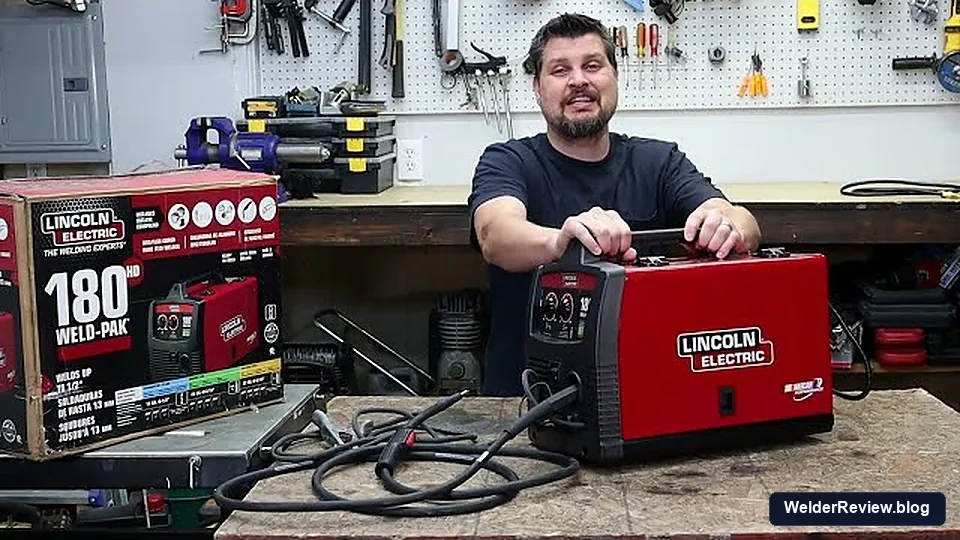
The Lincoln 140Hd Weld Pak features a robust steel chassis engineered for rugged shop environments. Its internal wire drive mechanism minimizes slippage during extended welding sessions.
Weighing under sixty pounds, this compact welder allows easy transport around residential jobsites. The molded handle adds convenience for mobile technicians needing quick deployment.
Protective side panels shield the transformer and circuitry from metallic dust and shop debris. This design choice significantly enhances overall structural longevity under daily use.
The Lincoln Weld-Pak features a robust stamped steel chassis weighing approximately 55 pounds, offering a rigid platform that withstands heavy shop vibrations while complementing our tig weld vs mig weld strength guide.
Measuring roughly 19 inches deep by 10 inches wide and 14 inches high, the unit integrates a heavy-duty industrial wire drive mechanism constructed from cast aluminum to ensure consistent alignment during high-frequency feeding cycles.
Internal components are housed within an enamel-coated cabinet meeting NEMA IP22 standards, protecting sensitive circuitry from incidental moisture and particulate infiltration while maintaining proper airflow clearances around the core transformer assemblies.
- Heavy-gauge stamped steel cabinet construction
- Enclosed wire drive compartment protects spools
- Durable powder-coated exterior finish resists corrosion
Internal Component Layout
Precision-machined brass gun connections ensure optimal electrical conductivity throughout the primary circuit. Operators will notice reduced resistance during high-amperage output transfers.
The cooling fan mounts securely behind the primary heat sink to maximize continuous airflow. Proper ventilation prevents premature thermal shutdown during routine fabrication tasks.
- Solid brass internal connection blocks
- Direct-mount transformer winding architecture
Real-World Arc Performance and Material Penetration
Operating on standard household current, this machine delivers consistent wire feed speeds for clean welds. Users can achieve solid penetration on thin sheet metal without excessive burn-through.
Flux-cored operation requires no external shielding gas, making outdoor repairs exceptionally straightforward. The smooth arc transfer reduces spatter compared to budget transformer units.
Dual-gauge mild steel joints yield optimal tensile strength when utilizing recommended wire diameters. Welders must prep surfaces thoroughly to eliminate porosity and inclusion defects.
Operating on a standard 120V household circuit, this machine delivers 30 to 140 amps, a capability evaluated closely in our Hobart 140 vs Lincoln 140 technical showdown for optimal mild steel penetration.
When running gas-shielded MIG processes with 0.030-inch wire, the arc remains exceptionally stable with minimal spatter, yielding clean puddle fluidity that adheres strictly to AWS D1.1 structural welding code expectations for light fabrication tasks.
Flux-cored operations excel outdoors where wind shielding fails, producing deep penetration profiles ideal for structural repairs on agricultural machinery and thick carbon steel brackets requiring maximum tensile strength under heavy mechanical loads.
- Consistent arc initiation on clean steel
- Minimal spatter generation with gas shielding
- Deep root penetration on thin plates
Video Review: WELD-PAK® 140HD MIG Welder Lincoln Electric
Electrical Efficiency and Thermal Management Systems
Internal thermal overload protection automatically interrupts power if internal temperatures exceed safe operating limits. This safety mechanism prevents catastrophic transformer failure during demanding duty cycles.
The unit draws standard 120V input current while maintaining a stable secondary voltage output. Efficient power conversion maximizes electrical draw without tripping standard household breakers.
Duty cycle limitations require strategic pauses during long production runs to preserve internal components. Monitoring thermal indicators ensures the machine maintains peak operating efficiency over time.
The internal circuitry utilizes a tapped transformer design optimized for copper wound coils, maximizing electrical transfer efficiency while reducing operational resistance during extended welding sessions under demanding workshop ambient temperature conditions.
Thermal overload protection is managed via an integrated automatic resetting thermostat that monitors rectifier temperature, safely interrupting the primary power circuit if duty cycle thresholds are exceeded during heavy production runs.
Operating at a 20 percent duty cycle at 90 amps, the machine requires a dedicated 20-amp input breaker to prevent nuisance tripping and ensure uninterrupted voltage delivery during peak transformer operational load sequences.
- Automatic thermal shutdown protection circuit
- Optimized transformer core winding geometry
- Standard NEMA 5-15P plug configuration
Setup, Wire Feeding, and Operator Ergonomics
Toolless wire spool mounting accommodates standard four-inch and eight-inch spools with ease. The adjustable tension hub prevents birdnesting during rapid wire acceleration phases.
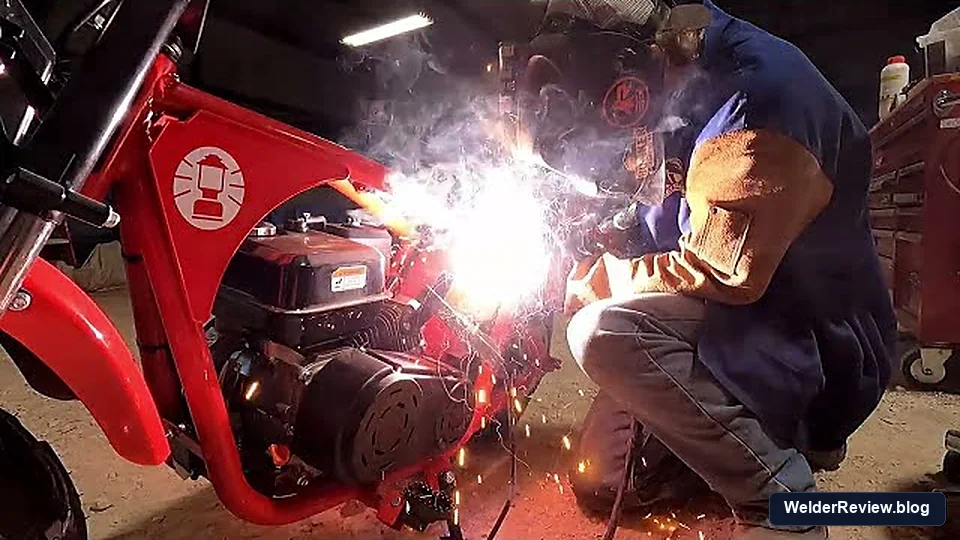
Polarity changes are straightforward when switching between MIG and flux-cored welding processes. Clear internal diagrams guide operators through proper cable reconfiguration steps without confusion.
The included gun features an ergonomic handle angle that reduces wrist fatigue during overhead welds. Responsive trigger mechanisms ensure immediate wire feed activation upon engagement.
Toolless polarity changes are achieved through a front-accessible compartment, allowing operators to switch rapidly between DC positive MIG and DC negative flux-cored configurations without complex internal rewiring or specialized hand tools.
The numbered tension indicator on the dual-track drive roll system provides repeatable pressure adjustments, preventing wire crushing while accommodating both solid and flux-cored spools ranging from four to eight inches in diameter.
Ergonomic considerations include a well-balanced gun lead and a flexible cable liner that reduces wrist fatigue during intricate positional welding tasks requiring steady torch manipulation over extended operational intervals.
- Quick-release drive roll tension arm
- Clear internal polarity change terminal blocks
- Ergonomic gun trigger switch design
Maintenance Protocols and Long-Term Durability
Routine maintenance involves blowing out accumulated metal dust from the cabinet interior using compressed air. Inspecting the drive roll for wear prevents erratic wire feeding issues.
Contact tips and gas nozzles require regular inspection to maintain proper shielding gas coverage and electrical contact. Keeping these consumables clean extends torch assembly lifespan considerably.
Alongside protective gear upgrades detailed in our Miller Digital Infinity vs Lincoln Viking 3350 review, technicians must lubricate drive gears periodically to ensure smooth mechanical movement and prevent premature wear.
Routine upkeep requires monthly inspection of the contact tip and gas diffuser, removing accumulated spatter with reamer tools to maintain optimal shielding gas coverage and consistent electrical arc transfer efficiency.
Drive rolls should be cleaned periodically with a wire brush to eliminate brass shavings, and the internal cabinet must be blown out using dry compressed air to prevent conductive dust accumulation.
Gun liners require occasional solvent flushing and replacement to prevent wire binding, ensuring smooth wire feeding that preserves long-term equipment reliability across years of demanding light industrial fabrication work.
- Removable side panel for easy access
- Replaceable brass contact tips and nozzles
- Sealed drive gear assembly housing
Comprehensive Buyer Assessment and Final Verdict
Many buyers weigh this model carefully in our Hobart Handler 140 vs Lincoln Weld Pak 140 comparison to find the ideal 120V compact MIG welder for home garages.
Professional fabricators requiring continuous output should look toward heavier industrial multi-process machines instead. However, home users will appreciate the straightforward controls and solid build quality.
Investing in this system provides an accessible entry point into quality wire-feed welding applications. Proper safety gear and adequate surface preparation complete the ideal operational setup.
This machine delivers exceptional utility for automotive restorers and DIY fabricators who demand reliable arc characteristics from standard household electrical outlets without sacrificing build quality or essential safety features.
While limited by its single-phase input and duty cycle constraints for heavy industrial production, the unit excels in repair garages requiring versatile multi-process capabilities on thin-to-medium gauge carbon steel sheets.
Ultimately, its robust construction and predictable arc behavior justify its reputation as a dependable workshop investment for hobbyists and professionals tackling maintenance tasks within standard electrical supply limits.
- Ideal for home garage and hobbyist use
- Strong resale value within used markets
- Backed by established manufacturer support networks
Frequently Asked Questions
Can this machine weld aluminum?
Yes, this versatile wire-feed machine can successfully process thin aluminum alloys when you install a dedicated optional spool gun and pure argon shielding gas.
However, you must carefully adjust the drive tension and maintain proper technique to completely prevent soft aluminum wire deformation inside the internal feed mechanism.
What is the maximum material thickness?
The machine achieves optimal penetration on mild steel up to five-sixteenths of an inch when utilizing multiple passes with flux-cored wire.
When running standard single-pass MIG configurations on household circuits, you should generally limit your maximum working thickness to about twelve-gauge sheet metal for structural integrity.
Does it require special electrical wiring?
No special electrical wiring is required because the unit operates efficiently on standard one-hundred-twenty-volt household grounded outlets.
This convenient power compatibility allows users to plug directly into conventional shop circuits without needing expensive professional electrician upgrades or dedicated heavy-duty breaker installations.
Can I use this welder outdoors?
Yes, you can successfully operate this machine outdoors by switching to self-shielded flux-cored wire without external shielding gas.
Using gasless flux-cored wire completely prevents ambient wind currents from blowing away your protective shielding envelope and creating severe porosity defects in the finished weld bead.
Is this suitable for beginners?
Absolutely, this model provides an exceptionally user-friendly interface that helps novice operators master basic wire-feed welding techniques very quickly.
The straightforward voltage settings and stable arc characteristics significantly reduce the steep learning curve for hobbyists tackling automotive restoration projects at home.