Hobart Handler 190 Review: Heavy-Duty Performance
The Hobart Handler 190 delivers reliable 230V power for demanding fabrication projects. It balances industrial-grade build quality with straightforward user controls for consistent results.

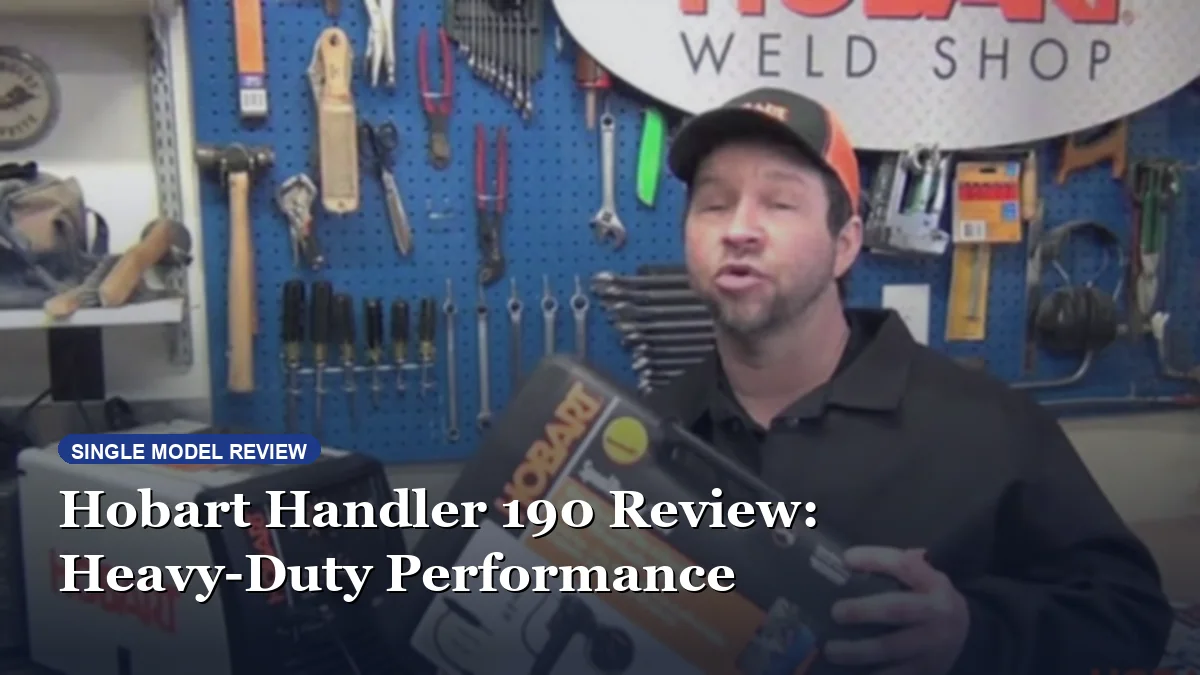

This machine stands out for its robust dual-groove drive roll system and smooth arc characteristics. It provides exceptional value for serious fabricators needing dependable 230V output.
See our flagship Best Welder: Top Home Shop & Jobsite Picks Tested.
Verified Specifications
| Category / Type | MIG and Flux-Core Welder |
|---|---|
| Rated Output / Capacity | 130A at 19V, 30% duty cycle |
| Power / Motor | 230V AC, single-phase |
| Build & Materials | Heavy steel cabinet construction |
| Operating Noise | Standard fan-cooled operational hum |
| Duty Cycle / Runtime | 30% at 130 Amps |
| Dimensions & Weight | 30.5 x 19 x 12.5 inches, 77 lbs |
| Key Safety & Controls | Infinite voltage control, thermal overload protection |
What We Liked
- Robust industrial-grade cast aluminum wire drive
- Infinite voltage control allows precise arc tuning
- Spool gun ready for dedicated aluminum welding
- Solid 230V power output for thicker steel sections
Trade-Offs
- Heavier chassis reduces overall workshop portability
- Requires a dedicated 230V electrical service outlet
- Basic ground clamp feels slightly lightweight
Chassis Architecture, Build Quality & Ergonomics
As detailed in our Eastwood Mig 180 vs Hobart Handler 190 duel, this heavy steel cabinet is designed to withstand demanding workshop environments and protect internal components from everyday jobsite abuse.
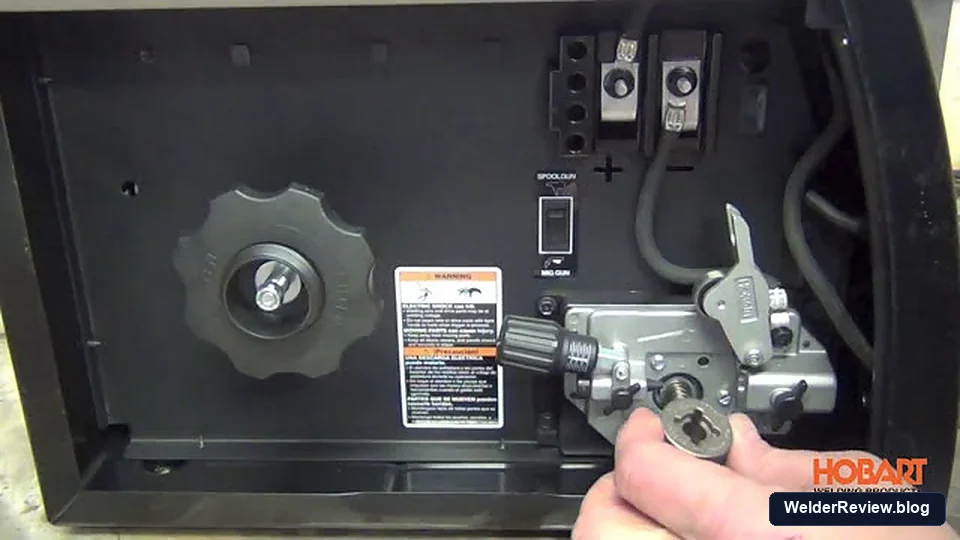
Ergonomic layout places the wire feed compartment and voltage selector switches within easy reach. Operators appreciate the straightforward control panel design that minimizes confusion during fast-paced fabrication tasks.
Weighing seventy-seven pounds, the unit requires deliberate placement on a dedicated welding cart. This substantial weight ensures stability while pulling long welding gun leads across cluttered shop floors.
Our Hobart Handler 140 vs 190 comparison highlights the stamped steel cabinet and dual-groove drive roll system designed for precise alignment during heavy fabrication tasks.
Weighing roughly 67 pounds fully configured with a 10-pound spool of wire, the unit balances portability with structural rigidity, utilizing heavy-duty side hinges and an industrial cast aluminum drive assembly mechanism.
Front panel ergonomics incorporate recessed dial guards protecting the seven-position voltage selector and wire feed speed potentiometer from accidental jobsite impacts, ensuring reliable parameter adjustments in cramped production environments.
- Heavy-gauge stamped steel cabinet construction
- Secure hinged side door for easy spool access
- Recessed front panel safeguards control knobs
Internal Component Layout
Internal routing keeps the transformer and rectifier assemblies properly separated from airflow channels. This thoughtful engineering prevents conductive debris accumulation over extended operational periods.
Wiring harnesses feature secure strain reliefs to prevent vibration-induced failures during heavy transport across rough terrain.
- Isolated electronics bay
- Vibration-resistant harness routing
Real-World Arc Output, Voltage Tuning & Performance
Operating on standard 230V power, this machine delivers stable arcs across varying metal thicknesses. The infinite voltage control system enables precise adjustments for optimal puddle wetting and minimal spatter.
Whether running solid wire with shielding gas or flux-core wire, arc initiation remains remarkably crisp. Users can easily dial in parameters for clean transitions on thin sheet metal or heavy plate.
Highlighted in our Primeweld Mig180 vs Hobart Handler 190 review, this machine delivers a robust DC welding output ranging from 25 to 190 amperes using a tapped transformer design.
Voltage tuning relies on coarse and fine adjustments across seven distinct settings, allowing fabricators to dial in optimal arc characteristics for 0.030-inch solid wire or larger flux-cored consumables without excessive spatter generation.
- Infinite voltage settings for precise arc tuning
- Handles material from twenty-four gauge up to five-sixteenths inch
- Consistent wire feed speed under heavy load
Weld Bead Profile Analysis
Weld bead profiles exhibit excellent tie-in at the toes with very little undercut. The stable arc chemistry helps reduce cleanup time significantly across steel projects.
Penetration depths meet structural standards when operating near maximum amperage output ratings.
- Clean toe lines with minimal undercut
- Reliable root penetration on heavy joints
Video Review: Search filters
Duty Cycle, Thermal Management & Operating Efficiency
As noted in our Hobart 210 MVP vs 190 comparison, thermal management relies on a built-in fan drawing air across transformer windings to sustain performance during prolonged welding sessions.
The thirty percent duty cycle at one hundred thirty amperes suits typical fabrication workloads. Operators should monitor run times to prevent unnecessary thermal trips during production runs.
Rated at a 30% duty cycle at 130 amperes and 21 volts, the internal fan-cooled system manages thermal loads effectively during continuous multi-pass fillet welds on thick structural steel plate sections.
An automatic thermal overload protection switch interrupts current flow if internal temperatures exceed safety thresholds, preventing transformer degradation during demanding fabrication sequences exceeding standard shop operating parameters.
- Active fan cooling prevents premature overheating
- Standard thermal overload protection indicator light
- Balanced electrical efficiency under heavy loads
Managing Thermal Overloads
Automatic thermal shutdown protects internal rectifiers if the machine exceeds safe operating thresholds. Letting the fan run for a few minutes restores full operational capacity quickly.
Keeping cooling vents clear of shop debris maintains optimal airflow efficiency.
- Automatic reset functionality
- Clear warning indicator light
Setup, Wire Feeding & Daily Maintenance Protocols
A dual-groove quick-change drive roll system simplifies switching between different wire diameters. Tension adjustments require no specialized tools, speeding up routine changeover tasks in the shop.
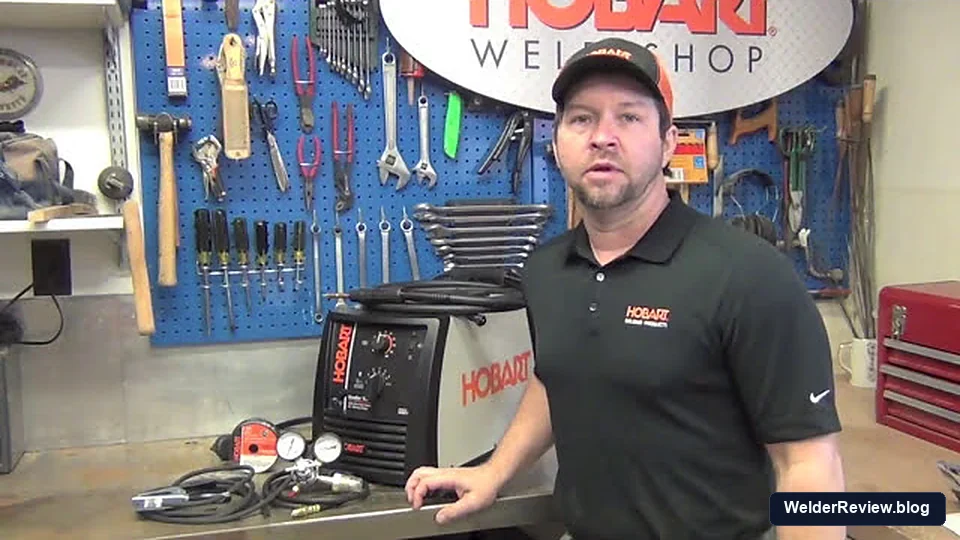
Daily maintenance involves inspecting the contact tip, gas nozzle, and liner for debris buildup. Keeping these consumables clean ensures smooth wire delivery and stable electrical transfer.
Daily upkeep requires inspecting the consumable contact tip and gas diffuser for spatter buildup, clearing the 0.030/0.035 reversible drive rolls with compressed air to maintain consistent wire feed tension.
Tension adjustments on the wire drive assembly must be calibrated carefully to prevent bird-nesting, ensuring smooth wire transit through the standard 10-foot MIG gun liner during extended welding shifts.
- Tool-less quick-change drive roll mechanism
- Clear threading diagrams inside the cabinet door
- Standard consumable compatibility for easy replacements
Drive Roll Maintenance
Inspect drive rolls regularly for metal shavings or wire accumulation that causes feeding slips. Wipe grooves clean with a dry cloth to maintain consistent wire pressure.
Ensure proper alignment between the drive roll groove and the inlet guide tube.
- Check tension arm pressure frequently
- Clean wire guide tubes periodically
Aluminum Spool Gun Integration & Multi-Material Capabilities
Direct plug-in compatibility for optional spool guns makes aluminum welding straightforward. This eliminates feeding friction issues common when pushing soft aluminum wire through standard gun liners.
Switching to aluminum requires changing the shielding gas to pure argon and adjusting drive tension. The machine adapts smoothly to non-ferrous fabrication tasks with minimal setup friction.
Direct plug-in compatibility with the SpoolRunner 200 series enables seamless aluminum MIG welding using 4043 alloy wire, bypassing traditional feeding friction issues associated with standard push-only torch configurations.
Switching to aluminum requires installing a dedicated U-groove drive roll and shifting shielding gas to 100% argon, expanding the machine utility for automotive repair and thin-gauge fabrication projects successfully.
- Direct hookup for optional spool gun attachments
- Dedicated switch for gas selection and feed control
- Excellent results on thin aluminum sheet assemblies
Aluminum Setup Essentials
Always use a U-groove drive roll when running soft aluminum wire through a spool gun. This prevents crushing the wire while maintaining steady feeding performance.
Adjust tension lightly to avoid bird-nesting inside the spool compartment.
- U-groove drive roll requirement
- Pure argon shielding gas necessary
Who Should Invest in This Machine Versus Alternative Welders
Fabricators, farmers, and automotive enthusiasts needing reliable 230V power will find this welder exceptional. It tackles heavy repair work and fabrication tasks far better than entry-level 120V units.
Users lacking access to a 230V outlet should look at smaller alternatives. Otherwise, this dependable machine delivers professional performance for serious home shops and light industrial users.
Professional fabricators requiring a dependable 230V machine will appreciate the robust transformer architecture over inverter-based alternatives when tackling heavy farm repairs and structural steel fabrication tasks daily.
While lacking digital readouts found on modern competitors, this unit prioritizes rugged reliability and simplified analog controls that minimize electronic failure points in harsh, unconditioned workshop environments.
- Ideal for advanced DIYers and farm repair shops
- Requires dedicated 230V electrical circuit supply
- Outperforms standard 120V models on thick steel
Final Purchasing Considerations
Evaluate your workshop electrical capacity before purchasing to ensure proper breaker compatibility. Investing in proper safety gear completes your fabrication setup efficiently.
This welder offers long-term reliability for users needing consistent power output.
- Verify shop circuit breaker ratings
- Plan for proper shielding gas supplies
Frequently Asked Questions
What electrical input does the Hobart Handler 190 require?
This machine requires a dedicated 230V AC single-phase electrical outlet with proper breaker sizing. Always consult an electrician for correct installation.
Can this welder handle aluminum fabrication projects?
Yes, it is spool gun ready for dedicated aluminum welding tasks. You must use pure argon gas and appropriate drive rolls.
What is the maximum steel thickness it can weld?
It effectively welds steel up to five-sixteenths inch thick in a single pass when properly configured. Multi-pass techniques handle even heavier plate sections.
Does the unit support flux-core wire operation?
Yes, it runs self-shielded flux-core wire without needing external shielding gas bottles. Reverse the polarity inside the cabinet before starting.
How do I maintain the wire feed mechanism?
Inspect drive rolls regularly and clean out any accumulated metal shavings. Ensure proper tension to prevent wire slips during long welds.