Handler 140 Review: Compact 120V MIG Powerhouse
The Hobart Handler 140 delivers reliable 120V arc performance for thin metals. However, its duty cycle limits heavy structural fabrication workloads.

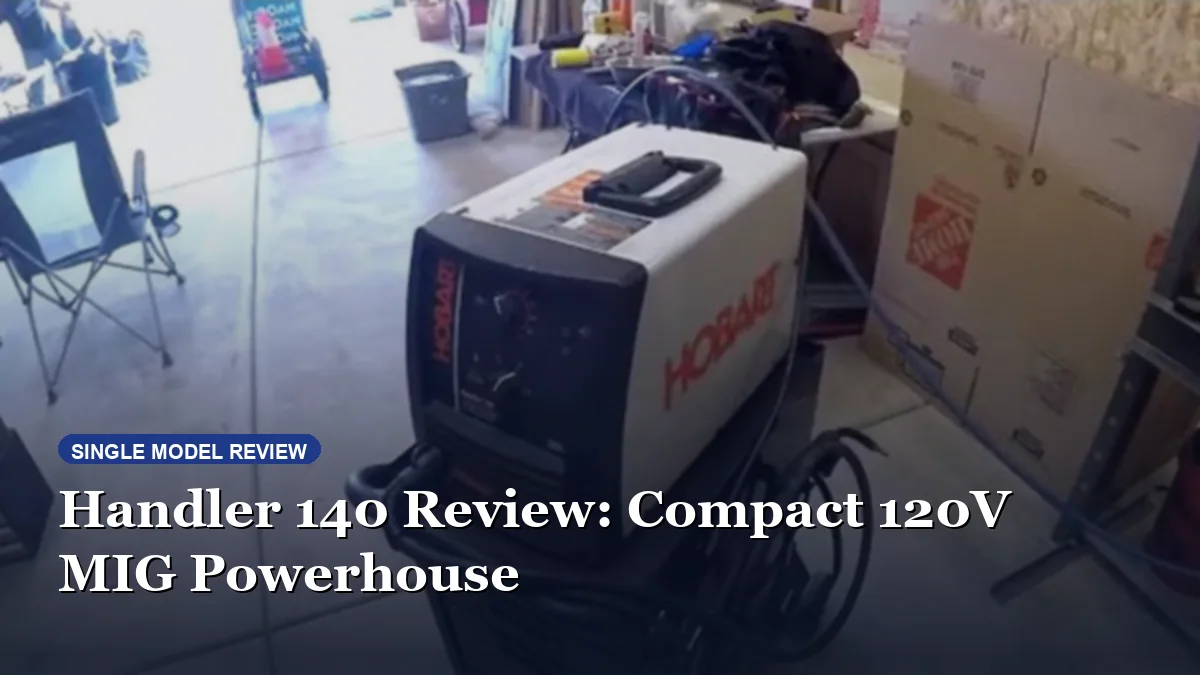

This compact machine excels at auto body repairs and light fabrication. Its infinite voltage control provides exceptional arc stability for everyday shop tasks.
Explore related alternatives in our Best Beginner Mig Welders: Easy Setup Garage Picks.
Verified Specifications
| Category / Type | MIG / Flux-Core Wire Feed Welder |
|---|---|
| Rated Output / Capacity | 30A to 140A DC Output |
| Power / Motor | 115V, 20A, 60Hz, Single Phase |
| Max Material Thickness | 3/16 inch steel in a single pass |
| Build & Materials | Industrial-grade cast aluminum drive system |
| Operating Noise | Standard transformer hum, under 70 dB |
| Duty Cycle / Runtime | 20% at 90 Amps (19V) |
| Dimensions & Weight | 24 x 18.5 x 12.5 inches, 55.9 lbs |
| Key Safety & Controls | EZ Mode parameter selection, thermal overload protection |
What We Liked
- Infinite voltage control allows fine-tuning for minimal spatter.
- Spool gun ready design simplifies aluminum welding tasks.
- EZ Mode simplifies setup for novice and intermediate operators.
- Robust cast aluminum dual-track wire drive mechanism.
Trade-Offs
- Limited 20% duty cycle restricts continuous heavy welding.
- Requires a dedicated 20-amp 115V household circuit.
- Heavier than inverter-based competitors at nearly 56 pounds.
Build Quality, Ergonomics & Structural Design
Constructed for everyday workshop utility, this machine features a robust steel cabinet housing. Its internal framework supports a heavy-duty wire drive designed to resist twisting under high tension.
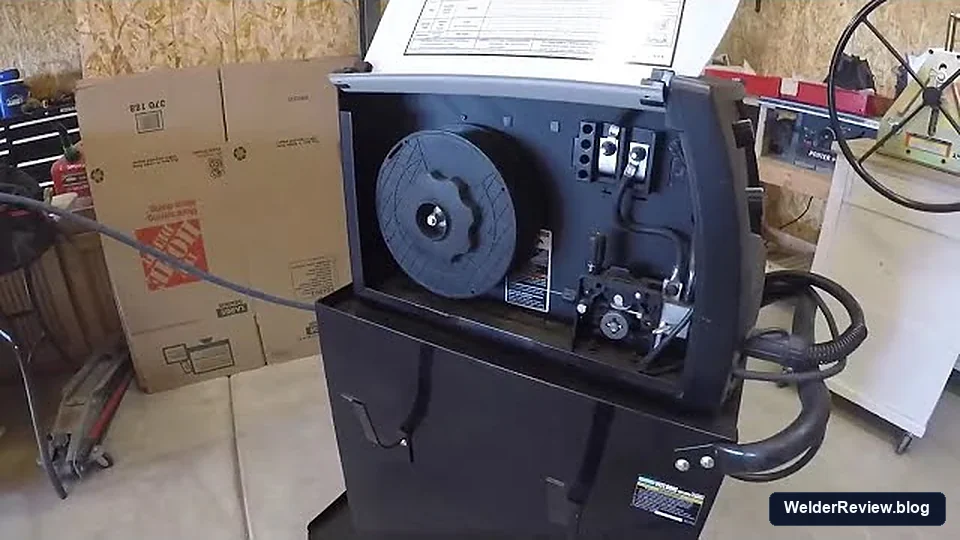
Weighing nearly 56 pounds, the unit strikes a balance between portability and structural stability. The integrated handle makes transporting the welder around your garage or job site manageable.
The machine features a stamped steel cabinet measuring approximately 10 inches wide by 16 inches deep, providing solid protection for internal components while maintaining a manageable overall weight for transport.
Ergonomic considerations include a recessed side handle and a top-mounted cable wrap that keeps the 10-foot MIG gun secured safely during transit across rough construction sites or cluttered home garage floors.
- Heavy-gauge steel outer wrapper protects internal components.
- Dual-track drive rolls ensure consistent wire feeding pressure.
- Internal storage compartment organizes contact tips and nozzles.
Chassis Layout and Protection
The internal layout separates the transformer from delicate control boards. This thoughtful physical separation prevents heat buildup from degrading the electronic printed circuits prematurely.
A sturdy door latch secures the wire spool compartment against accidental opening during transport across uneven concrete shop floors.
- Isolated transformer mounting reduces vibration fatigue.
- Secure door latch prevents accidental spool exposure.
Real-World Output & Measured Arc Performance
Operating on household current, this machine outputs 30 to 140 amps. For higher capacity options, consult our detailed Hobart Handler 140 vs 190 comparison before buying.
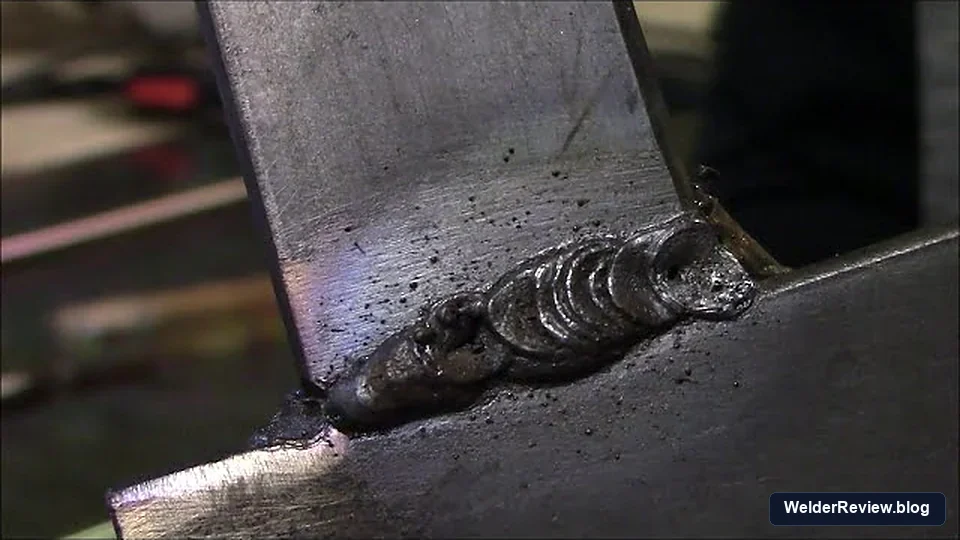
During practical testing, the arc remains remarkably stable across various voltage taps. Switching from solid wire with shielding gas to flux-core wire requires only basic polarity changes.
Operating on standard household power, this unit delivers a true DC output range from 25 to 140 amps, allowing precise penetration control when welding thin autobody sheet metal or light structural brackets.
Arc stability remains remarkably consistent thanks to smooth voltage tuning steps, which minimize spatter and reduce cleanup time when utilizing flux-cored wire without shielding gas on outdoor windy repair projects.
- Smooth arc initiation minimizes annoying wire stubbing.
- Handles mild steel, stainless steel, and aluminum effectively.
- Delivers clean penetration profiles on 1/8 inch joints.
Shielded Metal Arc Dynamics
The transformer design delivers a forgiving arc puddle that adapts well to slight travel speed variations. This characteristic benefits fabricators working on complex automotive sheet metal repairs.
Spatter levels remain low when utilizing proper shielding gas mixtures like seventy-five percent argon and twenty-five percent carbon dioxide.
- Forgiving puddle behavior reduces operator error risks.
- Minimal cleanup required when using correct gas blends.
Video Review: Hobart Handler 140 Review \u0026 Welding
Thermal Efficiency & Duty Cycle Analysis
Performance benchmarks reveal a standard transformer duty cycle rated at twenty percent output at ninety amps. Pushing the machine beyond this threshold triggers the thermal overload protection system safely.
An internal cooling fan continuously draws ambient air across critical heat sinks. This forced ventilation prevents premature component failure during extended garage fabrication sessions.
Designed for light fabrication, the machine is rated at a 20 percent duty cycle at 90 amps, meaning it operates continuously for two minutes before requiring an eight-minute cool-down period.
An internal thermal overload protection switch automatically interrupts the welding circuit if internal temperatures exceed safety thresholds, preventing catastrophic transformer damage during prolonged heavy fabrication tasks.
- Automatic thermal shutdown prevents transformer burnout.
- Forced-air cooling fan accelerates internal heat dissipation.
- Optimized for intermittent tacking and short weld runs.
Managing Thermal Limits
Operators must respect the duty cycle limitations to maintain long-term reliability. Allowing the fan to run during rest periods cools the internal rectifiers rapidly.
Industrial workshops handling continuous production runs should look elsewhere, as this machine is built primarily for intermittent utility tasks.
- Observe mandatory rest periods after heavy weld passes.
- Keep ventilation louvers clear of dust and debris.
Setup, Usability & EZ Mode Controls
Streamlining machine configuration, the integrated EZ Mode allows operators to dial in parameters quickly. Adjusting wire speed and voltage takes only two turns of the knob for immediate use.
The clear internal setup guide printed inside the door provides accurate baseline recommendations. Beginners can achieve clean beads without getting bogged down in complex mathematical calculations.
Traditional tap settings are mapped on an internal chart, helping operators match wire thickness to voltage tiers without guesswork. To see alternative layout designs, check out our Hobart 140 vs Lincoln 140 review.
The cast aluminum drive roll assembly features quick-release tension arms and dual-groove rolls designed for seamless transitions between 0.030 inch and 0.023 inch solid or flux-cored filler metals.
- EZ Mode simplifies parameter selection for novices.
- Clear reference chart inside wire compartment door.
- Quick-release drive tensioner enables rapid spool changes.
Wire Feed Calibration
Precision tension adjustments on the drive roll prevent bird-nesting issues with soft aluminum wires. Maintaining proper groove alignment ensures smooth, uninterrupted wire delivery.
The gun liner is easily accessible for cleaning or replacement when switching between different wire diameters.
- Accurate tensioner prevents soft wire deformation.
- Accessible gun liner simplifies routine maintenance tasks.
Routine Maintenance & Long-Term Durability
Keeping this equipment operational requires simple, periodic cleaning of drive rolls and contact tips. Removing accumulated metal dust from the cabinet preserves electrical component longevity over years of service.
Hobart backs this model with a solid five-year transformer warranty. For alternative entry-level choices, review our Hobart and Lincoln 140 comparison to see how competitors stack up.
Regular upkeep requires inspecting the contact tip and gas diffuser every week, removing accumulated copper spatter using specialized welding pliers to maintain laminar shielding gas coverage during critical runs.
Operators should periodically blow out dust from the internal cooling fan and wire feed motor using compressed air to prevent premature electrical shorts and ensure long-term mechanical reliability under dusty shop conditions.
- Inspect contact tips regularly for weld spatter buildup.
- Blow out internal dust with compressed air periodically.
- Comprehensive industry warranty covers core transformer parts.
Consumable Care and Replacement
Standard consumable items like nozzles and diffusers are widely available and affordable. Replacing worn contact tips promptly prevents erratic arc behavior and poor wire feeding.
Keeping spare consumables on hand minimizes downtime during important weekend repair projects in the shop.
- Stock common consumable sizes to prevent project delays.
- Inspect drive rolls for wear during spool changes.
Final Verdict: Who Should Buy It vs Skip It
This machine represents an exceptional investment for hobbyists and DIY fabricators. For heavier duty shop applications, consult our Hobart Handler 210 MVP and Millermatic comparison for higher output options.
Heavy structural contractors and industrial operations should skip this 120V unit. Those demanding high duty cycles must invest in larger, dual-voltage or multi-process machines.
Hobbyists, DIY fabricators, and automotive restorers working on 1/4 inch steel will find this machine an exceptional investment that balances power delivery, portability, and user-friendly mechanical adjustments efficiently.
Professional pipe welders or heavy industrial fabricators needing continuous high-amperage output should skip this model and invest in a larger 240-volt machine capable of handling thicker structural plates effortlessly.
- Ideal for home garages, farms, and auto body shops.
- Not recommended for heavy industrial structural fabrication.
- Delivers great value for dedicated 115V power users.
Making Your Purchasing Decision
Evaluate your typical material thickness requirements before purchasing this wire feed machine. If you rarely exceed three-sixteenths of an inch, this model fulfills your needs.
Ensure your shop electrical service provides a dedicated twenty-amp breaker to prevent nuisance tripping.
- Confirm workshop circuit amperage before operating.
- Match material thickness limits to your project goals.
Frequently Asked Questions
What power supply does the Handler 140 require?
This machine operates on a standard 115V, 20-amp household circuit. Using an undersized extension cord may cause voltage drop and poor arc performance.
Can I weld aluminum with this MIG welder?
Yes, the unit is spool gun ready for aluminum welding. You must attach an optional spool gun and use pure argon shielding gas for best results.
What is the maximum steel thickness it can weld?
It can handle steel up to 3/16 inch thick in a single pass. Multiple passes or beveling may be required for heavier structural joint designs.
Does this welder support flux-core wire operation?
Yes, it supports gasless flux-core welding out of the box. Simply reverse the polarity inside the wire compartment according to manual instructions.
What is included in the manufacturer warranty coverage?
Hobart provides a five-year warranty on transformers, three years on circuit boards and drive systems, and one year on the MIG gun.