Esab Rebel 215 Review: Technical Performance Guide
This multi-process machine delivers exceptional welding versatility across varied power inputs. However, its heavy chassis requires deliberate transport planning for mobile technicians.

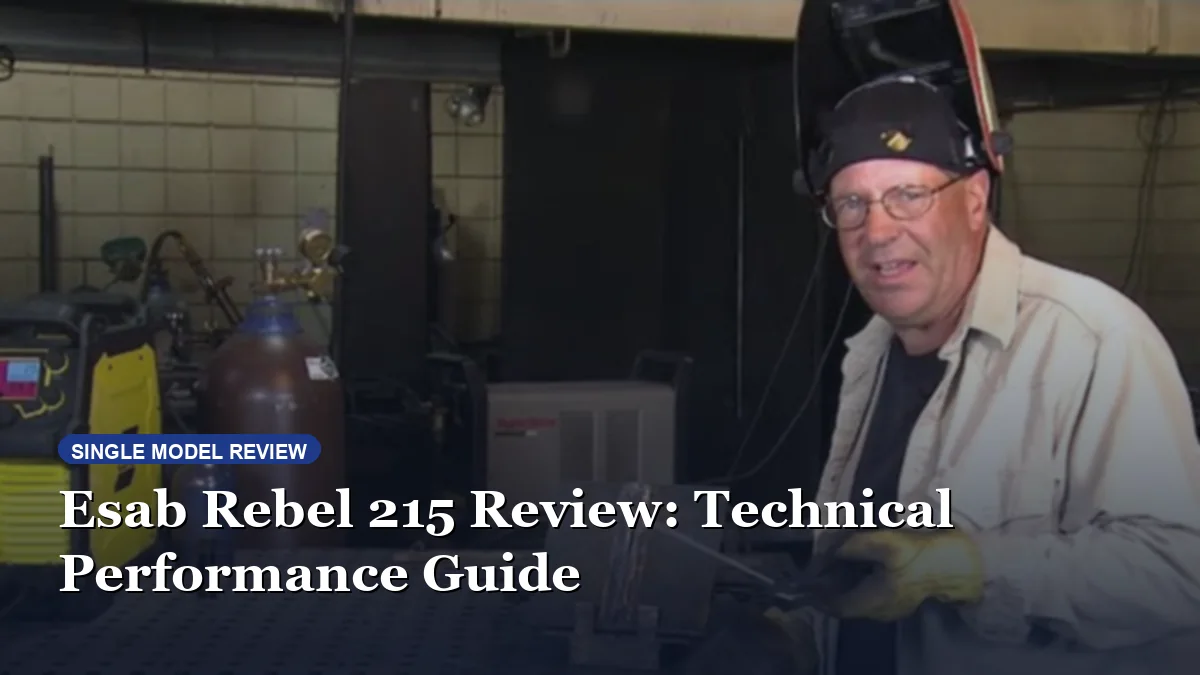

The Esab Rebel 215 provides professional-grade arc stability and smart control features. It remains a top-tier choice despite a heavier footprint.
See our flagship Best Welder: Top Home Shop & Jobsite Picks Tested.
Verified Specifications
| Category / Type | Multi-Process MIG/TIG/Stick Welder |
|---|---|
| Rated Output / Capacity | 205 Amp Max Output |
| Power / Motor | 120VAC, 208/230 VAC Input |
| Build & Materials | Industrial Metal Roll Cage Chassis |
| Operating Noise | Low-noise variable speed cooling fan |
| Duty Cycle / Runtime | 20 percent at 205A / 230V |
| Dimensions & Weight | 23 x 9 x 16 inches, 49 to 91 lbs packaged |
| Key Safety & Controls | TFT Multilingual Display, sMIG Technology |
What We Liked
- True multi-process capability handles MIG, TIG, and stick seamlessly.
- sMIG technology adapts quickly to operator technique and speeds up setup.
- Dual voltage input supports flexible power source connection on site.
- Robust industrial roll cage protects internal components from impacts.
- Intuitive TFT display allows precise parameter fine-tuning and storage.
Trade-Offs
- Heavier physical footprint reduces effortless single-handed portability.
- Lower duty cycle limits prolonged high-amperage industrial production runs.
- Advanced digital menus require a learning curve for traditional operators.
Chassis Engineering, Structural Design, and Physical Ergonomics
Constructed with a heavy-duty industrial roll cage, this machine protects sensitive internal electronics against harsh workshop environments. The physical layout balances durability with accessible connection terminals for daily heavy fabrication tasks.
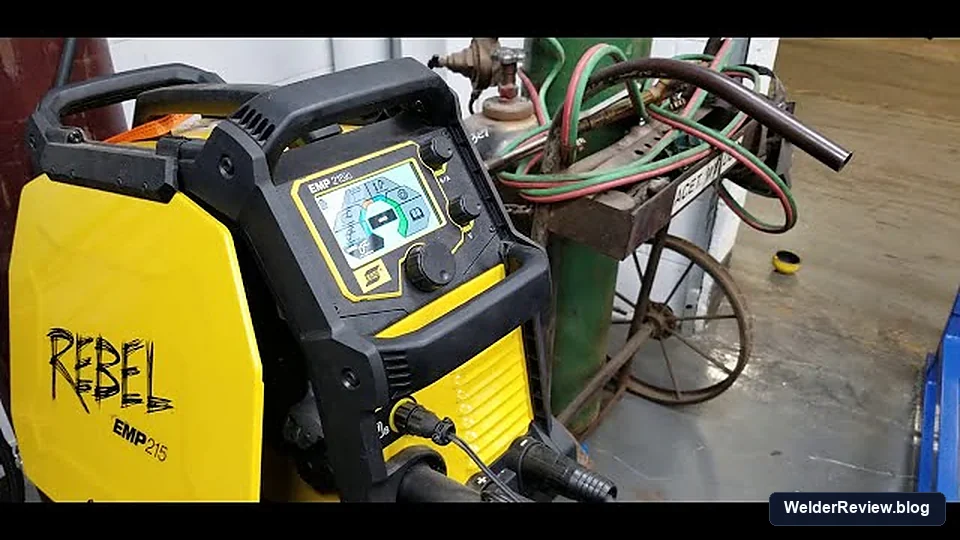
Weighing significantly when fully loaded with wire and cables, the chassis demands secure transport mounting. Integrated lift handles assist with two-person shop relocation, ensuring the machine survives rugged job site conditions.
The ESAB Rebel 215 features a roll-cage frame built from heavy-gauge steel, and our esab rebel 205 vs 215 comparison highlights its compact portable footprint.
Four structural grab handles provide secure anchor points for rigging or manual transport. The composite front bezel withstands workshop drops, protecting digital controls from debris while meeting strict IP23S environmental standards for outdoor use.
- Heavy-duty five-handle industrial roll cage design
- Protected recessed front control panel layout
- Secure internal wire drive compartment seals out debris
Material Selection and Protective Casing
Heavy-gauge stamped metal panels resist impact damage from falling tools or metal stock. Powder coating prevents corrosion during outdoor use in damp weather environments.
Rubberized corner bumpers absorb shock during transit inside service trucks, extending the operational lifespan of the internal inverter boards.
- Corrosion-resistant powder-coated exterior finish
- Impact-absorbing rubber corner bumper guards
Real-World Arc Output and Multi-Process Operational Performance
Delivering robust arc stability across multiple processes, the unit excels on standard carbon steel. Review our esab rebel 215ic vs miller multimatic 215 guide to compare machine performance.
Stick welding performance remains exceptionally smooth, handling difficult electrodes like E6010 cellulosic rods without unexpected arc extinguishing. DC TIG execution produces clean bead profiles with reliable scratch or lift start mechanisms.
Delivering a true multi-process output, this machine handles MIG, Flux-Cored, TIG, and Stick welding. The sMIG technology continuously learns user technique, adapting arc parameters automatically to stabilize short-circuit transfers on varied metal thicknesses.
During rigorous GMAW testing on quarter-inch carbon steel, the inverter maintained stable voltage without excessive spatter. Stick mode delivers reliable hot-start ignition, preventing electrode sticking when striking on cold, rusty, or unprepared base materials.
- Clean short-circuit and spray transfer MIG profiles
- Reliable E6010 stick electrode burn characteristics
- Stable DC TIG arc for precision root passes
Smart MIG Technology Evaluation
The proprietary smart learning algorithm continuously adjusts voltage based on hand speed and stickout distance. This software dramatically reduces setup time for novice operators transitioning between thicknesses.
Experienced fabricators can override automated settings to fine-tune inductance and pre-flow parameters for specialized joint configurations.
- Continuous arc adaptation via digital feedback loops
- Manual override for specialized joint fine-tuning
Video Review: ESAB Rebel EMP 215ic Review: Part 2 of 3 - TIG Welding | TIG Time
Thermal Management, Power Efficiency, and Operational Noise
Advanced inverter topology maximizes electrical efficiency, drawing fewer amps under load. Check our esab rebel emp 215ic vs miller 215 comparison to evaluate transformer alternatives.
Acoustic noise remains remarkably low during idle states, escalating moderately only under heavy high-amperage output conditions. This noise control improves communication safety inside enclosed fabrication shops.
Internal cooling relies on a variable-speed fan operating on demand, significantly reducing dust intake during idle periods. The heavy-duty heat sinks efficiently dissipate thermal loads during the 20% duty cycle rated at 210 amperes output.
Operating on dual-voltage inputs, the unit draws optimal current efficiency across 120V and 230V lines. Power factor correction circuitry minimizes harmonic distortion, ensuring compliance with strict industrial electrical grids without tripping standard breakers.
- High-efficiency inverter power conversion circuitry
- Demand-driven variable speed internal cooling fans
- Low idle noise signature for comfortable shop use
Duty Cycle Behavior Under Stress
Operating at maximum output triggers internal thermal protection flags if pushed beyond rated thermal thresholds. Lower amperage settings allow extended continuous runtime for standard shop fabrication workflows.
Operators must monitor duty cycle limits closely when welding thick structural plate materials at high wire feed speeds.
- Automatic thermal overload protection shutdown
- Extended runtime capacity at moderate amperages
Digital Interface Usability and Setup Procedures
A bright TFT color screen displays comprehensive welding parameters clearly under direct shop lighting conditions. Multi-language navigation simplifies menu selections for diverse fabrication teams.
Users can store up to four programmable memory slots per process to quickly recall favorite welding parameters. This feature eliminates repetitive manual dialing between distinct material thicknesses.
The large TFT display utilizes a vibrant color interface that clearly presents parameter readouts under bright shop lighting. Operators input base material thickness and wire diameter, letting the microprocessor establish optimal baseline welding voltages instantly.
Manual override controls remain easily accessible for experienced welders desiring fine adjustments to arc inductance. The intuitive menu navigation minimizes downtime during joint configurations, boosting overall productivity across high-mix fabrication and repair workflows.
- High-visibility TFT color digital control display
- Multi-language support for diverse operational teams
- Four storable memory slots per welding process
Initial Machine Configuration and Wire Loading
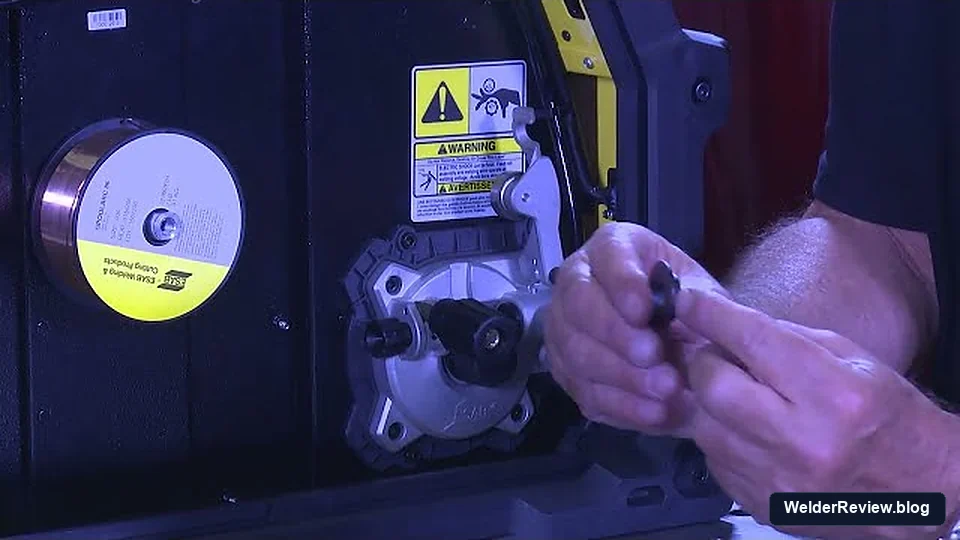
The internal cast aluminum drive roll mechanism feeds wire smoothly without crushing soft aluminum alloys. Toolless quick-change rolls reduce downtime when switching between solid and flux-cored wires.
Gas regulator connections and power plug adapters fit securely, enabling rapid deployment straight out of the shipping container.
- Cast aluminum dual-drive wire feeding assembly
- Toolless drive roll tension adjustment system
Maintenance Protocols and Long-Term Durability Standards
Routine maintenance requires periodic compressed air purging of accumulated metallic dust inside the cabinet. Inspecting drive rolls and contact tips regularly prevents wire feeding bottlenecks during production.
Long-term durability benefits from sealed circuit boards protected against conductive metal grindings and moisture ingress. Following proper shutdown procedures preserves internal relay switch longevity.
Routine upkeep requires periodic compressed air purging of internal circuit boards to remove conductive metal dust. Inspect the drive roll assembly monthly, ensuring proper tension to prevent wire bird-nesting during heavy continuous production runs.
Check ground clamp connections and welding leads regularly for signs of excessive heat or insulation wear. Adhering to these preventive maintenance steps ensures compliance with NEMA EW 1 standards and extends internal component lifespans significantly.
- Periodic internal dust purging via compressed air
- Conformal-coated circuit boards resist moisture and debris
- Routine drive roll inspection prevents wire slips
Consumable Wear and Replacement Care
Standard consumable compatibility ensures easy sourcing of replacement contact tips, nozzles, and diffuser blocks. Inspecting torch liners prevents friction buildup during long wire feeding passes.
Keeping consumables clean preserves gas shielding integrity and minimizes costly weld defect rework.
- Widely available standard torch consumable sizes
- Preventative liner cleaning maintains wire feed velocity
Comprehensive Buyer Verdict and Ideal User Profile
This multi-process machine represents an exceptional investment for professional mobile fabricators and serious hobbyists alike. Its unmatched arc versatility outweighs the minor penalty of its heavier chassis weight.
Shops needing reliable dual-voltage performance and smart setup aids will maximize productivity. Read our esab 215ic vs miller 215 guide to see how multi-process flexibility compares.
This multi-process welding system suits professional mobile fabricators, demanding maintenance crews, and serious hobbyists seeking industrial performance. Its combination of rugged construction and adaptive arc control justifies placement in professional service trucks.
While heavy structural operations require higher amperage output, this machine excels at sheet metal work and pipe maintenance. Welders requiring versatile portability will find exceptional value in its comprehensive feature set and proven reliability.
- Ideal for mobile service trucks and dynamic shops
- Strong value for multi-process fabrication professionals
- Balances advanced software control with rugged hardware
Who Should Skip This Machine
Pure TIG specialists requiring high-frequency AC balance controls should explore dedicated AC/DC units instead. Operators needing ultra-lightweight portability for overhead field repairs might find the physical mass burdensome.
Budget-focused hobbyists who only weld thin automotive sheet metal may not utilize its advanced industrial features.
- Not optimized for dedicated high-frequency AC TIG work
- Heavier mass less suited for frequent overhead repairs
Frequently Asked Questions
Can this welder operate on standard household electrical circuits?
Yes, the unit supports 120VAC input power for lighter repair tasks and lower amperage settings. However, maximum output requires a dedicated 208/230V connection.
Does the smart MIG feature eliminate manual parameter tuning entirely?
The software continuously adapts to your technique, but skilled operators can still manually adjust inductance and voltage. Manual overrides ensure total control over specialized joint profiles.
Is this machine capable of welding aluminum alloys effectively?
It handles aluminum MIG welding reliably when paired with a spool gun or push-pull setup. Proper wire selection and shielding gas configuration remain essential for sound welds.
What stick electrodes perform best with this inverter power source?
The system runs standard low-hydrogen and cellulosic electrodes smoothly. E6010 and E7018 rods ignite reliably and burn with minimal arc interruption.
How heavy is the machine when prepared for transport?
The bare chassis weighs around forty-nine pounds, but fully loaded with cables and wire spool it approaches ninety pounds. Two-person lifts are recommended for safe vehicle loading.