Eastwood TIG 200 AC/DC Welder Review: Technical Analysis
This dedicated AC/DC machine delivers reliable high-frequency starts and precise aluminum welding. However, its heavy chassis limits portability for field repair work.


The Eastwood TIG 200 AC/DC excels in home fabrication shops by providing stable aluminum arc characteristics without demanding industrial three-phase power supplies.
See our flagship Best Welder: Top Home Shop & Jobsite Picks Tested.
Verified Specifications
| Category / Type | Inverter-based AC/DC TIG and Stick welder |
|---|---|
| Rated Output / Capacity | 200 Amps at 60 percent duty cycle |
| Power / Motor | 220V single-phase primary input power |
| Build & Materials | Heavy gauge steel housing with powder coat |
| Operating Noise | Moderate cooling fan acoustic signature |
| Duty Cycle / Runtime | 60 percent at maximum 200 Amp output |
| Dimensions & Weight | Weighs approximately 50 pounds total |
| Key Safety & Controls | High-frequency arc start with foot pedal |
What We Liked
- Reliable high-frequency start eliminates tungsten contamination risks.
- Comprehensive AC balance control optimizes aluminum cleaning action.
- Dual-function capability allows both TIG and Stick welding processes.
- Robust steel enclosure protects internal transformer and inverter boards.
Trade-Offs
- Substantial physical weight restricts easy one-handed jobsite transport.
- Stock torch setup is rigid and benefits from aftermarket upgrades.
- Cooling fan runs continuously during active welding operations.
Chassis Construction and Physical Design
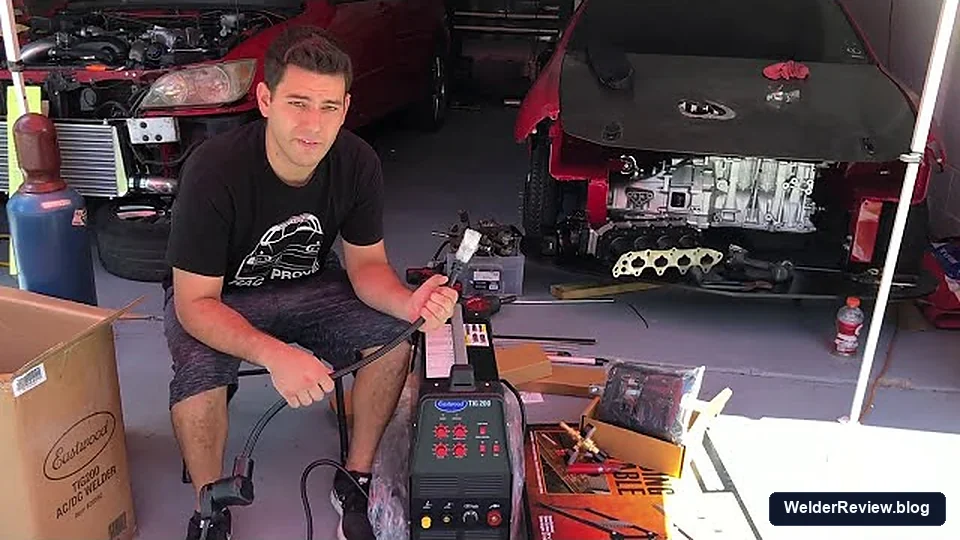
The steel outer housing provides robust protection for internal inverter components against workshop impacts. Its utilitarian blue finish resists common chemical spills and standard abrasion hazards encountered daily.
Internal layout optimization separates sensitive electronic logic boards from heavy power pathways. This spatial separation significantly reduces electromagnetic interference risks during high-frequency arc initiation sequences.
The heavy-gauge steel chassis provides robust physical protection for internal electronics against workshop impacts. Measuring roughly 20 by 11 inches, the cabinet balances portability with stability on standard welding carts.
Integrated carrying handles are welded directly to the frame to support safe manual transport across job sites. Compliance with IP21S standards ensures basic indoor defense against dripping water and solid foreign objects.
- Heavy gauge rolled steel body panels.
- Isolated internal electronic board routing.
- Reinforced carrying handle for bench moves.
Control Panel Layout and Protection
Recessed analog knobs protect adjustment dials from accidental strikes by heavy materials. Clear silk-screened parameter labels ensure rapid identification during complex multi-step fabrication tasks.
- Recessed dials prevent physical impact damage.
- High-contrast labeling aids low-light visibility.
Electrical Output and Arc Performance
Delivering up to 200 amperes of clean welding current, this machine handles standard automotive sheet metal effortlessly. The inverter architecture ensures steady amperage delivery despite minor input line fluctuations.
High-frequency arc stabilization provides effortless tungsten ignition without touching base metal. This non-contact method preserves expensive tungsten tips and prevents weld pool tungsten inclusions.
Delivering a 200-amp maximum output, this inverter handles thin aluminum sheets and structural steel plates. When evaluating options in our best 200 amp ac dc tig welder review, this machine stands out for clean tungsten preservation.
The adjustable AC frequency control lets operators narrow the cleaning action for faster travel speeds. Meanwhile, waveform balancing optimizes heat input into the base metal to prevent burn-through on delicate joints.
- Stable 200A maximum output capacity.
- Non-contact high-frequency arc starting circuit.
- Precise current regulation across all ranges.
Aluminum TIG Capabilities
Adjustable AC balance controls allow operators to fine-tune oxide cleaning action versus penetration depth. Proper balancing creates clean, shiny aluminum weld beads with minimal heat distortion.
- Variable AC balance for oxide removal.
- Customizable frequency settings for arc focus.
Video Review: opening and using eastwood tig 200 from eastwood,
Thermal Management and Duty Cycle
An internal cooling fan actively draws ambient air across critical heat sinks during operation. This thermal management system supports extended welding sessions without unexpected electronic thermal shutdowns.
Operating at a sixty percent duty cycle at maximum output satisfies most fabrication workloads. Users can weld continuously for six minutes before requiring a standard cooling pause.
Operating at a 30 percent duty cycle at 200 amps requires careful monitoring during extended fabrication runs. Exploring details in the eastwood tig 200 vs digital tig comparison highlights how cooling fans prevent premature thermal overload.
Internal thermal switches automatically interrupt the output if internal components exceed safe operational temperature thresholds. This safety mechanism protects the insulated gate bipolar transistors from permanent heat degradation during heavy use.
- Active forced-air cooling fan architecture.
- Reliable 60% duty cycle at 200 amps.
- Automatic thermal overload protection switch.
Fan Noise and Airflow Dynamics
The cooling fan operates constantly whenever the primary power switch remains engaged. Air intake louvers require periodic inspection to prevent dust accumulation inside the cabinet.
- Continuous fan operation during power-on.
- Side-vented louvers for efficient airflow.
Setup Procedure and Ergonomic Usability
Initial assembly requires standard gas regulator connections and heavy-duty ground clamp placement. As noted in our eastwood digital vs ahp alphatig clash, clear terminal markings simplify polarity changes between shielding setups.
The included foot pedal provides hands-free amperage control during intricate welding procedures. Smooth pedal travel allows precise heat input manipulation on thin aluminum corners.
Connecting the shielding gas supply requires a standard argon regulator attached to the rear flowmeter inlet. Front-panel digital displays provide clear visual feedback for adjusting amperage, post-flow time, and pulse parameters.
The included torch features a flexible neck design that reduces wrist fatigue during intricate positional welding tasks. Ergonomic grip angles promote proper hand posture, complying with occupational safety guidelines for manual arc welding operations.
- Straightforward gas and power terminal setup.
- Responsive foot pedal for amperage scaling.
- Ergonomic torch handle reduces hand fatigue.
Torch and Consumable Compatibility
Standard consumable sizing ensures easy replacement of collets, bodies, and ceramic cups. Standard torch heads accept universal aftermarket components without requiring proprietary adapters.
- Accepts standard industry torch consumables.
- Universal thread patterns for gas fittings.
Routine Maintenance and Long-Term Durability
Preventative maintenance involves blowing out accumulated metal dust with compressed air periodically. Keeping internal inverter boards clean prevents electrical shorts and extends overall machine lifespan significantly.
Inspect power input cables and gas hoses regularly for signs of cracking or wear. Routine hose checks prevent costly shielding gas leaks and maintain optimal weld shielding integrity.
Regular upkeep involves blowing out conductive metal dust from the internal transformer using compressed air. Inspecting power cables for fraying ensures compliance with electrical safety standards in busy professional workshop environments.
Collets and ceramic cups require periodic replacement to maintain smooth gas coverage around the tungsten electrode. Proper tungsten grinding maintains a focused arc cone, directly extending consumable lifespan during aluminum AC welding.
- Periodic compressed air dust removal required.
- Regular inspection of power cables and hoses.
- Tungsten electrode grinding maintenance habits.
Common Troubleshooting Protocols
If high-frequency arc initiation fails, check tungsten gap spacing and ground clamp continuity. Most operational interruptions stem from poor grounding or contaminated tungsten electrode tips.
- Check ground connection integrity first.
- Verify tungsten cleanliness and tip prep.
Target User Profile and Purchasing Verdict
This welding machine suits hobbyists, automotive restorers, and fabrication professionals needing aluminum capabilities. According to the eastwood tig 200 vs primeweld tig225x breakdown, its price-to-performance ratio makes dedicated TIG welding accessible.
While heavy weight hinders mobile field repairs, it remains an exceptional stationary shop asset. Anyone prioritizing reliable AC aluminum welding will find tremendous value in this platform.
This machine suits independent fabricators, automotive restoration hobbyists, and maintenance shops needing reliable AC output. It bridges the gap between basic hobby units and expensive industrial-grade welding systems without sacrificing core performance.
Buyers seeking a capable dual-voltage machine will find solid value for general fabrication and repair work. Adhering to recommended duty cycles guarantees dependable operation across various structural steel and alloy projects.
- Ideal for stationary shop and garage fabrication.
- Outstanding value for AC aluminum welding capability.
- Best suited for users with stable 220V power.
Who Should Skip This Model
Mobile contractors requiring lightweight equipment for remote job sites should explore smaller inverters. Welders needing advanced digital pulse profiles should also consider higher-tier industrial alternatives.
- Not optimized for ultra-portable field work.
- Lacks advanced multi-waveform pulse programming.
Frequently Asked Questions
Can this machine weld aluminum right out of the box?
Yes, it features true AC capability and high-frequency start designed specifically for aluminum sheet and plate fabrication.
What input power supply is required for full output?
Achieving the maximum two-hundred amp output requires a standard single-phase twenty-two volt workshop power receptacle.
Does the unit support standard stick welding electrodes?
Yes, it includes a built-in stick welding mode with reliable hot-start ignition for general repair tasks.
Is a foot pedal included with the standard package?
Yes, a responsive mechanical foot pedal ships standard to allow precise hands-free amperage adjustments during welding.
How heavy is the complete welding machine chassis?
The heavy-duty steel enclosure weighs approximately fifty pounds, making it best suited for permanent workshop benches.