Single Phase vs Three Phase Welder: Technical Guide
Choosing the right electrical supply configuration dictates your maximum arc stability and duty cycle. Understanding phase differences prevents costly shop upgrades.

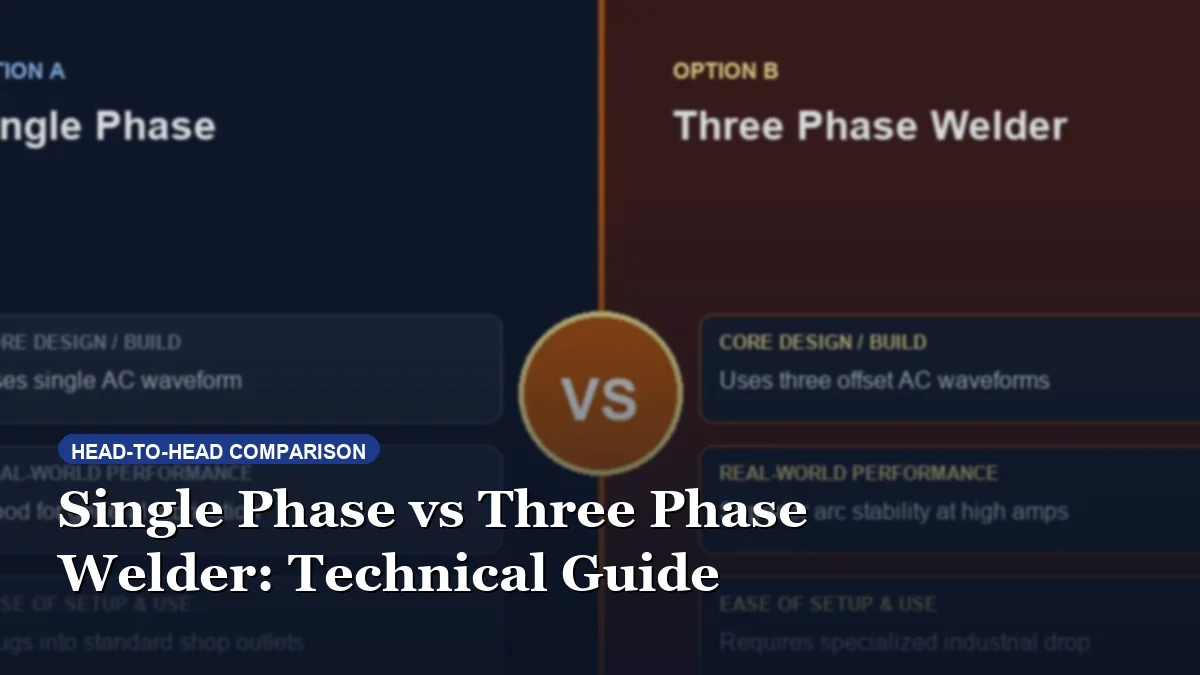
Choose single phase for residential shops and portable repair rigs needing standard 240V outlets. Select three phase for heavy industrial fabrication demanding continuous high duty cycles.
Compare all top models in our Best Welder: Top Home Shop & Jobsite Picks Tested.
Side-by-Side Breakdown
| Criteria | Single Phase | Three Phase Welder | Edge |
|---|---|---|---|
| Core Design / Build | Uses single AC waveform | Uses three offset AC waveforms | Three Phase Welder |
| Real-World Performance | Good for general fabrication | Superior arc stability at high amps | Three Phase Welder |
| Ease of Setup & Use | Plugs into standard shop outlets | Requires specialized industrial drop | Single Phase |
| Durability & Reliability | Lower component count in transformers | Balanced load reduces thermal stress | Three Phase Welder |
| Efficiency / Operating Footprint | Lower overall electrical efficiency | Higher power factor and efficiency | Three Phase Welder |
| Maintenance Requirements | Standard contactor and cable checks | Phase balance and rectifier checks | Single Phase |
| Best Ideal Use Case | Mobile repair and hobby shops | Heavy structural steel production | Three Phase Welder |
Core Design and Electrical Architecture
Single phase systems rely on a single alternating voltage waveform to deliver power to the internal transformer. This design suits standard residential grids but introduces minor arc pulsing during metal transfer.

Three phase machines utilize three separate AC waveforms offset by one hundred twenty electrical degrees. This overlapping delivery provides continuous power flow, eliminating the zero-voltage drops experienced in simpler circuits.
Single-phase transformers utilize two live lines, creating a pulsating magnetic field that drops to zero frequently. For precise aluminum work, many fabricators choose options from our best single phase ac dc tig welder lineup.
Three-phase systems overlap three distinct AC waveforms separated by 120 degrees of phase, delivering continuous power transfer to the primary winding and significantly reducing internal ripple voltage.
- Single phase architecture draws significantly higher amperage through two live conductors during maximum output, requiring heavier gauge copper wiring.
- Three phase distribution balances the electrical load evenly across three distinct hot legs, reducing thermal stress on internal components.
Transformer and Inverter Topologies
Traditional transformer based units handle the incoming line frequency directly. Modern inverter designs rectify the incoming voltage to DC before high frequency switching occurs.
Inverter based single phase units improve portability significantly while maintaining respectable output levels for standard shop fabrication and maintenance tasks.
- Inverter topology reduces overall machine weight by shrinking core transformer sizes.
- Rectification stages must handle higher ripple currents on single phase inputs.
Real-World Welding Performance and Arc Dynamics
Arc stability remains a primary differentiator when pushing welding machines to their maximum rated amperage. Three phase power supplies maintain a smoother puddle due to uninterrupted power delivery.
Single phase units can struggle with arc initiation at extreme low end settings, which is why professionals often prefer a specialized best single phase pulse mig welder for cleaner droplet transfer control.
During heavy MIG welding, single-phase power sources often exhibit noticeable voltage sag under high amperage loads, leading to occasional spatter and inconsistent puddle wetting on structural steel.
Three-phase inverters maintain superior arc stability because the constant power delivery prevents zero-crossing dropouts, resulting in smoother short-circuit transfers and deeper root penetration profiles.
- Three phase output delivers superior puddle wetting action on thick structural steel plates.
- Single phase systems handle routine maintenance fillet welds efficiently without requiring complex arc controls.
Penetration Profiles Across Processes
Stick and TIG welding processes benefit immensely from the clean arc characteristics found on multi phase equipment. Gas metal arc welding shows noticeable improvements in bead profile consistency.
Operators running flux cored wires will notice smoother arc recovery times when utilizing industrial grade three phase power sources in heavy production environments.
- Consistent voltage delivery prevents lack of fusion defects in thick joints.
- Spray transfer modes operate with noticeably reduced spatter generation levels.
Efficiency, Power Factor, and Utility Costs
Electrical efficiency directly impacts monthly operating expenses for commercial fabrication facilities. For smaller shops, finding the best welder ensures optimal power consumption without requiring expensive heavy-duty service drops.
Single phase transformers draw higher peak current from the grid, which can trigger utility surcharges or nuisance breaker trips during extended heavy fabrication runs.
Operating single-phase industrial equipment typically draws unbalanced current from the grid, resulting in a lower power factor and potential utility surcharges for heavy fabrication facilities.
Three-phase welders distribute electrical load evenly across all three supply legs, achieving higher electrical efficiency and minimizing thermal losses within the facility distribution transformer.
- Three phase systems minimize resistive line losses across long facility distribution runs.
- Power factor correction capacitors are frequently integrated into industrial multi phase welding packages.
Energy Consumption Metrics
Idle power consumption tends to be slightly higher on large multi phase transformers due to auxiliary cooling fans and control board transformers running constantly.
Active welding efficiency favors the balanced load of industrial grids, converting more incoming kilowatt hours directly into useful arc heat energy.
- Balanced phase drawing prevents premature overheating of facility step down transformers.
- Lower primary amperage requirements reduce overall electrical infrastructure upgrade expenses.
Maintenance, Component Wear, and System Longevity
Component longevity depends heavily on thermal management and electrical load distribution. Balanced phase loads produce less internal component degradation over years of continuous industrial service.
Single phase rectifiers and input capacitors absorb severe thermal cycling stress during heavy use. Budget equipment like a typical best starter welder manages this by implementing robust internal cooling fans.
The higher ripple voltage in single-phase machines forces filter capacitors to work much harder, accelerating thermal degradation and shortening the operational lifespan of internal rectifier assemblies.
Because three-phase architectures deliver balanced loads, internal switching transistors experience less stress, directly improving mean time between failures for heavy-duty industrial welding power sources.
- Routine inspections should verify input terminal torque to prevent localized resistive heating.
- Cooling fan filters require regular cleaning to maintain adequate airflow across heat sinks.
Preventative Maintenance Protocols
Checking internal contactors and primary wiring harnesses prevents unexpected downtime during critical production schedules. Multi phase units require careful balancing verification periodically.
Technicians must test diode rectifiers regularly to ensure equal current flow across all legs of industrial three phase welding equipment configurations.
- Infrared thermography helps identify high resistance electrical connections early.
- Capacitor bank testing ensures stable DC bus voltage during arc initiation.
Shop Infrastructure and Installation Requirements
Facility electrical infrastructure often dictates whether a shop can support high amperage welding machinery. Standard residential and light commercial buildings rarely feature three phase service drops.
Installing heavy industrial machinery requires professional electrician consultation, dedicated breaker panels, and heavy duty twist lock receptacles designed for high continuous loads.
Installing a single-phase 240V machine usually requires a dedicated heavy-duty breaker, but three-phase drops demand commercial 480V service and specialized industrial-grade disconnect switches.
Facility managers must evaluate local utility transformer capacity before wiring three-phase equipment to prevent voltage imbalance that can severely damage sensitive internal control pcbs.
- Single phase machines connect easily to standard domestic or commercial 240V outlets.
- Three phase setups demand specialized utility drops and commercial service contracts.
Wiring and Breaker Sizing
Conductor sizing must account for voltage drop over long runs from the main distribution panel to the welding workstation. Proper grounding remains non negotiable for safety.
Time delay fuses or heavy duty circuit breakers prevent nuisance tripping during rapid arc strikes and high initial inrush current surges.
- Always consult national electrical codes when sizing supply wiring for welders.
- Dedicated earth grounding rods protect sensitive internal inverter control boards.
Material Thickness and Production Volume Limits
Production volume and joint thickness determine the minimum required power source capacity for profitable fabrication work. Heavy structural projects demand high duty cycle equipment.
Thin sheet metal and general repair tasks are handled exceptionally well by portable single phase machines without requiring expensive utility infrastructure overhauls.
Single-phase welders safely handle mild steel plate up to three-eighths inch in continuous production, but thicker sections require multi-pass procedures due to duty cycle limitations.
Heavy industrial three-phase systems easily sustain high amperage outputs required for heavy plate fabrication, pushing productivity limits without triggering thermal overload protection circuits.
- Three phase welders easily push past two hundred amps at one hundred percent duty cycles.
- Single phase units excel in maintenance operations requiring frequent mobility around shops.
Duty Cycle Realities
Duty cycle ratings define how many minutes out of ten a machine can weld continuously before requiring a cooling pause. Industrial setups offer massive advantages here.
Pushing single phase equipment beyond its rated thermal limit triggers internal thermal overload protectors, halting production until core temperatures drop safely.
- High duty cycles prevent costly bottlenecks in high output fabrication environments.
- Thermal overload switches protect expensive copper windings from catastrophic burnout.
Frequently Asked Questions
Can a single phase welder run on standard residential power?
Yes, most portable units plug directly into standard 240V household outlets. Ensure your circuit breaker is properly rated for the maximum input amperage draw.
Why do industrial shops prefer three phase welding machines?
Industrial shops rely on three phase power for superior arc stability and higher duty cycles. This configuration balances the electrical load evenly across the supply lines.
Is it possible to convert a three phase welder to single phase?
Converting standard units is generally impractical and voids manufacturer safety certifications. Purchasing a dedicated multi voltage machine is the safest and most reliable alternative.
Do three phase welders consume less electricity overall?
Yes, they operate at a much higher power factor and efficiency rating. This reduces resistive line losses and lowers long term operating costs significantly.
What happens if a phase drops on a three phase welder?
Dropping a phase causes severe motor or transformer hum, erratic arc behavior, and thermal overload. Shut down the machine immediately to prevent permanent electrical damage.