Short Circuit vs Spray Transfer Mig: Technical Comparison
Choosing the correct metal inert gas transfer mode dictates your weld quality, penetration depth, and overall shop productivity. Mastering these parameters transforms structural fabrication.

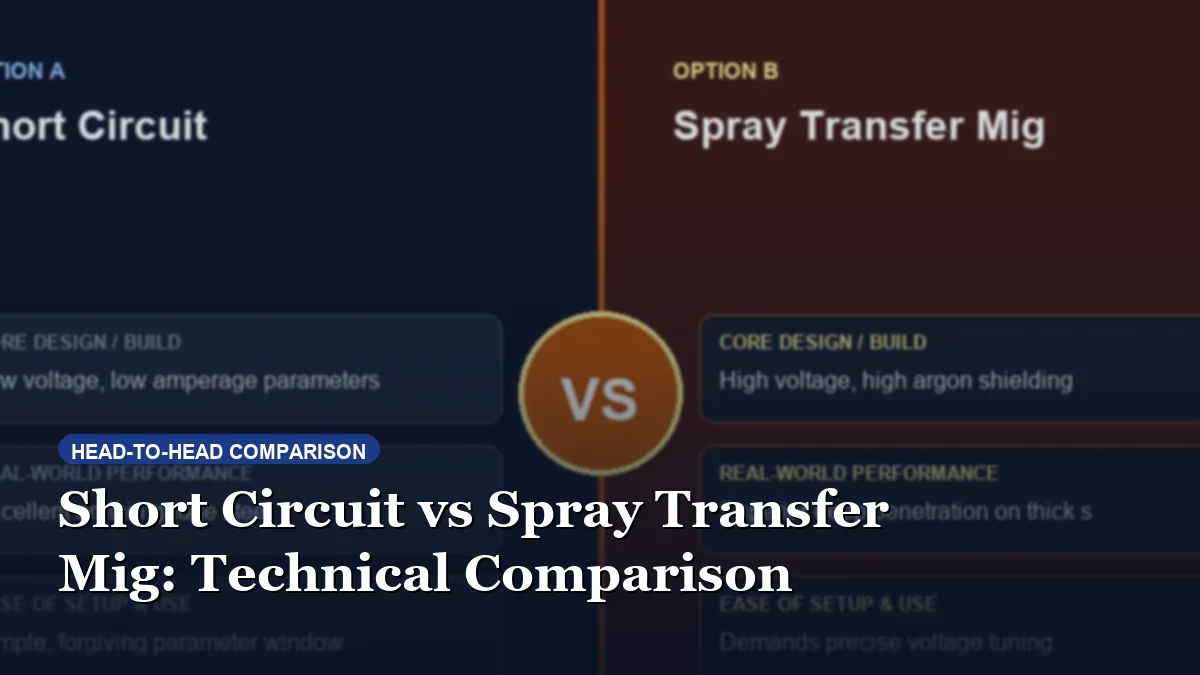
Pick short circuit for thin sheet metal and out-of-position welds, but switch to spray transfer for heavy structural plates requiring deep fusion.
Compare all top models in our Best Welder: Top Home Shop & Jobsite Picks Tested.
Side-by-Side Breakdown
| Criteria | Short Circuit | Spray Transfer Mig | Edge |
|---|---|---|---|
| Core Design / Build | Low voltage, low amperage parameters | High voltage, high argon shielding | Depends on Material |
| Real-World Performance | Excellent on thin gauge steel | Superior deep penetration on thick steel | Spray Transfer |
| Ease of Setup & Use | Simple, forgiving parameter window | Demands precise voltage tuning | Short Circuit |
| Durability & Reliability | Highly consistent in mobile rigs | Sensitive to contact tip wear | Short Circuit |
| Efficiency / Operating Footprint | Lower deposition rates, less heat | High deposition rates, heavy fumes | Spray Transfer |
| Maintenance Requirements | Standard contact tip replacement | Requires water-cooled gun upgrades | Short Circuit |
| Best Ideal Use Case | Automotive body panels and tubing | Heavy machinery and thick structural beams | Depends on Material |
Core Design and Engineering Principles
Understanding the fundamental differences between these two metal inert gas techniques requires looking closely at power source architecture, arc stability, and metal deposition rates during standard structural fabrication procedures today.
Short circuit MIG relies on lower voltages, letting the wire physically touch the base metal to create controlled short circuits. Beginners often explore options within our best beginner mig welders guide to master this process.
Short circuit MIG relies on a constant voltage power source cycling between open circuit and direct workpiece contact. This mechanical droplet transfer operates efficiently under lower heat input thresholds for thin sheet metal fabrication.
Spray transfer engineering demands a high inductive output and specific constant voltage parameters to maintain a continuous, non-contacting axial stream. Molten metal droplets accelerate across the arc column without stubbing.
- Power source architecture dictates droplet transfer mechanics.
- Electrode wire physical contact initiates short circuit events.
- Arc stability depends directly on inductance tuning adjustments.
Power Source Architecture
Modern inverter machines handle both transfer modes effectively by regulating voltage spikes and current slopes. Operators must understand internal transformer behavior to prevent undercut defects on sensitive joints.
- Inverter topology ensures rapid arc recovery times.
- Transformer units offer robust industrial duty cycles.
Voltage And Amperage Operating Parameters
Operating windows dictate whether your machine produces a crisp shorting arc or a smooth axial stream. Maintaining correct voltage ranges prevents stubbing and eliminates excessive spatter during heavy production runs.
Spray transfer demands significantly higher voltages and amperages, pushing the power source past the critical transition current threshold. This forces the filler wire to melt into tiny droplets continuously.
Operating short circuit MIG typically requires running between 15 to 22 volts alongside lower amperages. You can compare affordable machine specifications inside our best budget mig welder review to prevent burn-through.
Transitioning into spray transfer requires elevated thresholds exceeding 24 volts and 200 amps. These aggressive electrical settings push the power source past the critical transition current for stable axial spraying.
- Short circuit operates below the transition current threshold.
- Spray transfer requires elevated voltage and amperage settings.
- Transition current varies based on shielding gas mixtures.
Transition Current Thresholds
Crossing the transition threshold changes the physics of droplet detachment completely. Operators must calibrate wire feed speeds to match the elevated electrical output for stable axial spray.
- Droplet detachment becomes non-contact in spray mode.
- Wire feed speed must increase proportionally with voltage.
Shielding Gas Composition Mechanics
Gas selection fundamentally alters arc characteristics, bead profile geometry, and overall cleaning action. Standard carbon dioxide mixtures work well for short circuiting but cause severe spatter in spray modes.
Achieving a stable spray transfer requires a shielding gas blend rich in argon, typically mixing eighty percent argon with twenty percent carbon dioxide or adding helium for increased heat input.
Short circuit processes heavily utilize carbon dioxide or argon-rich mixtures featuring minor carbon dioxide additives to stabilize the erratic arc. Pure argon causes erratic droplet detachment and severe undercut defects during fabrication.
Spray transfer strictly demands high argon blends containing a minimum of 80 to 90 percent argon mixed with oxygen or carbon dioxide. This specific shielding formulation prevents atmospheric contamination at high amperages.
- Argon-heavy blends stabilize axial spray droplet transfer.
- Carbon dioxide improves short circuit penetration profiles.
- Helium additions enhance weld puddle fluidity significantly.
Argon Rich Blends
Using high percentage argon shielding gases reduces oxidation rates and promotes a clean, spray-like metal transfer. Proper gas flow meter calibration ensures adequate weld pool coverage in drafty workshops.
- Argon shielding prevents atmospheric contamination effectively.
- Flow rates must remain consistent during long passes.
Real-World Penetration And Weld Profiles
Penetration depth dictates the structural integrity of your welded assemblies under heavy mechanical loads. Short circuit provides shallow fusion, making it ideal for thin materials where burn-through is risky.
Spray transfer delivers deep, finger-like penetration profiles into thick steel plates, ensuring maximum joint strength. Fabricators rely on this deep fusion for heavy equipment repair and structural steel erection.
Short circuit welding delivers a shallow, rounded fusion profile ideal for bridging root gaps. However, insufficient energy can cause lack of fusion defects if operators move too quickly over thick steel plates.
Spray transfer produces a deep, finger-like penetration profile characterized by a broad, clean weld bead. Structural fabricators rely on this profile to achieve maximum structural integrity in heavy machinery manufacturing.
- Short circuit prevents distortion on thin sheet metal.
- Spray transfer achieves deep root fusion on thick plate.
- Bead appearance varies from convex to flat profiles.
Penetration Depth Analysis
Evaluating root penetration requires destructive testing or sectional macro-etching procedures. Engineers specify spray transfer when structural codes mandate complete joint penetration on heavy industrial frames.
- Macro-etching reveals internal weld fusion quality.
- Code compliance often dictates specific transfer modes.
Heat Input And Distortion Management
Managing thermal input prevents warping, metallurgical degradation, and costly part rejections in precision fabrication shops. Short circuit introduces lower cumulative heat, minimizing distortion on thin gauge fabrications.
Spray transfer pumps massive thermal energy into the base material, increasing the risk of severe part distortion. Welders must utilize proper clamping jigs and controlled interpass temperatures to mitigate thermal stress.
Managing thermal distortion during short circuit operations involves controlling travel speed and utilizing intermittent stitching techniques. Minimizing the heat-affected zone protects thin metals from warping out of dimensional tolerance.
Spray transfer introduces significantly higher thermal energy into the base metal, amplifying the risk of severe angular distortion. Welders must apply proper preheating protocols and rigid clamping jigs to control movement.
- Low heat input protects thin automotive body panels.
- High heat input requires strict distortion control methods.
- Interpass temperature monitoring prevents metallurgical flaws.
Thermal Distortion Control
Controlling heat distribution requires strategic sequencing and adequate cooling intervals between passes. Home fabricators check out our best home mig welder picks to manage thermal distortion.
- Backing bars absorb excess heat during welding.
- Weld sequencing reduces cumulative thermal stress.
Equipment Maintenance And Consumable Lifespan
Consumable wear rates impact operational budgets and overall welding efficiency in high-output manufacturing facilities. Short circuit generates considerable spatter, requiring frequent contact tip cleaning and nozzle anti-spatter spray.
Spray transfer operates cleanly with minimal spatter, extending contact tip and nozzle lifespan significantly. However, the high thermal output demands water-cooled gun setups to prevent internal torch overheating.
Short circuit setups experience frequent stubbing, which rapidly degrades contact tips and accelerates liner wear. Routine inspection of drive roll tension prevents bird-nesting issues inside the wire feeder mechanism.
Spray transfer operates continuously at high thermal loads, causing rapid degradation of standard nozzles and contact tips. Using heavy-duty chrome-zirconium tips extends consumable lifespan under high-amperage industrial production schedules.
- Spatter buildup clogs contact tips in short circuit.
- Clean spray transfer extends consumable replacement intervals.
- Water-cooled torches handle high amperage spray loads.
Torch Cooling Requirements
Extended spray transfer operations generate intense radiant heat that can melt standard air-cooled welding guns. Upgrading to industrial water-cooled systems ensures reliable performance during continuous production shifts.
- Air-cooled guns overheat during prolonged spray welding.
- Water-cooled systems maintain stable torch operating temperatures.
Choosing The Right Process For Your Shop
Selecting the optimal transfer mode depends entirely on your specific material thickness, joint configuration, and production volume requirements. Match your machine capabilities to your daily workflow for maximum operational profitability.
Evaluate your power supply limitations, shielding gas availability, and operator skill levels before committing to a specific process. Proper planning guarantees superior weld quality and consistent fabrication output.
Selecting short circuit MIG suits fabrication shops focusing on autobody repair and sheet metal enclosures. Many hobbyists evaluate models featured in our best 110v mig welder roundup for reliable results.
Opting for spray transfer serves heavy structural steel shops, pipe welding operations, and thick plate fabrication facilities. This method maximizes deposition rates when running long flat-position welds on thick materials.
- Assess material thickness before choosing transfer modes.
- Verify machine output capacity and duty cycle ratings.
- Train operators on correct parameter tuning techniques.
Workflow Optimization
Optimizing shop workflow involves standardizing procedures for different material grades and thickness ranges. Clear standard operating procedures reduce setup errors and improve overall welding department productivity.
- Standardized procedures reduce costly fabrication errors.
- Clear guidelines improve overall shop turnaround times.
Frequently Asked Questions
Can short circuit mig be used on thick steel plates?
It can be used on thick plates, but it lacks deep fusion and risks lack of fusion defects. Always choose spray transfer for heavy structural applications.
Why does spray transfer require an argon shielding gas?
Argon gas stabilizes the high-energy arc and prevents droplet interference during axial metal transfer. Using pure carbon dioxide will ruin spray arc stability entirely.
Is spray transfer suitable for vertical or overhead welding positions?
Spray transfer is strictly limited to flat and horizontal fillet positions due to gravity. The extremely fluid weld puddle will sag instantly during out-of-position welds.
What causes excessive spatter during short circuit welding?
Incorrect voltage and wire feed speed pairings usually cause explosive short circuiting events. Adjusting your inductance settings will significantly reduce weld spatter.
Do I need a special machine for spray transfer mig?
You need a constant voltage power source with sufficient amperage output and high duty cycles. Many modern multi-process machines easily handle axial spray parameters.