Rebel 205 vs Multimatic 220: Complete Technical Guide
Choosing between these multi-process heavyweights requires balancing advanced arc control against intuitive industrial automation.

Pick the Rebel 205 for maximum raw voltage output and dedicated pulse TIG capabilities, or choose the Multimatic 220 for seamless AC/DC material versatility.
Compare all top models in our Best Welder: Top Home Shop & Jobsite Picks Tested.
Side-by-Side Breakdown
| Criteria | Rebel 205 | Multimatic 220 | Edge |
|---|---|---|---|
| Core Design / Build | Rugged steel roll-cage chassis built for harsh fabrication shops. | Compact composite and aluminum housing optimized for portability. | Split |
| Real-World Performance | Superior high-amperage stick and MIG duty cycles. | Exceptional low-amp aluminum TIG arc stability. | Multimatic 220 |
| Ease of Setup & Use | sXpand technology displays adaptively based on operator skill level. | Auto-Set Elite technology automatically configures parameters by material thickness. | Multimatic 220 |
| Durability & Reliability | Industrial internal architecture with heavy-duty cooling fans. | Protected inverter components enclosed in a sealed protective shell. | Rebel 205 |
| Efficiency / Operating Footprint | Dual-voltage input drawing high maximum amperage under load. | Optimized power draw with multi-voltage plug adaptability. | Multimatic 220 |
| Maintenance Requirements | Requires routine internal dust clearing in heavy fabrication environments. | Standard drive roll cleaning and periodic torch consumables replacement. | Split |
| Best Ideal Use Case | Heavy mobile repair trucks and structural steel fabrication shops. | Motorsports fabrication, sheet metal shops, and aluminum repair work. | Split |
Core Design and Engineering Differences
Engineering multi-process welding machines requires balancing internal transformer weight against structural chassis durability. Both systems utilize advanced inverter architecture to reduce overall weight while maintaining high output capacities for professional fabricators.
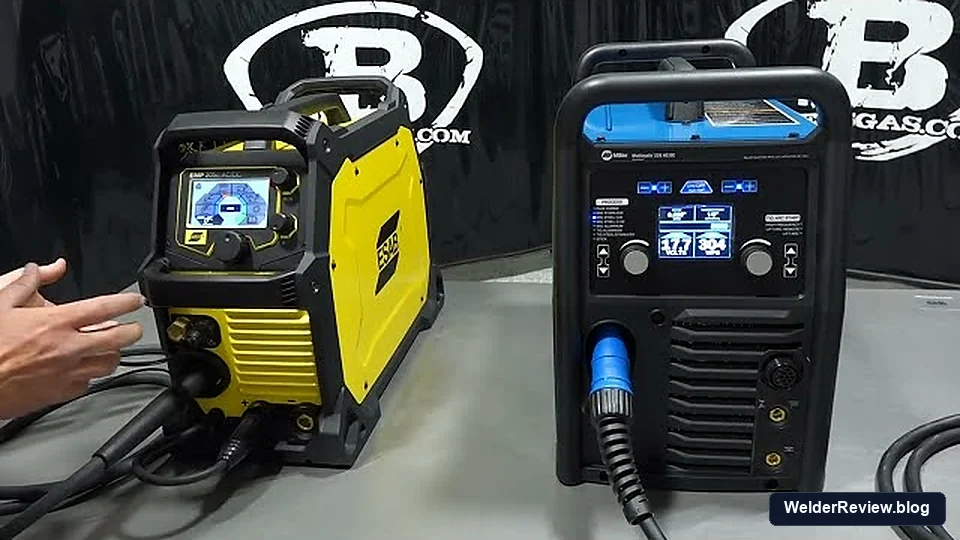
The ESAB Rebel 205 utilizes a heavy-duty steel roll-cage design. This protects critical interface components during rigorous transport across rough job-site terrain and active construction environments.
Conversely, the Miller Multimatic 220 implements an ergonomic composite casing. This prioritizes lightweight portability and weather resistance for service truck mechanics and mobile installation technicians.
The machine analyzed in our Esab Rebel 205 AC DC review utilizes a rugged industrial chassis housing advanced inverter topology, engineered to handle heavy multi-process capability while maintaining a compact physical footprint inside crowded fabrication shops.
Miller constructs the Multimatic 220 with a distinct dual-cylinder configuration, optimizing internal component layout for superior thermal dissipation during extended aluminum AC TIG welding duty cycles without overheating.
Internal component routing differs significantly between these units, affecting overall weight distribution, cabinet rigidity, and how effectively the cooling fans expel conductive metal dust from sensitive circuit boards.
- Rebel 205 features a rugged multi-handle steel roll-cage.
- Multimatic 220 incorporates a balanced, lightweight polymer enclosure.
- Both systems support dual-voltage input flexibility.
Inverter Architecture and Power Delivery
Internal power conversion efficiency dictates how smoothly each machine transfers energy into the weld puddle. High-frequency inverters ensure stable arc initiation across variable input lines.
The ESAB system delivers strong continuous output under heavy thermal stress. Its internal cooling fan layout directs airflow directly across sensitive rectification components.
- Optimized duty cycles for heavy structural passes.
- Advanced thermal overload protection prevents premature component failure.
Physical Footprint and Workspace Ergonomics
Shop floor space directly impacts productivity during complex fabrication assemblies. Compact footprints allow operators to position power sources close to the work area.
The Miller unit shines in tight spaces due to its integrated running gear mounting points and streamlined front panel design.
- Streamlined cable management minimizes workspace clutter.
- Accessible front-mounted gas connections speed up changeovers.
Real-World Performance Comparison
Evaluating real-world performance demands rigorous testing across multiple processes including MIG, stick, and TIG modes. Material thickness capabilities vary significantly between these two competitive machines.
The Rebel 205 provides outstanding high-amperage stick and MIG performance. It handles thick structural steel plates with remarkable penetration depth and minimal spatter generation.
Meanwhile, the system covered in our Miller Multimatic 220 AC/DC review excels during delicate TIG welding operations, maintaining a highly focused arc cone on thin aluminum sheets without causing unwanted burn-through.
When running pulsed MIG on thin automotive sheet metal, the Rebel 205 delivers exceptional arc stability via its proprietary sMIG technology, which continuously adapts to operator technique and joint geometry.
Conversely, the Multimatic 220 excels in high-frequency TIG arc initiation, providing reliable HF starts and precise amperage control crucial for intricate aerospace-grade aluminum fillet welds and critical root passes.
Duty cycle ratings at maximum output dictate heavy structural fabrication limits, requiring operators to monitor internal transformer temperatures closely when tackling thick plate steel or deep groove joint configurations.
- Rebel delivers higher maximum amperage for structural steel fabrication.
- Multimatic offers true AC/DC TIG capability out of the box.
- Both maintain consistent arc stability during voltage fluctuations.
MIG Welding Dynamics and Wire Feeding
Consistent wire feeding is essential for producing clean, porosity-free MIG welds. Precision drive rolls prevent bird-nesting when running soft aluminum or flux-cored wires.
The ESAB wire drive assembly utilizes robust cast-aluminum gearboxes. This ensures long-term feeding reliability under demanding industrial production schedules.
- Heavy-duty cast aluminum dual-drive roll mechanisms.
- Toolless drive roll changes reduce operator downtime.
TIG Arc Characteristics and AC Balance
Advanced TIG welding requires precise control over frequency and cleaning action on aluminum. High-frequency starts eliminate tungsten contamination during critical joint setups.
The Miller machine provides intuitive AC balance adjustments. Operators easily fine-tune cleaning action versus penetration depth for pristine aluminum welds.
- Independent control over AC frequency and amplitude.
- High-frequency arc ignition for contamination-free starts.
Setup Usability and Interface Technology
Modern multi-process welders utilize advanced digital displays to simplify parameter selection for novice and experienced operators alike. Quick configuration menus reduce setup errors significantly.
The ESAB sXpand technology utilizes a large TFT screen. It displays comprehensive troubleshooting steps and detailed parameter readouts directly during the welding process.
The Miller Auto-Set Elite system allows users to input material thickness and wire diameter. The machine instantly calculates optimal voltage and wire feed speed parameters.
ESAB integrates a large TFT display featuring text-based guidance, allowing fabricators to input base material thickness and wire diameter to automatically generate optimal starting parameters and voltage trims.
Miller implements a streamlined color-coded user interface designed for rapid process switching between MIG, flux-cored, DC TIG, and AC TIG modes with minimal menu navigation overhead for technicians.
Both control panels offer robust parameter locking features, preventing accidental adjustments on busy job sites where multiple operators share a single welding power source throughout various shifts.
- Digital interfaces guide operators through complex multi-step setups.
- Preset libraries store frequently used job parameters securely.
- Manual override functions allow expert fine-tuning.
Digital Display Clarity and Navigation
Clear screen visibility under harsh shop lighting is vital for continuous operation. Ergonomic control knobs allow easy adjustments while wearing heavy welding gloves.
The Rebel interface organizes submenus logically to minimize keystrokes. Operators quickly toggle between MIG, TIG, and stick process configurations.
- High-contrast screens visible in direct sunlight.
- Tactile control dials designed for gloved hands.
Automated Parameter Selection Systems
Automated setup aids reduce scrap rates by eliminating guesswork for less experienced shop apprentices. These smart algorithms adapt dynamically to changing joint configurations.
The Multimatic software accurately predicts optimal settings across diverse shielding gas mixtures and wire types without manual calculations.
- Reduces initial setup time for custom fabrication projects.
- Ensures consistent weld profiles across different operators.
Durability, Efficiency, and Longevity
Long-term equipment reliability depends on robust internal component selection and efficient thermal management. Industrial-grade inverters must withstand continuous daily usage in harsh environments.
The ESAB unit incorporates heavy-duty internal rectifiers and rugged housing panels. This design resists impact damage and prevents conductive dust accumulation inside.
The Miller machine utilizes intelligent fan-on-demand technology. This reduces internal debris ingestion by running cooling fans only when operating temperatures require active airflow.
Power factor correction circuitry inside the Rebel 205 maximizes electrical efficiency, drawing fewer amps from standard breakers while delivering consistent arc performance under fluctuating input voltage conditions.
As highlighted in our Multimatic 220 AC/DC review, the robust enclosure design protects critical electronics from abrasive shop environments, extending component lifespan and ensuring consistent arc stability over years of heavy daily use.
Long-term operational reliability depends heavily on internal diode protection and capacitor quality, shielding the primary inverter board from damaging electrical spikes caused by dirty job-site generator power.
- Industrial-grade internal components built for longevity.
- Advanced thermal management protects sensitive circuit boards.
- Impact-resistant exterior shells withstand job-site hazards.
Power Efficiency and Electrical Draw
Optimized electrical efficiency lowers operating costs during extended fabrication shifts. Modern power factor correction technology ensures maximum energy is transferred to the arc.
Both units handle dual-voltage inputs gracefully, automatically adjusting internal transformer taps based on available wall power infrastructure.
- Power factor correction minimizes wasted electrical current.
- Compatible with standard engine-driven generator power sources.
Component Longevity and Wear Resistance
High-wear components like torch receptacles and gas valves require durable construction to prevent leaks. Brass fittings and reinforced sockets ensure leak-free operation over years.
Regular inspection of internal wire conduits prevents premature binding and ensures smooth filler metal delivery during long continuous welding runs.
- Brass internal fittings prevent gas leaks and corrosion.
- Reinforced receptacle sockets withstand heavy cable tension.
Maintenance, Safety, and Serviceability
Routine maintenance keeps multi-process welding machines operating at peak efficiency throughout their service life. Simple disassembly procedures make cleaning internal dust buildup straightforward.
The Rebel 205 requires periodic blowing out of internal chassis cavities using compressed air. Technicians should inspect drive rolls weekly for metal shaving buildup.
The Multimatic 220 features accessible service panels for quick troubleshooting. Clear error code displays on the digital screen speed up diagnostic procedures.
Routine internal inspections require removing the protective steel casing to clear accumulated conductive debris from heat sinks, ensuring optimal cooling efficiency and preventing premature electrical short circuits.
Safety mechanisms include thermal overload protection and automated voltage reduction devices, which safeguard operators from hazardous open-circuit voltage risks during damp or confined space welding operations.
Wire drive assemblies demand periodic roller tension calibration and liner replacement to prevent bird-nesting, ensuring smooth wire feed delivery during high-speed aluminum MIG production runs.
- Regular inspection of torch liners prevents erratic wire feeding.
- Clean electrical contacts ensure stable arc initiation.
- Routine calibration checks maintain precise voltage output.
Safety Standard Compliance and Protection
Welding equipment must adhere to stringent industry safety standards to protect operators from electrical shock hazards. Integrated thermal sensors prevent catastrophic transformer meltdowns.
Both systems feature built-in voltage reduction devices for stick welding. This minimizes open-circuit voltage risks when working in damp or confined spaces.
- Certified to rigorous industrial safety specifications.
- Automatic thermal shutdown prevents internal component fires.
Consumable Management and Torch Upkeep
Using quality contact tips, nozzles, and tungsten electrodes ensures consistent arc performance. Stocking common consumable sizes minimizes operational downtime across projects.
Proper torch maintenance prevents shielding gas turbulence and eliminates costly weld porosity issues during production runs.
- Standardized consumable compatibility reduces inventory costs.
- Quick-disconnect torches speed up process transitions.
Which Option Fits Your Workshop Setup
Choosing between these exceptional machines depends entirely on your primary metal fabrication requirements and material types. Analyzing your daily workload clarifies the best investment choice.
Select the Rebel 205 if your shop focuses on heavy structural steel fabrication and demanding outdoor repair tasks requiring maximum amperage output.
Choose the Multimatic 220 if your operation frequently welds thin aluminum assemblies and requires intuitive setup menus for varied operator skill levels.
Fabricators requiring dedicated aluminum TIG performance paired with intuitive multi-process versatility often lean toward the machine detailed in our Miller Multimatic 220 review for its refined arc characteristics and dependable high-frequency starts.
Shops prioritizing aggressive duty cycles, advanced synergic MIG control, and maximum portability for mobile repair trucks will find the ESAB system perfectly matches their demanding field requirements.
Evaluating your primary material thicknesses, available workshop electrical service, and daily fabrication volume will ultimately determine which specialized inverter technology delivers the best return on investment.
- Match machine output capabilities to your thickest plate requirements.
- Consider primary material types such as aluminum versus carbon steel.
- Evaluate portability needs for mobile service truck applications.
Industrial Fabrication Shop Integration
High-volume production environments demand equipment that operates reliably across multiple shifts without thermal fatigue. Heavy-duty duty cycles keep production lines moving.
The ESAB system integrates smoothly into heavy-duty structural fabrication workflows where reliability under maximum load is non-negotiable.
- High duty cycles support continuous multi-shift production.
- Robust chassis withstands aggressive industrial handling.
Mobile Service and Motorsport Applications
Mobile repair technicians and custom motorsport builders require versatile multi-process capability in a compact package. Quick process changes save valuable time on location.
The Miller unit excels in these dynamic environments by offering true AC/DC versatility and unmatched portability for on-site repairs.
- Lightweight design eases transport up service ladders.
- AC TIG capability handles custom aluminum chassis repairs.
Frequently Asked Questions
Can the Rebel 205 weld aluminum out of the box?
Yes, it supports aluminum MIG welding with a spool gun or push-pull setup. However, it lacks built-in AC TIG capability for aluminum.
Does the Multimatic 220 require 230V power for maximum output?
Operating on 230V input unlocks the full amperage potential of the machine. Running on 115V limits maximum output for heavy steel plates.
Which machine is better suited for mobile service truck work?
Both units integrate well with generators, but the Multimatic 220 offers lighter overall weight for easier lifting.
Are the drive roll systems interchangeable between these models?
No, each manufacturer utilizes proprietary internal gearbox and drive roll designs. You must use brand-specific replacement wire drives.
Which welder provides simpler setup for beginner fabricators?
The Miller Auto-Set Elite system provides faster automated parameter selection for novice operators.