Lincoln 210Mp vs Miller 215: Head-to-Head Guide
Choosing between these multi-process heavyweights requires analyzing architecture, duty cycles, and control interfaces. We examine their engineering specs to help you select the ideal machine.

Choose the Lincoln 210Mp for raw structural versatility and robust DC TIG performance in heavy fabrication shops. Pick the Miller 215 if you prioritize automated autostet setup menus and seamless dual-voltage transitions.
Compare all top models in our Best Welder: Top Home Shop & Jobsite Picks Tested.
Side-by-Side Breakdown
| Criteria | Lincoln 210Mp | Miller 215 | Edge |
|---|---|---|---|
| Core Design / Build | Rugged sheet metal chassis with an industrial footprint and clear digital display. | Compact industrial polymer-steel hybrid casing optimized for portable jobsite applications. | Lincoln 210Mp |
| Real-World Performance | Delivers up to 210A output with exceptional arc stability on thick steel. | Produces a smooth 200A output arc optimized for clean automotive sheet metal. | Miller 215 |
| Ease of Setup & Use | Intuitive push-and-turn digital controls require manual parameter entry for fine-tuning. | Advanced Auto-Set Elite technology simplifies multi-material configuration for operators. | Miller 215 |
| Durability & Reliability | Heavy-duty internal wire drive system built for harsh industrial environments. | Precision-engineered cast aluminum drive assembly ensuring consistent wire feed rates. | Tie |
| Efficiency / Operating Footprint | Dual-voltage capability draws efficiently on standard 120V and 230V circuits. | Smart-voltage technology automatically detects input power without manual linking. | Miller 215 |
| Maintenance Requirements | Straightforward modular component layout allows quick internal troubleshooting. | Enclosed drive housing requires periodic debris removal for optimal wire tracking. | Lincoln 210Mp |
| Best Ideal Use Case | Structural fabrication, heavy farm repairs, and traditional shop welding tasks. | Mobile maintenance, light fabrication, and rapid-setup multi-process applications. | Miller 215 |
Core Engineering and Physical Architecture
Evaluating multi-process power sources demands close inspection of internal component layout and cabinet design. The structural integrity of your welding machine directly influences long-term reliability under heavy shop conditions.
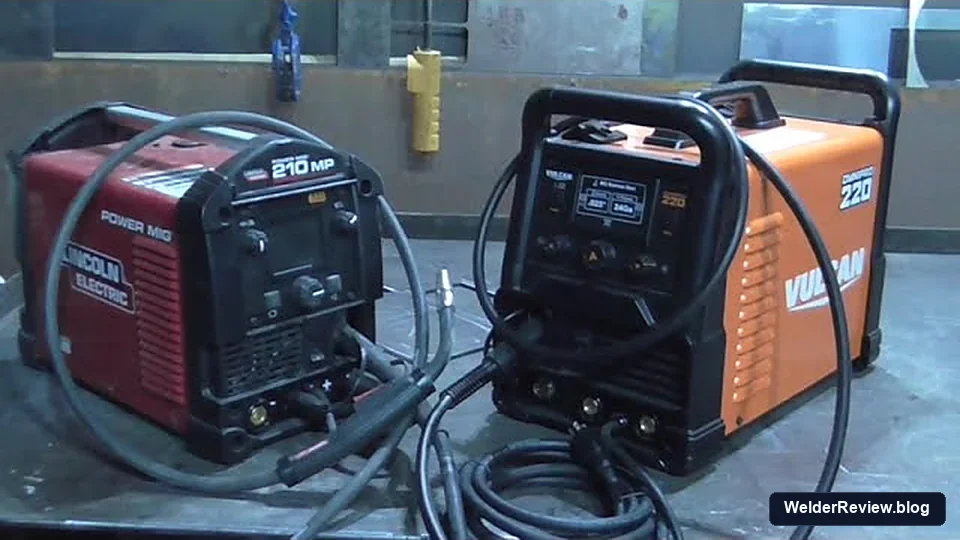
Both machines offer portable multi-process capability, yet their internal framing philosophies diverge significantly. Understanding these baseline engineering differences helps technical buyers match equipment specifications to their specific operational demands.
- Heavy-gauge steel internal frames protect sensitive circuitry against severe impact drops.
- Optimized airflow channels isolate electronic control boards from grinding dust and metallic debris.
- Ergonomic handle placement ensures balanced weight distribution during manual jobsite transport.
Chassis Construction and Materials
The Lincoln 210Mp utilizes a rugged sheet metal housing engineered for traditional workshop environments. Its structural reinforcement plates minimize cabinet flex during rigorous wire spool changes and heavy transport.
Our detailed Miller 215 welder review highlights how it integrates high-impact industrial polymers with steel supports. This hybrid approach reduces weight without sacrificing critical impact resistance.
- Reinforced corner brackets prevent chassis distortion during accidental drop events.
- Weather-resistant exterior coatings protect against premature corrosion in outdoor elements.
Internal Wire Drive Assembly
Reliable wire feeding forms the backbone of consistent MIG performance across structural joints. Both systems incorporate dual-drive roll mechanisms designed to eliminate common bird-nesting issues during operation.
Precision machining on the Miller 215 drive rolls ensures exact wire alignment. Meanwhile, the Lincoln architecture prioritizes high torque delivery for sustained pushing power through long gun liners.
- Quick-release tension arms simplify rapid wire spool replacements in the field.
- Tool-less drive roll removal accelerates routine maintenance and size conversions.
Real-World Arc Performance and Output
Laboratory metrics mean little without practical validation on real-world joint configurations. Welders must maintain stable arcs across varied metal thicknesses without excessive spatter or voltage drop.
Testing these systems reveals distinct arc characteristics tailored to specific user preferences. Professional fabricators will immediately notice how each machine handles puddle manipulation and heat input control.
- Maximum output current reaches past two hundred amps on dedicated input circuits.
- Dynamic inductance control shapes the arc profile for minimal post-weld cleanup.
- Smooth arc starts eliminate frustrating wire stubbing during initial contact.
MIG Welding Dynamics
Operating in short-circuit MIG mode highlights the refined arc control engineered into both units. The Lincoln 210Mp produces a crisp, forceful arc that bites aggressively into thick steel plates.
As shown in our Miller TIG kit review, this machine delivers a softer, highly controllable puddle that prevents destructive burn-through on thin automotive sheet metal.
- Optimized waveform technology reduces annoying spatter across standard shielding gases.
- Consistent voltage regulation compensates for minor operator hand-speed variations.
TIG and Stick Capabilities
Multi-process versatility requires competent DC TIG and stick welding functionality. Both machines deliver smooth lift-arc TIG performance for precision stainless steel and chromoly fabrication tasks.
Stick welding output remains exceptionally stable, easily handling hard-to-run electrodes like seventy-eighty-eight. Arc force control prevents electrode sticking during tight root passes in confined joint spaces.
- Hot-start technology ensures reliable electrode ignition on cold, dirty steel.
- Accurate amperage adjustment allows fine-tuning for delicate thin-wall tubing.
User Interface and Setup Ergonomics
Complex digital menus can severely hinder productivity in fast-paced fabrication environments. Manufacturers must balance advanced technological features with straightforward, glove-friendly physical control knobs.
Examining the front panel layouts highlights divergent philosophies regarding operator assistance. One prioritizes manual mastery while the other automates parameter selection for rapid deployment.
- High-contrast digital screens remain clearly legible under glaring shop lights.
- Robust control dials withstand aggressive twisting from heavy welding gloves.
- Logical menu structures minimize navigation steps between welding processes.
Digital Display Technologies
The Lincoln 210Mp features a vibrant color screen displaying clear graphical readouts. Operators manually adjust voltage and wire feed speed using a central push-and-turn control dial.
The Miller 215 utilizes an advanced Auto-Set Elite menu system. Users simply input material thickness and wire diameter, allowing the machine to calculate optimal parameters automatically.
- Manual override modes give expert welders full control over exact parameters.
- Preset memory slots allow fast recall of frequently used job configurations.
Multi-Voltage Flexibility
Jobsite versatility relies heavily on seamless dual-voltage input adaptability. Both machines accept standard household current or heavy industrial power supplies without complex internal rewiring.
As detailed in our Miller 215 review, the machine features automatic voltage sensing that adapts instantly to power changes, whereas the Lincoln unit requires a manual plug adapter swap.
- Dedicated power cords lock securely to prevent accidental mid-job disconnection.
- Over-voltage protection safeguards sensitive internal boards from dirty generator power.
Maintenance, Efficiency, and Longevity
Equipment longevity depends on proactive maintenance schedules and robust internal cooling systems. Industrial welders face harsh operating conditions that test the limits of electronic components.
Minimizing downtime requires accessible internal layouts and durable external contact points. Let us analyze how these two rival machines manage long-term wear and tear in professional shops.
- Variable-speed cooling fans reduce internal dust ingestion during idle periods.
- Corrosion-resistant terminal blocks ensure reliable welding cable connections over time.
- Modular circuit board architecture streamlines advanced technician repairs.
Cooling and Thermal Protection
Thermal overload circuits prevent catastrophic transformer damage during heavy duty cycle pushes. Both units employ intelligent cooling fans that activate only when internal temperatures demand airflow.
This conservative thermal management strategy extends component lifespan significantly. Fabricators can push these machines hard on thick structural joints without fearing premature thermal shutdowns.
- Integrated thermal sensors monitor critical component temperatures continuously.
- Efficient heat sink geometry dissipates thermal loads rapidly during intensive runs.
Routine Service Requirements
Keeping your welding machine operational demands regular cleaning of internal drive components. The open layout of the Lincoln 210Mp makes blowing out accumulated wire shavings remarkably fast.
The enclosed drive compartment of the Miller 215 keeps dust away from sensitive gears. However, it requires careful vacuuming around tight corners during scheduled monthly maintenance checks.
- Contact tip and nozzle inspections prevent erratic wire feeding issues.
- Drive roll groove reversal accommodates varying wire diameters effortlessly.
Safety Standards and Compliance
Modern welding equipment must meet rigorous international safety standards to protect operators. Electrical insulation, grounding integrity, and arc radiation shielding are paramount design considerations.
Compliance with recognized testing organizations ensures these machines operate safely in professional facilities. Understanding these safety mechanisms gives buyers essential peace of mind.
- Certified to meet stringent North American electrical safety and performance standards.
- Robust grounding circuits prevent hazardous electrical shock during damp conditions.
- Insulated electrode holders safeguard operators against accidental short circuits.
Electrical Protection Systems
Both units incorporate advanced surge suppression to handle unstable jobsite power grids. Internal circuit breakers isolate faults instantly before they can damage expensive inverter boards.
Proper grounding lugs ensure secure connection paths for heavy work clamps. This attention to electrical safety minimizes risks during high-amperage structural welding operations.
- Sealed control panels protect electronics from conductive moisture ingress.
- Robust strain reliefs prevent internal wire fraying at cable entry points.
Operator Exposure Mitigation
Minimizing UV radiation emission and electromagnetic interference remains a critical engineering goal. Heavy steel cabinets effectively contain high-frequency arc start interference common in TIG mode.
Ergonomic torch designs reduce repetitive strain injuries during extended daily production runs. Comfort-grip handles promote proper hand posture across all available welding processes.
- Low-EMF transformer designs protect nearby sensitive electronic devices.
- Balanced torch weight distribution reduces forearm fatigue during overhead welding.
Which Option Fits Your Setup
Selecting the right multi-process welder ultimately depends on your specific workspace requirements. Heavy fabrication shops demand different performance characteristics than mobile repair service trucks.
Matching machine specifications to your daily workload ensures maximum return on investment. Let us examine which professional profile benefits most from each distinct welding machine.
- Evaluate your typical material thicknesses before finalizing any purchasing decision.
- Consider whether mobility or raw structural output dictates your daily workflow.
- Factor in operator skill levels when choosing between manual and automated controls.
Ideal Profile for Lincoln 210Mp
Choose the Lincoln 210Mp if your shop tackles heavy structural steel fabrication. Its forceful arc dynamics and rugged chassis withstand punishing industrial environments with ease.
Traditional fabricators who prefer absolute manual control over voltage and wire feed parameters will feel right at home with its straightforward digital interface.
- Perfect for busy farm repair shops and structural steel fabricators.
- Excels in applications requiring traditional manual parameter tuning.
Ideal Profile for Miller 215
According to our Miller Multimatic 215 review, its advanced Auto-Set technology dramatically speeds up multi-material transitions when you perform mobile maintenance on thin sheet metal.
Fabricators seeking a lightweight, highly portable machine that handles varied tasks quickly will appreciate its refined arc and intuitive setup menus.
- Outstanding choice for mobile service trucks and automotive repair shops.
- Ideal for operators benefiting from automated parameter calculation.
Frequently Asked Questions
Can both welders run on standard household electrical outlets?
Yes, both machines feature dual-voltage capability for standard 120V circuits. They automatically adapt or use adapters to deliver reliable light-duty welding performance anywhere.
Which machine is better suited for welding aluminum?
Both units support spool guns for aluminum MIG welding operations. The Miller 215 offers slightly smoother arc initiation for thin aluminum sheet applications.
Do these welders require shielding gas for all processes?
Shielding gas is necessary for MIG and TIG welding processes. However, both units handle flux-cored wires effectively for gasless outdoor welding tasks.
What is the maximum steel thickness each machine can weld?
Both power sources handle steel up to three-eighths of an inch thick on maximum output. Proper joint preparation ensures full structural penetration on heavy plates.
Are specialized torches required for TIG welding?
Yes, optional TIG torch kits must be purchased separately to utilize DC TIG modes. Both machines accept standard industry-standard torch connections without modification.