Forney 140 MP vs Titanium Unlimited 200 Head-to-Head
Comparing a lightweight multi-process entry machine against a heavy-duty dual-voltage powerhouse. Choose carefully based on your power availability and metal thickness needs.

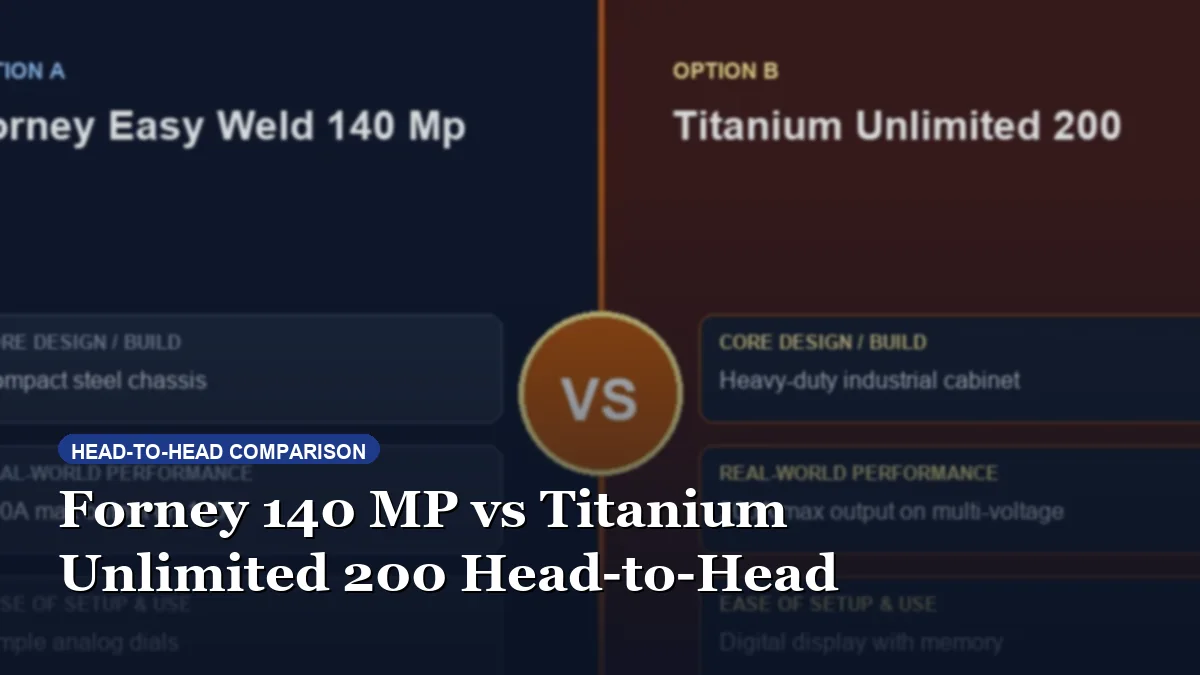
Pick the Forney 140 MP for portable 120V garage repairs and light fabrication. Choose the Titanium Unlimited 200 if you require dual-voltage versatility and heavy structural fabrication capacity.
Compare all top models in our Best Welder: Top Home Shop & Jobsite Picks Tested.
Side-by-Side Breakdown
| Criteria | Forney Easy Weld 140 Mp | Titanium Unlimited 200 | Edge |
|---|---|---|---|
| Core Design / Build | Compact steel chassis | Heavy-duty industrial cabinet | Titanium Unlimited 200 |
| Real-World Performance | 140A max output on 120V | 200A max output on multi-voltage | Titanium Unlimited 200 |
| Ease of Setup & Use | Simple analog dials | Digital display with memory | Titanium Unlimited 200 |
| Durability & Reliability | Standard hobbyist duty cycle | Enhanced thermal protection | Titanium Unlimited 200 |
| Efficiency / Operating Footprint | Lightweight and highly portable | Heavier multi-process footprint | Forney Easy Weld 140 Mp |
| Maintenance Requirements | Basic drive-roll cleaning | Standard liner and torch upkeep | Tie |
| Best Ideal Use Case | Sheet metal and auto body | Structural steel and thick plate | Titanium Unlimited 200 |
Architectural Design and Portability
While evaluating physical build quality, reference our Titanium Unlimited 140 review to compare structural engineering; the Forney 140 MP prioritizes lightweight portability, whereas heavier alternatives utilize rugged steel housings.
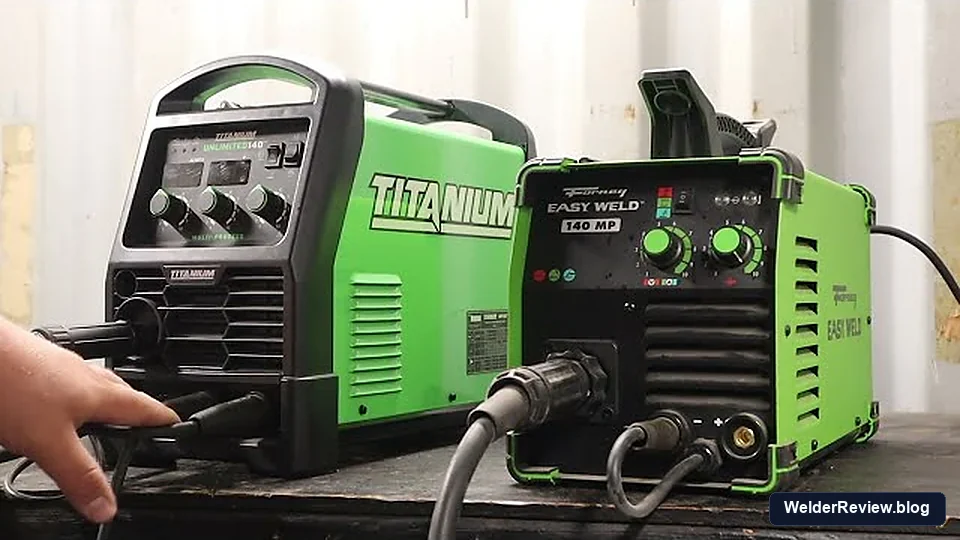
Transporting your equipment to remote job sites demands a compact footprint and reliable handles. Operators frequently favor lighter machines when climbing ladders or navigating tight workshop corners during routine fabrication projects.
As detailed in our Forney Easy Weld 140 MP review, this machine features a compact pressed steel chassis weighing roughly 25 pounds, making it exceptionally portable for field repairs and mobile service trucks.
Conversely, the Titanium Unlimited 200 utilizes a heavier structural housing scaled for dual-voltage transformers, demanding a dedicated rolling cart setup rather than casual single-handed transport across larger industrial fabrication shops.
- Forney weight: Approximately 45 pounds for effortless transport.
- Titanium weight: Around 51 pounds offering rugged stability.
- Chassis materials: Pressed steel versus heavy-gauge panels.
Structural Footprint and Workshop Ergonomics
Bench space utilization dictates how efficiently you can stage materials around your welding table. Larger units require dedicated carts, while smaller portables easily tuck away underneath standard workshop benches.
- Footprint dimensions vary significantly between models.
- Cable management hooks improve overall workflow safety.
Power Delivery and Output Capabilities
Electrical input requirements fundamentally dictate where and how you deploy your welding equipment. The Forney unit runs strictly on standard household 120V circuits for maximum convenience.
Conversely, the larger competitor offers dual-voltage flexibility. This allows you to plug into 120V or 240V power sources depending on your immediate job site amperage demands.
Operating strictly on 120V input power, the Forney machine delivers a modest output range peaking around 140 amperes, perfectly suited for light gauge sheet metal and maintenance tasks on mild steel.
As highlighted in our Titanium Unlimited 200 review, this unit leverages a dual-voltage inverter architecture to produce up to 200 amperes on 240V input, easily penetrating thicker structural plates and handling demanding multi-pass requirements.
- Input voltage: 120V single-phase for the entry model.
- Input voltage: 120V/240V dual capability for the larger unit.
- Maximum output amperage reaches significantly higher levels.
Amperage Range and Material Penetration
Thick steel plates demand higher amperage to ensure complete joint fusion and structural integrity. Operating at lower limits restricts you primarily to sheet metal and thin tubing.
- Penetration depth scales directly with available amperage.
- Duty cycles drop when pushing maximum output limits.
Multi-Process Functionality and Performance
Modern fabrication shops value machines capable of handling MIG, TIG, and stick welding processes interchangeably. Both platforms provide multi-process capabilities, though execution and accessory inclusions vary.
MIG welding performance on thin autobody panels remains smooth when using proper shielding gas and wire tension settings. Slag removal during stick welding requires standard chipping hammers and wire brushes.
Building on our Forney multi-process welder review, both systems handle core processes, yet the Forney employs simplified circuitry optimized for basic flux-core applications where gas shielding cylinders are entirely unnecessary.
The Titanium model features advanced arc controls including adjustable hot start and arc force for stick mode, alongside high-frequency TIG capabilities that ensure clean starts on aluminum or stainless substrates.
- Process versatility covers MIG, TIG, and stick.
- Spool gun compatibility aids aluminum wire feeding.
- Lift TIG setup requires purchasing optional torch kits.
Arc Stability Across Different Processes
Maintaining a stable arc prevents spatter and reduces post-weld cleanup time across all joint configurations. Digital controls on advanced machines help regulate voltage drops during arc initiation.
- Arc smoothness dictates overall weld bead appearance.
- Inductance controls refine puddle wetting action.
User Interface and Setup Precision
Machine configuration should be intuitive for both beginner fabricators and seasoned professional welders alike. Traditional analog dials offer straightforward adjustments without complex digital menus to navigate.
Digital screens provide precise readouts for wire speed and voltage, eliminating guesswork during parameter fine-tuning. Saved memory channels allow rapid switching between recurring production tasks and material thicknesses.
Forney utilizes a straightforward analog dial interface requiring manual wire feed speed adjustments matched with voltage settings, relying heavily on operator experience and welding chart references.
Titanium incorporates a digital LED display panel featuring synergic parameter control, automatically calculating optimal wire feed speeds and voltage parameters once the user inputs wire diameter and material thickness.
- Analog interface features dual control knobs.
- Digital interface includes a clear LED display.
- Parameter charts inside cabinets guide initial settings.
Calibration Accuracy and Fine-Tuning
Fine wire feed adjustments directly influence bead profile consistency and penetration depth on critical joints. Experienced operators rely on tactile feedback from mechanical dials during setup.
- Precision voltage scaling minimizes excessive spatter.
- Wire jog features simplify torch loading procedures.
Duty Cycles and Thermal Management
Extended welding sessions generate substantial internal heat that can trigger thermal overload protection circuits. Understanding your machine duty cycle prevents unexpected work interruptions on larger fabrication runs.
Industrial cooling fans circulate air across internal transformers to dissipate heat rapidly during high-amperage operations. Heavy-duty units generally sustain longer run times before requiring mandatory cool-down periods.
Engineered for light hobbyist schedules, the Forney runs at a lower duty cycle percentage, requiring mandatory cooling intervals during prolonged continuous welding sequences on thicker metals.
The Titanium machine integrates an efficient internal cooling fan and robust thermal overload protection, supporting higher amperage duty cycles that sustain productive output throughout demanding commercial fabrication shifts.
- Duty cycle ratings reflect ten-minute operational intervals.
- Thermal overload indicators warn operators of overheating risks.
- Ambient workshop temperature impacts overall cooling efficiency.
Overload Protection and Component Lifesaving
Built-in safety mechanisms automatically shut down power output if internal temperatures exceed safe operating thresholds. This prevents catastrophic transformer failure during demanding commercial structural projects.
- Automatic reset functions resume operation after cooling.
- Circuit breakers protect sensitive internal control boards.
Consumables and Long-Term Maintenance
Routine equipment upkeep ensures consistent wire feeding and clean electrical contact throughout the welding torch. Inspecting contact tips, nozzles, and liners prevents erratic arc behavior and premature wear.
Sourcing replacement consumables locally or online remains straightforward for both popular equipment brands. Regular cleaning extends equipment lifespan and maintains optimal arc performance across various metal types.
Routine maintenance for the Forney involves standard contact tips and nozzle cleaning, relying on a basic gear-driven wire feed mechanism that requires occasional lubrication and drive roll inspections.
Titanium maintenance centers around industrial-grade cast aluminum drive assemblies and Euro-connect torch configurations, ensuring quick torch swaps and minimal downtime during heavy welding consumable changes.
- Contact tips require frequent inspection for wear.
- Drive rolls must match selected wire diameters.
- Liner cleaning prevents friction and birdnesting issues.
Preventive Care and Troubleshooting
Scheduled maintenance routines minimize unexpected downtime and costly repair bills inside busy fabrication workshops. Compressed air effectively clears accumulated metal dust from sensitive internal electronic components.
- Keep drive mechanisms free of wire shavings.
- Check ground clamp connections for secure contact.
Frequently Asked Questions
Can I run a spool gun on the Forney Easy Weld 140 MP?
Yes, this versatile multi-process machine fully supports optional direct-connect spool gun attachments designed to feed softer aluminum wire smoothly without frustrating birdnesting issues during continuous operation.
You must always ensure proper U-groove drive rolls and pure argon shielding gas are correctly installed before starting any critical aluminum fabrication project.
What electrical breaker size do I need for the Titanium Unlimited 200?
Operating this powerful dual-voltage machine at its maximum amperage on a 240V circuit typically requires a dedicated thirty-amp breaker to prevent frequent electrical power tripping during heavy projects.
Always consult a certified professional electrician to thoroughly verify your home workshop wiring can safely handle heavy industrial electrical loads without hazard.
Are these welders suitable for complete beginners learning in a garage?
Both units offer user-friendly interface designs that easily accommodate novice operators looking to learn MIG, TIG, or stick welding processes safely at home.
Selecting the right machine depends primarily on your available garage electrical service and the maximum thickness of the steel you plan to fabricate.
Can I weld thick structural steel plates using the Forney Easy Weld 140 MP?
The lower amperage output limits this compact machine primarily to sheet metal, autobody panels, and light steel tubing under a quarter-inch thick during standard fabrication.
Attempting to weld heavy structural plates will result in poor joint penetration and eventual structural failure under operational loads.
What type of shielding gas should I use for general carbon steel MIG welding?
A standard seventy-thirty argon and carbon dioxide gas blend provides optimal arc stability and minimal spatter when joining ordinary carbon steel plates.
Pure carbon dioxide offers deeper penetration on thicker metals but creates significantly more spatter during your everyday workshop welding sessions.