ESAB Rebel EMP 215ic vs Miller 215: Head-to-Head
Choosing between these multi-process champions depends on duty cycle demands and arc control preferences. Evaluating power delivery and build quality clarifies which machine suits your shop.

Choose the ESAB Rebel for aggressive industrial duty cycles and advanced arc adjustments. Opt for the Miller Multimatic if you value seamless auto-set simplicity and robust customer service networks.
Compare all top models in our Best Welder: Top Home Shop & Jobsite Picks Tested.
Side-by-Side Breakdown
| Criteria | Esab Rebel Emp 215Ic | Miller 215 | Edge |
|---|---|---|---|
| Core Design / Build | Roll-cage multi-process chassis | Compact steel cabinet frame | Esab Rebel Emp 215Ic |
| Real-World Performance | High duty cycle on 230V input | Smooth arc stability on thin metals | Esab Rebel Emp 215Ic |
| Ease of Setup & Use | sXpand technology learning interface | Auto-Set Elite digital display screen | Miller 215 |
| Durability & Reliability | Rugged industrial composite handles | Traditional heavy-duty metal housing | Miller 215 |
| Efficiency / Operating Footprint | Dual-voltage flexibility with PFC | Standard multi-voltage input design | Esab Rebel Emp 215Ic |
| Maintenance Requirements | Standard modular internal wire drive | Smooth dual-drive roll assembly | Miller 215 |
| Best Ideal Use Case | Heavy fabrication and field repairs | Light manufacturing and mobile maintenance | Esab Rebel Emp 215Ic |
Architecture and Physical Build Quality
Evaluating structural integrity requires examining the exterior shell and internal frame construction. Both machines utilize portable designs, but their engineering philosophies differ significantly regarding shop and field deployment.
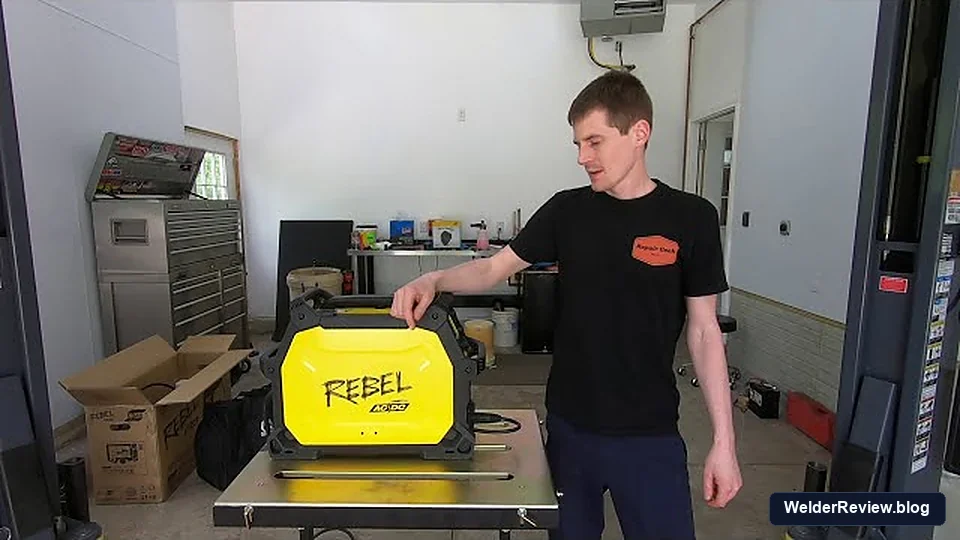
The ESAB model features a distinctive roll-cage framework designed to absorb harsh jobsite impacts. Meanwhile, the Miller competitor prioritizes a sleek, traditional steel cabinet that fits neatly on standard rolling carts.
Both machines use heavy-duty steel chassis designed for harsh job sites, but our esab rebel emp 215ic review highlights how the distinctive five-handle roll cage offers exceptional impact absorption and easy rigging across crowded fabrication shops.
The Miller Multimatic opts for a more traditional enclosed housing with a robust composite front bezel to shield controls from spatter, balancing portability with structural rigidity for mobile mechanical repair contractors and service trucks.
- Roll-cage protection guards vulnerable front-panel controls.
- Steel cabinetry provides excellent overall stationary rigidity.
- Integrated handles simplify transport across rugged terrain.
Chassis Protection and Portability
Heavy-duty composite roll bars shield the ESAB unit from falling debris and corner impacts. Field technicians frequently praise this robust protective exterior during demanding outdoor installation jobs.
The Miller unit relies on internal structural bulkheads to maintain rigidity without external bars. This results in a cleaner aesthetic suitable for clean fabrication environments.
- Composite corners absorb high-velocity lateral shocks.
- Internal steel frames prevent chassis twisting under stress.
Power Delivery and Arc Performance
Arc stability directly dictates weld bead profile consistency across various base materials. Analyzing voltage regulation reveals how each machine handles real-world electrical fluctuations during heavy fabrication tasks.
Power factor correction technology inside the unit, analyzed thoroughly in our esab rebel 215 review, ensures steady output during input sags, while the Miller alternative provides exceptional arc initiation specifically tuned for stainless steels.
Dual-voltage inverter architecture enables both units to automatically sense input power, transitioning smoothly between 120V and 240V circuits while maintaining a stable arc envelope during fluctuating utility loads on remote construction sites.
ESAB incorporates smart-MIG technology that rapidly adapts to user technique, whereas Miller utilizes Auto-Set Elite parameters to pre-program optimal voltage and wire feed speeds based on specific material thickness and joint configurations.
- PFC circuitry optimizes incoming power efficiency under load.
- Inverter architecture maintains constant voltage during drops.
- Smooth arc starts minimize spatter on thin steel plates.
Voltage Regulation Under Load
Maintaining arc length consistency is vital when running long extension cords on remote jobsites. Advanced inverter controls compensate instantly for minor voltage drops without sacrificing penetration depth.
Operators running high amperage settings will notice superior thermal management on the ESAB. This prevents premature thermal shutdown during extended structural welding operations.
- Fast response times eliminate electrode stubbing risks.
- Thermal overload protection prevents core component damage.
User Interface and Parameter Setup
Modern multi-process welders rely heavily on digital control panels to simplify complex parameter adjustments. Navigating these menus efficiently saves valuable production time in fast-paced fabrication environments.
The ESAB unit utilizes a large TFT display featured in our esab rebel emp 205ic ac dc review alongside smart technology that adapts to operator habits, while the Miller alternative implements a straightforward Auto-Set Elite menu.
Navigating the ESAB interface involves a large TFT display paired with a central control knob, delivering deep access to advanced wave controls and inductive tuning directly suited for precise short-circuit mig welding applications.
Miller employs a bright LCD screen accompanied by intuitive soft keys, streamlining setup procedures for apprentices while giving experienced welders precise control over pre-flow and post-flow timers during critical TIG welding operations.
- TFT color screens offer clear visibility in bright sunlight.
- Adaptive controls learn individual operator technique preferences.
- Simplified digital menus reduce operator training timelines significantly.
Digital Display Usability
Customizable screen layouts on the ESAB give users immediate access to advanced wave controls. This level of granular adjustment pleases seasoned fabricators seeking absolute puddle manipulation freedom.
Novice welders often prefer the intuitive nature of the Miller Auto-Set feature. Entering wire diameter and material thickness automatically locks in optimal parameters.
- High-contrast text remains legible through welding helmets.
- Preset libraries eliminate guesswork for common joint configurations.
Wire Feed Mechanisms and Drive Systems
Consistent wire delivery prevents bird-nesting and ensures stable MIG and flux-cored performance. Inspecting the internal drive roll assembly highlights mechanical differences between these two competitive systems.
A heavy-duty cast aluminum dual-drive mechanism anchors the ESAB wire feed compartment reliably. The Miller system utilizes a precision-machined cast-aluminum housing engineered for smooth, slip-free wire travel.
Reliable wire delivery starts with robust casting quality, and the Rebel utilizes a heavy-duty cast aluminum drive system featuring dual-driven rolls to minimize slip and ensure consistent feeding of soft aluminum wires.
The Multimatic features a dependable quick-change drive mechanism that requires no tools for roll swaps, effectively reducing downtime when alternating between solid carbon steel wires and flux-cored consumables in production environments.
- Dual-drive gearboxes pull long torch leads without hesitation.
- Quick-release tension arms simplify spool replacement procedures.
- Enclosed compartments keep abrasive grinding dust away.
Drive Roll Maintenance and Alignment
Routine maintenance requires easy access to drive rolls and inlet guides. Both units feature tool-less tension adjustments, reducing downtime during high-volume production welding shifts.
Precision alignment grooves on the Miller drive rolls accommodate specialized aluminum wire smoothly. This minimizes deformation and prevents frustrating burnbacks inside contact tips.
- Tool-less roll changes speed up multi-process transitions.
- Knurled drive rolls grip flux-cored wires securely.
Multi-Process Versatility: MIG, TIG, and Stick
True multi-process capability allows mobile technicians to tackle diverse repair tasks without swapping machines. Switching between MIG, TIG, and Stick modes should be seamless and mechanically reliable.
Both systems support standard MIG and DC TIG alongside robust stick welding, but our esab 215ic review notes how high-frequency arc starting features and lift-TIG integration vary noticeably across the platforms.
True multi-process capability requires dedicated internal circuitry, allowing operators to switch from gas metal arc welding to scratch-start TIG or shielded metal arc welding without compromising output stability or secondary arc characteristics.
Both systems handle cellulosic and low-hydrogen stick electrodes admirably, incorporating adjustable hot start and arc force controls to prevent electrode sticking and maintain puddle fluidity during out-of-position structural steel erection tasks.
- Dedicated gas solenoids manage shielding gases independently.
- Lift-TIG functionality prevents tungsten contamination effectively.
- Robust stick hot-start circuits ignite stubborn low-hydrogen rods.
TIG Welding Capabilities
Fine-tuning amperage delivery during DC TIG welding produces pristine stainless steel weld beads. The ESAB incorporates advanced pulse controls that assist fabricators managing heat input carefully.
Operators using the Miller platform benefit from smooth lift-arc ignition characteristics. This eliminates high-frequency interference issues around sensitive shop electronics and computers.
- Pulsed TIG parameters reduce thermal distortion significantly.
- Lift-arc technology protects tungsten tips from damage.
Duty Cycle and Thermal Performance
Heavy fabrication demands continuous output without forcing frequent cool-down thermal breaks. Reviewing official duty cycle ratings highlights which machine handles demanding production workloads better.
Running at higher amperages on a dual-voltage input reveals clear performance distinctions. The ESAB maintains superior duty cycle percentages, making it ideal for heavier structural steel fabrication.
Heavy thermal loads demand efficient internal cooling fans and oversized heatsinks, ensuring continuous operation at rated amperage without triggering thermal overload protection during production fillet welding on thick plate joints.
The duty cycle ratings on 240V input power comfortably support standard fabrication schedules, though operators must monitor amperage thresholds when pushing equipment toward its maximum output limit on extended structural runs.
- High duty cycles support continuous multi-pass welding runs.
- Internal cooling fans activate intelligently to expel heat.
- Thermal sensors protect transformers from catastrophic overload failures.
Sustained Output Under Pressure
Production welding requires pushing equipment near its maximum rated threshold safely. Efficient internal airflow design prevents hot spots from developing around critical transformer windings.
Operators tackling thick plate projects will appreciate the sustained output longevity. Choosing the right machine prevents frustrating delays caused by unexpected thermal shutdowns.
- Optimized airflow channels direct cooling over heat sinks.
- Continuous output ratings reflect genuine industrial capability.
Long-Term Reliability and Support
Investing in a premium welding machine requires reliable warranty backing and accessible replacement parts. Evaluating manufacturer support networks ensures minimal downtime throughout the equipment lifecycle.
Both brands offer comprehensive consumer protection plans and extensive service networks worldwide. Local distributor availability often dictates how quickly replacement consumables and specialized parts arrive.
Industrial equipment longevity depends heavily on robust warranty coverage and accessible replacement parts inventories, minimizing costly downtime for structural fabrication shops relying on consistent daily uptime across multiple shift rotations.
Comprehensive manufacturer support networks ensure authorized service centers can quickly diagnose electronic faults, protecting your initial capital investment in these advanced multi-process inverter welding systems over decades of service.
- Robust warranty coverage protects against manufacturing defects.
- Global service networks simplify calibration and repair logistics.
- Widely available consumables reduce ongoing operational overhead expenses.
Warranty and Distributor Network
Authorized service centers provide necessary electrical diagnostics and software firmware updates. Keeping firmware current ensures optimal arc behavior as new metallurgical techniques emerge.
Local welding supply stores stock standard contact tips and nozzles for both units. This immediate access prevents minor maintenance issues from halting critical shop operations.
- Factory-trained technicians ensure accurate diagnostic repairs.
- Readily available replacement parts minimize operational downtime.
Frequently Asked Questions
Can both welders operate safely on standard household 115V electrical circuits?
Yes, both machines feature dual-voltage inputs allowing operation on standard household outlets. However, maximum output amperage drops significantly when running on standard 115V power.
Which machine is better suited for welding thin automotive sheet metal?
Both units handle thin sheet metal exceptionally well using small wire diameters. The Miller Auto-Set feature makes dialing in parameters very straightforward for beginners.
Do these multi-process welders support spool guns for aluminum MIG welding?
Yes, both machines accept optional direct-connect spool guns for feeding soft aluminum wire. Utilizing a dedicated spool gun prevents frustrating feeding jams during fabrication.
What is the primary difference in their display interfaces during setup?
The ESAB uses a large adaptive TFT screen with advanced manual controls. Meanwhile, the Miller digital display prioritizes quick automated setup configurations for everyday users.
Are these welders heavy enough to require a dedicated rolling cart?
Neither machine is overly heavy, but lifting them onto tall benches is cumbersome. Placing them on a sturdy rolling cart improves shop mobility and organization.