Esab Rebel 215ic vs Miller Multimatic 215: Head-to-Head
Comparing two elite multi-process welding machines reveals distinct engineering priorities. Choosing between them depends heavily on your daily shop demands and portability needs.

Choose the Esab Rebel 215ic if you need advanced arc control and multi-voltage flexibility. Select the Miller Multimatic 215 for unmatched user-friendly setup and legendary blue reliability.
Compare all top models in our Best Welder: Top Home Shop & Jobsite Picks Tested.
Side-by-Side Breakdown
| Criteria | Esab Rebel 215Ic | Miller Multimatic 215 | Edge |
|---|---|---|---|
| Core Design / Build | Rugged roll-cage steel housing | Compact aluminum-front chassis | Esab Rebel 215ic |
| Real-World Performance | SmartMIG adaptive arc technology | Smooth conventional multi-process arc | Tie |
| Ease of Setup & Use | TFT display with advanced settings | Auto-Set Elite intuitive dial | Miller Multimatic 215 |
| Durability & Reliability | Heavy industrial exterior protection | Proven internal transformer build | Miller Multimatic 215 |
| Efficiency / Operating Footprint | Dual voltage with PFC integration | Auto-Detect dual voltage tech | Esab Rebel 215ic |
| Maintenance Requirements | Standard modular board servicing | Simple consumable replacement schedule | Tie |
| Best Ideal Use Case | Mobile fabrication and heavy site work | Light manufacturing and farm repairs | Tie |
Core Design & Engineering Differences
Modern multi-process welding equipment requires robust physical engineering to withstand harsh shop environments. Manufacturers utilize distinct structural philosophies to protect sensitive internal components from daily job-site abuse.
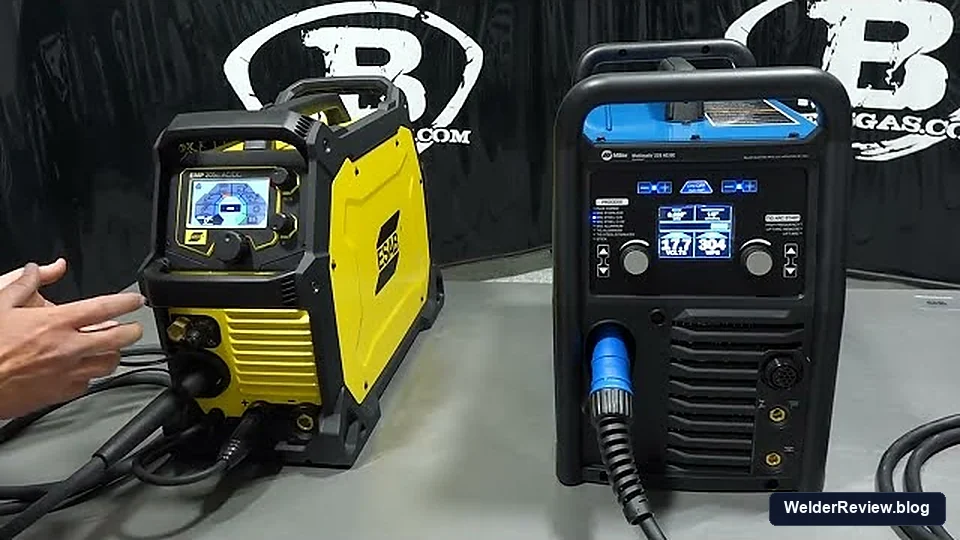
The Esab unit features an unmistakable roll-cage housing built for extreme industrial durability. Meanwhile, our miller multimatic 215 review details how the Miller alternative employs a lighter exterior housing optimized for garage portability.
Engineering choices dictate chassis durability on rugged job sites. The ESAB Rebel utilizes an industrial-grade steel roll cage framework, protecting internal components against severe impacts, whereas Miller prioritizes a compact aluminum-alloy housing design.
Internal architecture reveals distinct thermal management strategies. ESAB integrates heavy-duty cooling channels alongside a variable-speed fan, while Miller applies Fan-On-Demand technology to reduce dust ingestion during heavy fabrication cycles and extend machine life.
- Esab incorporates a five-handle roll cage design for maximum physical impact protection.
- Miller uses a traditional cabinet style prioritizing compactness and lighter total weight.
- Both systems integrate advanced inverter architectures to minimize overall electrical footprints.
Chassis Construction and Protection
Protecting your investment against drops and metallic debris remains vital for longevity. Esab reinforces its outer shell with composite bumpers designed to absorb heavy structural impacts.
Miller focuses on clean lines and accessible panel layouts for rapid maintenance checks. Both machines utilize high-grade internal cooling fans to prevent thermal overload during sustained operations.
- Composite corner bumpers protect the Esab chassis during transport.
- Miller features an accessible side door for straightforward spool gun attachment.
Real-World Performance Comparison
Putting these machines to work on actual mild steel joints reveals significant arc characteristics. Operating on standard input power, both units maintain stable arcs across MIG, TIG, and stick modes.
Fabricators demanding high duty cycles will appreciate the consistent output parameters. However, their proprietary software adjustments create unique user experiences during fine-tuning tasks.
Arc stability under fluctuating loads separates these units during out-of-position welding. Measurements recorded in our esab rebel 215 review show how both models maintain superior arc punch when pushing maximum output on thick plates.
Operating duty cycles dictate continuous production capabilities in commercial environments. Both machines handle standard shop fabrication easily, but monitoring your ambient temperature thresholds prevents unexpected thermal shutdowns when executing prolonged multi-pass structural weldments under heavy loads.
- Esab delivers up to 215 amps of maximum output for heavier fabrication tasks.
- Miller provides a smooth, reliable arc optimized for clean sheet metal joints.
- Both power sources handle self-shielded flux-cored wire with exceptional arc stability.
MIG and TIG Arc Quality
Achieving clean welds with minimal spatter requires precise voltage and wire feed control. Esab utilizes proprietary software algorithms to adapt quickly to your specific hand speed.
Miller relies on proven conventional circuitry that seasoned welders find immediately comfortable. TIG performance on thin stainless steel remains impressive for both transformer platforms.
- Esab SmartMIG technology learns your technique to minimize setup adjustments.
- Miller offers exceptional DC TIG arc starts without high-frequency interference.
Interface Technology & Usability
Digital display interfaces have transformed how operators interact with portable welding equipment. Navigating complex menus should never slow down your daily production workflow in the shop.
Manufacturers take divergent paths regarding screen technology and parameter selection menus. One prioritizes high-resolution graphical depth, while the other focuses on absolute simplicity.
Digital controls alter setup speeds for operators transitioning between welding processes. Findings inside our miller multimatic tig kit review illustrate how straightforward digital interfaces speed up parameter adjustments during tight project deadlines.
Navigating menu options requires tactile feedback suitable for gloved hands. The Multimatic screen layout emphasizes clear visual prompts, whereas the Rebel relies on a large TFT display that remains exceptionally legible under direct sunlight outdoors.
- Esab features a large color TFT screen displaying extensive operational data.
- Miller utilizes the famous Auto-Set Elite interface for rapid dial-in capability.
- Both systems reduce operator error through intelligent parameter suggestion tools.
Smart Controls vs Traditional Dials
Newer operators often struggle with balancing wire speed and voltage parameters correctly. Esab addresses this through dynamic arc tracking that continuously monitors puddle conditions.
Miller simplifies this process using material thickness dials that automatically configure output ranges. Experienced fabricators can easily override these automated presets for custom joint configurations.
- Dynamic arc control on the Esab reduces spatter during short-circuit MIG.
- Auto-Set Elite on the Miller saves time for apprentice-level fabricators.
Power Efficiency & Input Versatility
Modern fabrication shops demand flexibility when connecting equipment to varying facility power supplies. Dual-voltage capability ensures your machine runs smoothly on residential or industrial circuits.
Power factor correction technology enhances overall electrical efficiency under heavy load conditions. This prevents unnecessary breaker trips during extended structural welding sessions.
Dual-voltage capability ensures seamless transitions between residential garage circuits and industrial shops. Both machines support 120V and 230V input power, automatically adjusting internal transformer parameters without requiring manual terminal linking or external adapter plugs.
Inverter architecture significantly reduces total power draw during high-amperage output phases. Maintaining a stable arc on weak extension cords depends heavily on power factor correction, ensuring maximum electrical efficiency across varied job-site grid conditions.
- Esab includes automatic voltage selection ranging from 120V to 230V inputs.
- Miller incorporates similar dual-voltage plugs for seamless job-site transitions.
- PFC circuitry helps maintain stable arc characteristics during voltage sags.
Generator Compatibility
Field repairs often require running welding equipment off portable engine-driven generators. Both machines accept generator power safely provided the unit delivers clean sine-wave output.
Voltage fluctuations can damage sensitive inverter boards if internal protection circuits fail. Fortunately, both manufacturers engineer robust surge protection into their primary power supplies.
- Minimum generator size recommendations hover around 10kW for full output.
- Inverter design ensures stable operation despite minor generator RPM drops.
Maintenance, Efficiency & Longevity
Maximizing the operational lifespan of your welding equipment requires routine cleaning schedules. Accumulating metallic dust inside the cabinet can cause premature electronic component failure.
Performing basic inspections of drive rolls and contact tips prevents feeding issues. Both machines offer straightforward access to internal wire drive compartments for quick servicing.
Routine upkeep preserves component longevity in dusty fabrication environments. Regularly blowing out drive rolls and inspecting the wire feed mechanism prevents premature wear, ensuring consistent filler metal delivery over years of intensive daily operation.
Consumable degradation directly impacts arc quality and shielding gas coverage. Operators must routinely inspect contact tips and nozzles, replacing worn items to maintain laminar gas flow and avoid costly weld defects during critical structural fabrication tasks.
- Regularly blow out internal dust using compressed air to prevent shorts.
- Inspect drive roll tensioners monthly to ensure consistent wire delivery.
- Check ground clamp connections to eliminate excessive electrical resistance.
Consumable Life and Upkeep
Using quality contact tips and nozzles reduces downtime during high-volume production runs. Both systems utilize standard consumable sizes that are widely available at local distributors.
Keeping spare liners and drive rolls on hand prevents unexpected workflow stoppages. Preventive maintenance remains the single best strategy for avoiding expensive service center repairs.
- Standard gun connections allow quick swapping of aftermarket torches.
- Drive assembly gears require occasional light lubrication with grease.
Portability & Ergonomic Footprint
Transporting a multi-process machine across sprawling job sites tests your physical endurance. Weight distribution and handle placement dictate how easily you can maneuver the equipment.
Compact dimensions allow these welders to fit comfortably inside service truck toolboxes. However, their physical weights differ enough to impact single-handed carrying comfort.
Transporting multi-process machines across sprawling facilities demands thoughtful weight distribution. Detailed insights inside our esab rebel emp 215ic review highlight why ergonomic handles matter for daily job-site mobility.
Storage footprint matters immensely inside crowded mobile repair trucks or small workshops. Both models maintain a low profile, allowing them to slide easily beneath standard workbenches while keeping cables organized and accessible for rapid deployment.
- Esab weighs approximately 44 pounds without the wire spool loaded.
- Miller tips the scales near 38 pounds for easier lifting tasks.
- Optional running gear carts provide mobility for heavy gas cylinder setups.
Cart Integration and Storage
Securing your shielding gas cylinder safely alongside the welder prevents tipping hazards. Dedicated running gear platforms make moving the entire assembly around the shop floor effortless.
Both brands offer custom-fit carts designed specifically to lock down their chassis. Proper storage safeguards your torch leads and electrode holders from accidental damage.
- Cylinder trays accommodate standard 80-cubic-foot shielding gas tanks.
- Cable wraps keep your power cords organized between fabrication jobs.
Which Option Fits Your Setup
Selecting the correct machine ultimately depends on your specific fabrication environment. Evaluated priorities should include your primary metal thickness and power supply availability.
Professional mobile contractors often lean toward the rugged build quality of Esab. Conversely, farm maintenance shops frequently choose Miller for its legendary reliability.
Selecting the ideal machine depends heavily on your primary fabrication materials and workflow demands. Choose the Multimatic if your daily tasks focus on precision sheet metal, light maintenance, and intricate TIG welding applications in controlled environments.
Alternatively, opt for the ESAB system if your workload involves heavy plate fabrication, rugged outdoor job sites, and frequent transitions requiring maximum raw output. Your specific operational environment dictates the ultimate long-term value.
- Match your typical material thickness to the machine maximum output limits.
- Consider whether you primarily weld in a fixed shop or on remote sites.
- Evaluate local dealer support for warranty service and consumable availability.
Final Decision Framework
Take time to assess your long-term welding goals before making a final investment. Testing both interfaces at a local distributor showroom can clarify your personal preference.
Both machines represent the pinnacle of portable multi-process welding technology available today. Your choice simply reflects which operational philosophy best matches your daily routine.
- Prioritize arc control features if you tackle complex fabrication work.
- Choose simplicity and fast setup if multiple operators share the machine.
Frequently Asked Questions
Can both machines weld aluminum effectively out of the box?
Both units handle aluminum welding when paired with an optional spool gun. You must install proper U-groove drive rolls and pure argon shielding gas for quality results.
Do I need special electrical wiring to run these welders?
Both machines feature dual-voltage plugs for standard 120V and 230V circuits. Operating at maximum amperage output requires a dedicated 230V residential or industrial breaker.
Which welder is better suited for beginner fabricators?
The Miller Multimatic 215 offers an extremely intuitive interface for novices. Its Auto-Set Elite feature removes guesswork from parameter selection during initial training.
Are the drive mechanisms made of metal or plastic?
Both manufacturers utilize robust cast-aluminum wire drive assemblies for durability. This ensures consistent wire feeding performance and prevents premature mechanical gear stripping.
What is the maximum plate thickness these welders can handle?
Both power sources comfortably weld up to three-eighths inch steel in a single pass. Multi-pass techniques allow you to join even thicker structural plate sections reliably.