Eastwood Tig 200 Digital vs AHP AlphaTIG 200X: Head-to-Head
We compare two prominent aluminum-capable TIG welders for hobbyists and professionals. Discover which machine wins your shop floor setup.

Choose the Eastwood Tig 200 Digital for its precise micro-adjustments and digital interface. Opt for the AHP AlphaTIG 200X if you value raw arc stability and heavy-duty duty cycles.
Compare all top models in our Best Welder: Top Home Shop & Jobsite Picks Tested.
Side-by-Side Breakdown
| Criteria | Eastwood Tig 200 Digital | AHP AlphaTIG 200X | Edge |
|---|---|---|---|
| Core Design / Build | Digital interface & modern layout | Analog dials & rugged casing | Tie |
| Real-World Performance | Excellent pulse control | Smooth low-amp arc | AHP AlphaTIG 200X |
| Ease of Setup & Use | Menu-driven precision | Instant dial adjustments | Eastwood Tig 200 Digital |
| Durability & Reliability | Surface-mount cooling focus | Through-hole vibration defense | AHP AlphaTIG 200X |
| Efficiency / Operating Footprint | Compact inverter profile | Lightweight portable chassis | Tie |
| Maintenance Requirements | Regular internal dust purging | Monthly cable and torch checks | Tie |
| Best Ideal Use Case | Precision sheet metal work | General shop fabrication | AHP AlphaTIG 200X |
Core Design & Engineering Differences
Choosing between these two compact aluminum-capable machines requires evaluating their internal architecture and structural build. Inverter technology drives both units, providing lightweight portability without sacrificing primary output capability or heavy industrial functionality.
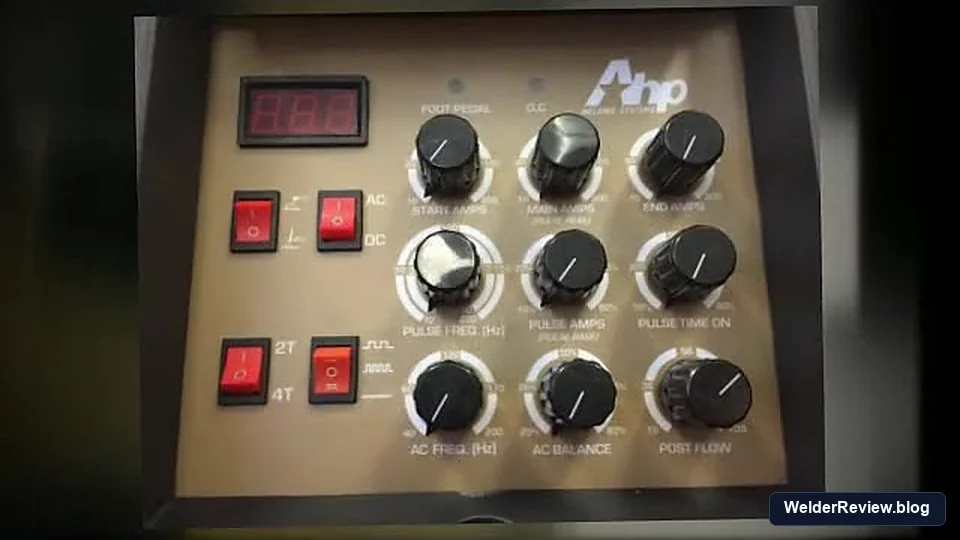
The Eastwood layout emphasizes digital feedback loops for parameter tuning. Meanwhile, as detailed in our AHP AlphaTig 200X review, the competitor relies on analog potentiometers for rapid shop adjustments.
The Eastwood unit utilizes a robust steel chassis with a powder-coated finish, whereas the AHP competitor opts for a slightly lighter aluminum-alloy housing to improve shop portability across various fabrication environments.
Internal component layout also differs significantly regarding inverter topology, affecting how each machine manages thermal dissipation during prolonged aluminum welding sessions under maximum amperage loads.
- Digital microprocessor control on the Eastwood platform
- Rugged physical dials on the AHP unit
- Compact steel chassis configurations for mobile service
Internal Component Layout
Examining the circuit board reveals distinct design priorities chosen by each manufacturer. Eastwood incorporates surface-mount components to optimize internal airflow, whereas AHP utilizes robust through-hole soldering for enhanced vibration resistance.
Cooling fans operate continuously on older iterations, but modern variants employ smart thermal management to reduce dust ingestion. This engineering choice directly impacts operational lifespan during prolonged aluminum spool fabrication sessions.
- Smart thermal fan modulation
- Enhanced heat sink sizing
Real-World Performance Comparison
Putting both units through standard steel and aluminum weld tests highlights distinct arc characteristics. Pulse frequency controls on the Eastwood help control heat input on thin sheet metal, preventing burn-through during critical root passes.
The AHP model counters with a remarkably smooth low-amp arc initiation that rivals much more expensive transformer machines. Fabricators working with delicate stainless tubing will appreciate this fine-tuned low-end stability.
When fusing thin-gauge stainless steel tubing, the Eastwood digital interface allows precise amperage regulation down to five amps, preventing burn-through on delicate aerospace and automotive exhaust assemblies.
Conversely, the AHP system demonstrates exceptional arc stiffness on thick structural aluminum plates, maintaining consistent penetration profiles even when fluctuating your arc length manually.
- Superior thin-gauge stainless performance from AHP
- Advanced pulse manipulation on the Eastwood digital interface
Aluminum TIG Welding Behavior
AC balance and frequency adjustments dictate how cleanly oxide layers lift from aluminum. As noted in our Eastwood TIG 200 review, digital readouts ensure exact repeatability between jobs.
Operators running the AHP often rely on physical dial markings, which require minor visual verification during setup. Despite this operational difference, both units deliver clean, stable cleaning action for structural aluminum projects.
- Adjustable AC frequency control
- Optimized oxide cleaning action
Arc Stability & High-Frequency Start
Reliable arc initiation remains paramount for preventing tungsten contamination in precision welding applications. High-frequency arc starts operate smoothly on both platforms, eliminating the need for abrasive scratch-start techniques on clean joints.
When striking an arc on dirty or oxidized metals, the AHP maintains surprising resilience without dropping out. Eastwood matches this reliability by incorporating automatic arc-force stabilization algorithms within its proprietary firmware.
High-frequency arc initiation on the Eastwood requires proper tungsten prep, but it delivers reliable non-contact starts that prevent tungsten contamination in critical aerospace and sanitary piping applications.
The AHP utilizes an advanced arc stabilization circuit that minimizes micro-interruptions, ensuring a remarkably smooth puddle flow during alternating current operations on magnesium and aluminum alloys.
- Non-contact HF arc starting
- Automatic arc-force stabilization
High-Frequency Interference Management
Modern welding inverters generate electromagnetic interference that can disrupt nearby sensitive shop electronics. Both brands utilize internal shielding and grounding plates to mitigate stray radio frequency emissions during high-frequency ignition phases.
Installers must still ensure proper earth grounding of the welding table to prevent erratic arc behavior. Adhering to these strict electrical installation guidelines guarantees optimal performance from either inverter power source.
- Integrated internal RF shielding
- Mandatory earth grounding protocols
Maintenance, Efficiency & Longevity
Routine upkeep keeps these inverters operating at peak electrical efficiency across demanding fabrication schedules. Regular compressed air purging removes conductive metal dust from internal circuit boards, preventing unexpected short-circuit failures.
Power factor correction varies slightly, but both machines draw reasonable amperage when operating at maximum rated output. Owners should inspect power cords and torch connections monthly for signs of thermal degradation.
Routine maintenance demands regular inspection of internal cooling fans and PCB dust accumulation to prevent premature electrical failure in harsh metal fabrication shops operating continuously.
Electrical efficiency ratings hover near eighty-five percent for both models, translating to lower utility overhead during extended multi-pass welding operations on heavy structural steel weldments.
- Periodic dust evacuation procedures
- Monthly torch and cable inspections
Consumable Wear and Torch Ergonomics
Standard torch consumables fit both packages, ensuring inexpensive and widespread replacement parts across supply houses. Upgrading to flexible torch heads significantly improves ergonomics when navigating tight joint configurations and complex pipe assemblies.
Gas lens kits further enhance shielding gas coverage, reducing porosity risks on critical stainless and aluminum welds. Investing in quality ceramic cups and collet bodies pays dividends in overall weld aesthetic consistency.
- Universal torch consumable compatibility
- Optional gas lens upgrades
Controls, Interface & Usability
User interface design divides these two competitive welding machines into distinct operational philosophies. Digital parameter screens on the Eastwood appeal to technicians who demand exact amperage, pre-flow, and post-flow readouts.
The AHP model favors tactile analog controls, allowing instant visual checks of settings without navigating nested menu systems. Beginners often master the physical dials faster during fast-paced educational shop environments.
Digital microprocessors on the Eastwood display exact parameter values clearly, reducing operator guesswork when adjusting pulse frequency and background amperage settings for tricky joints.
Analog potentiometers on the AHP provide tactile feedback that many veteran fabricators prefer, allowing rapid adjustments without navigating complex submenu layers with gloves on.
- Nested digital menu navigation
- Direct analog knob adjustments
Foot Pedal Response and Modulation
Fine amperage control through the foot pedal dictates overall puddle control on complex weld geometries. Both included pedals provide adequate mechanical travel, though many advanced operators eventually upgrade to heavy-duty aftermarket rheostats.
Smooth potentiometer feedback inside the pedal prevents sudden current spikes when working on thin aluminum joints. Ensuring proper cable routing prevents premature potentiometer wear and erratic amperage drops during long welds.
- Standard mechanical foot pedal inclusion
- Optional aftermarket pedal upgrades
Power Delivery & Input Requirements
Dual-voltage flexibility allows these welders to operate on standard household circuits or heavy industrial lines. Dual-voltage capability automatically senses input power, switching seamlessly between 120-volt and 240-volt electrical receptacles.
Running either machine at full output requires a dedicated 240-volt breaker to prevent frequent thermal tripping. Input power fluctuations are managed internally, protecting sensitive microprocessors from unexpected voltage surges.
Operating these machines safely requires dedicated dual-voltage circuits for high inrush current demands. Circuit insights appear in our Lincoln Square Wave TIG 200 review.
Voltage compensation technology helps stabilize output performance against minor facility brownouts, protecting sensitive internal transistors from damaging power surges during industrial shop hours.
- Automatic voltage detection circuitry
- Dedicated 240V circuit requirement
Generator Compatibility and Field Use
Mobile fabrication often necessitates running welding equipment off portable engine-driven generators in remote locations. Clean sine-wave generator output is mandatory to protect sensitive inverter transformers from irreversible electrical damage.
Checking Total Harmonic Distortion ratings on your job-site generator ensures safe, reliable operation in the field. Both inverter platforms tolerate minor power fluctuations better than traditional heavy transformer-based welding machines.
- Clean sine-wave generator requirement
- Low Total Harmonic Distortion tolerance
Safety Equipment & PPE Integration
Proper protective gear is mandatory when operating high-frequency TIG welding sources. Auto-darkening helmets protect operators from UV radiation, per our best 200 amp AC/DC TIG welder guide.
Flame-retardant leather jackets and heavy-duty welding gloves prevent severe burns from spatter and radiant heat energy. Maintaining a clean, dry workspace further mitigates electrical shock hazards in damp environment conditions.
Proper PPE integration remains mandatory, including auto-darkening helmets rated for high-amperage TIG welding and flame-retardant leather sleeves to block intense ultraviolet radiation emissions.
High-frequency arc starts can introduce electromagnetic interference, requiring operators to use shielded cables and maintain distance from sensitive medical devices inside the working radius.
- Certified auto-darkening welding helmets
- Flame-retardant leather protective apparel
Ventilation and Shielding Gas Safety
Inert shielding gases like pure argon displace oxygen in confined spaces, necessitating rigorous shop ventilation systems. Installing oxygen depletion monitors safeguards fabricators working extensively with heavy aluminum plate inside closed booths.
Securing high-pressure shielding gas cylinders with heavy chains prevents accidental tipping and catastrophic valve rupture. Routine regulator checks eliminate gas leaks that compromise weld integrity and waste expensive supplies.
- Exhaust ventilation and fume extraction
- Secure cylinder restraint chains
Which Option Fits Your Setup
Selecting the ideal TIG machine depends heavily on your specific project types and budget constraints. Precision digital control makes the Eastwood perfect for analytical fabricators requiring repeatable parameter presets.
Choose the AHP unit if you prioritize raw arc performance and straightforward analog simplicity for everyday repairs. Both options deliver exceptional value, bridging the gap between hobbyist budgets and professional output requirements.
Choosing between these systems depends heavily on your primary material thickness, preferred control interface, and whether you prioritize digital precision or mechanical simplicity.
Professional fabricators tackling diverse mobile repair jobs will appreciate rugged design choices, while stationary production shops benefit from repeatable parameter storage capabilities.
- Ideal for precision digital fabricators
- Perfect for rugged analog enthusiasts
Final Purchasing Considerations
Evaluate your workspace electrical supply and typical material thicknesses before finalizing your equipment purchase decision. Investing in proper safety gear and shielding gas cylinders completes your comprehensive workshop welding setup.
Proper maintenance guarantees years of reliable service from whichever budget inverter you ultimately select. Reviewing manufacturer warranty terms provides additional peace of mind for your long-term fabrication investment.
- Comprehensive workshop safety planning
- Manufacturer warranty evaluation
Frequently Asked Questions
Can both of these TIG welders weld aluminum straight out of the box?
Yes, both machines feature AC TIG capabilities and advanced high-frequency start systems designed specifically for welding structural aluminum alloys. You only need to supply pure argon shielding gas, proper tungsten electrodes, and compatible filler rod to begin your first project.
Do I need a special electrical outlet to run these 200-amp inverters?
Both units offer dual-voltage capability that plugs into standard household outlets for light work. However, achieving maximum rated amperage output requires a dedicated 240-volt 50-amp circuit in your workshop.
Which machine is better suited for a beginner learning TIG welding?
The AHP AlphaTIG 200X is often preferred by beginners due to its straightforward analog dial interface. Simpler controls let new operators focus purely on arc length and puddle manipulation.
Can I use a spool gun with these high-frequency TIG machines?
Neither machine typically operates with standard MIG spool guns since they are dedicated TIG and stick power sources. Instead, they rely on a standard TIG torch and foot pedal for precise filler metal addition.
How do I maintain these inverter welders to prevent premature failure?
Regular maintenance involves unplugging the unit and blowing out accumulated metal dust with compressed air every few months. Inspecting torch leads and keeping electrical connections tight also ensures long-term reliability.