Eastwood MP250i vs Miller: Core Technical Showdown
Comparing the Eastwood MP250i against industrial Miller multi-process systems reveals stark differences in duty cycle and arc stability. Choosing the right machine demands careful evaluation of your input power requirements.

Pick the Eastwood MP250i for budget-conscious multi-process versatility in light fabrication shops. Choose Miller equipment for uncompromising industrial durability and high-duty-cycle production environments.
Compare all top models in our Best Welder: Top Home Shop & Jobsite Picks Tested.
Side-by-Side Breakdown
| Criteria | Eastwood MP250i | Miller | Edge |
|---|---|---|---|
| Core Design / Build | Sheet metal chassis with hybrid architecture | Heavy-gauge steel frame with conformal coating | Miller |
| Real-World Performance | Solid MIG, TIG, and stick output up to 250A | Proprietary waveform control and Auto-Set technology | Miller |
| Ease of Setup & Use | Analog adjustment knobs with digital display | Advanced digital menus with parameter locking | Miller |
| Durability & Reliability | Optimized for hobbyists and light mobile repairs | Built for continuous three-shift industrial fabrication | Miller |
| Efficiency / Operating Footprint | Dual voltage capability with moderate power draw | Advanced inverter topology minimizing idle current | Miller |
| Maintenance Requirements | Standard internal cleaning and liner replacements | Modular circuit boards with self-diagnostics | Miller |
| Best Ideal Use Case | Restoration shops and independent home fabricators | Heavy manufacturing and structural construction sites | Miller |
Core Architecture and Structural Engineering
Evaluating the structural design of welding machines requires examining internal components, chassis materials, and cooling architectures. The Eastwood MP250i utilizes a robust sheet metal housing tailored for static shop environments.
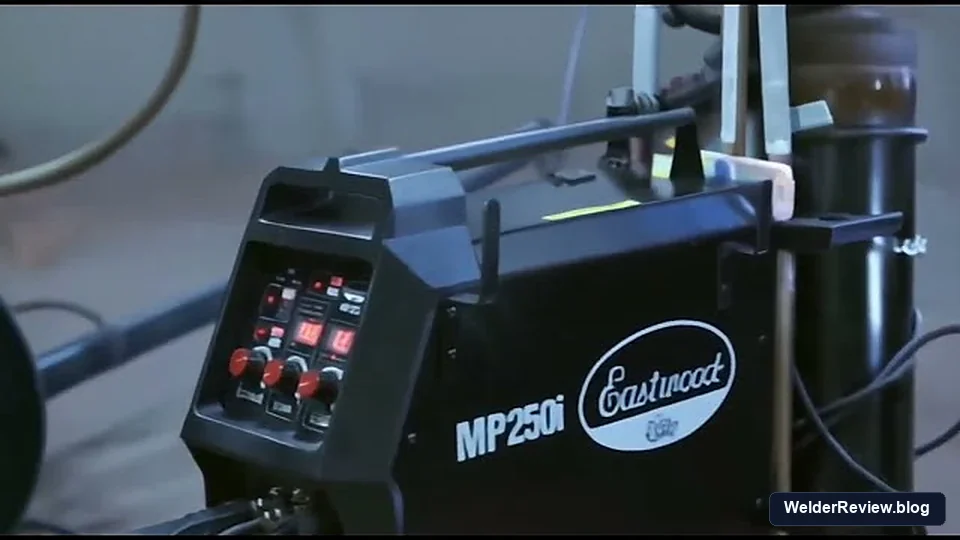
Industrial Miller systems incorporate heavy-gauge steel frameworks designed to endure severe jobsite abuse. We explore similar robust construction standards in our comprehensive Miller 215 welder review for garage fabricators.
The Eastwood chassis relies on heavy stamped steel panels reinforced with internal gussets to protect the wire drive assembly. Meanwhile, Miller utilizes heavy-gauge aluminum framing components designed to minimize overall weight while maximizing structural rigidity.
Internal component layout dictates airflow paths and cooling efficiency across both units. Proper sealing around the transformer windings prevents conductive debris accumulation, adhering to strict NEMA enclosure standards for industrial workshop longevity.
- Heavy-gauge steel versus standard sheet metal
- Conformal coating on industrial Miller control boards
- Chassis weight and mobile footprint differences
Internal Component Layout
Component placement directly impacts cooling efficiency and long-term hardware longevity. Miller isolates high-voltage transformers from digital control panels to minimize electromagnetic interference during high-amperage welds.
The Eastwood layout provides straightforward access to internal wire feed mechanisms, making routine maintenance simple for independent operators working in smaller garage footprints.
- Isolated transformer design in Miller units
- Accessible wire drive systems on Eastwood
Multi-Process Versatility and Arc Characteristics
Multi-process machines must deliver consistent voltage and current across modes. To compare smaller platforms, examine findings from our Eastwood MIG 180 review before selecting your equipment.
Miller engineers proprietary waveform control technologies that automatically adapt to arc length variations. This results in ultra-smooth puddle manipulation and significantly reduced spatter during short-circuit MIG welding operations.
When running MIG processes, stable arc initiation requires precise voltage regulation. The Eastwood machine delivers smooth short-circuit transfers, while the Miller alternative incorporates adaptive control algorithms to automatically smooth out arc voltage fluctuations.
TIG welding performance depends heavily on high-frequency arc starting reliability and precise gas pre-flow timing. Operators switching to stick welding will appreciate superior hot start parameters that prevent electrode sticking on oxidized base metals.
- Consistent voltage across multiple welding processes
- Proprietary Miller waveform control systems
- Flexible output ranges for restoration work
Arc Initiation and Stability
Reliable arc ignition prevents frustrating tungsten contamination during high-frequency TIG welding sequences. Miller integrates advanced start parameters that outperform budget alternatives when striking an arc on cold base metals.
Operators using the Eastwood platform find the manual inductance controls helpful for tailoring puddle wetting action. Balancing arc stiffness enhances bead profile consistency across different joint configurations.
- High-frequency TIG arc ignition quality
- Manual inductance controls on Eastwood
Duty Cycle Realities and Thermal Management
Thermal overload protection prevents premature transformer failure during prolonged heavy fabrication runs. High-output performance benchmarks are analyzed further within our Miller Diversion 180 review focusing on duty cycles.
The Eastwood unit delivers respectable performance for intermittent hobbyist welding projects in home shops. However, pushing the machine near its upper limit requires monitoring operational run times carefully.
Thermal management directly limits continuous runtime during heavy structural fabrication projects. Advanced inverter designs utilize proportional cooling fans that activate only under significant thermal loads, maintaining optimal semiconductor operating temperatures throughout grueling industrial duty cycles.
Exceeding rated amperage outputs will trip internal thermal overload protection circuits immediately. Operators must monitor ambient shop temperatures because excessive heat buildup reduces overall transformer efficiency and accelerates premature wear on internal rectifying diodes.
- Thermal overload protection mechanisms
- High percentage duty cycles at max amperage
- Intermittent run time limits for hobbyists
Cooling Fan Dynamics
Variable speed cooling fans draw ambient air through internal heat sinks only when necessary. This intelligent airflow design reduces dust accumulation inside the primary power compartment over extended service periods.
Maintaining clear clearance around cabinet ventilation louvers prevents localized overheating during strenuous structural steel fabrication tasks. Proper shop placement maximizes the thermal efficiency of both machine classes.
- Variable speed internal cooling fans
- Ventilation clearance requirements
Interface Ergonomics and Digital Controls
User interface design dictates how quickly operators can dial in optimal wire feed speeds and voltages. Miller features advanced digital menus with pre-programmed material thickness parameters to streamline setup.
Eastwood utilizes a straightforward combination of digital readouts and analog adjustment knobs for quick parameter changes. This tactile approach appeals to traditional welders who prefer physical feedback over menus.
Front panel layout influences everyday workflow efficiency inside busy fabrication facilities. Digital encoder knobs provide tactile feedback, allowing operators to dial in precise wire feed speeds while wearing heavy welding safety gloves under harsh shop lighting.
Menu navigation requires intuitive software architecture to minimize setup time between material changes. High-resolution digital displays clearly present stored user presets, ensuring repeatable parameter recall for certified structural welding tasks requiring strict quality assurance documentation.
- Advanced digital menus with preset thicknesses
- Tactile analog knobs and digital readouts
- Streamlined parameter setup procedures
Parameter Locking and Preset Memory
Production environments demand strict adherence to approved welding procedure specifications across multiple shifts. Miller platforms allow supervisors to lock user interfaces, preventing unauthorized adjustments to critical amperage settings.
Independent operators benefit from intuitive menu structures found on modern multi-process welding machines. As detailed in our Eastwood MP200I review, preset storage options save valuable fabrication time.
- Supervisor interface locking features
- Quick preset storage for production runs
Power Efficiency and Utility Requirements
Modern inverter technology reduces overall electrical consumption compared to older transformer-based welding systems. Both machines operate efficiently on standard single-phase input power lines found in typical commercial buildings.
Harmonic distortion and power factor correction circuits ensure compliance with strict electrical grid standards. Industrial Miller units excel in minimizing idle power draw during periods of non-welding activity.
Electrical infrastructure demands careful planning before connecting high-output multi-process welders. Dual-voltage input capabilities allow seamless transitions between standard household circuits and heavy-duty industrial power sources, minimizing downtime across various job site locations.
Power factor correction circuitry reduces total harmonic distortion drawn from standard wall receptacles. This technical advantage ensures maximum energy conversion efficiency, protecting upstream electrical panels from excessive current spikes during demanding arc ignition sequences.
- Inverter technology for lower energy consumption
- Single-phase input power compatibility
- Power factor correction circuitry
Dual Voltage Operation
Seamlessly switching between input voltages allows mobile repair technicians to operate across diverse job locations. The Eastwood unit includes versatile adapter pigtails for quick connection to standard receptacles.
Verifying proper circuit breaker sizing prevents nuisance tripping during high-amperage structural steel welding operations. Adequate primary wire gauge ensures optimal arc performance under heavy electrical loads.
- Mobile dual-voltage connection adapters
- Circuit breaker sizing and primary wire gauge
Maintenance Protocols and Long-Term Reliability
Routine preventative maintenance extends the operational lifespan of complex welding equipment significantly. Operators should regularly inspect drive rolls, contact tips, and shielding gas hoses for signs of wear.
Miller simplifies troubleshooting through integrated self-diagnostic error codes displayed directly on the front panel. This capability minimizes equipment downtime by pinpointing exact internal faults for service technicians.
Routine maintenance routines extend equipment lifespan significantly in high-debris fabrication environments. Technicians must regularly inspect drive roll tensioners and clear accumulated metal dust from internal cooling fans using dry compressed air under controlled pressure limits.
Preventative checks on internal wiring harnesses prevent unexpected electrical shorts during critical projects. Following manufacturer service intervals guarantees compliance with major safety compliance standards, ensuring reliable arc performance throughout years of heavy workshop usage.
- Preventative maintenance inspection schedules
- Integrated self-diagnostic error code displays
- Minimizing downtime with fault pinpointing
Consumable Availability and Replacement
Standardizing consumable sizes across your welding fleet reduces inventory costs and supply chain delays. Both brands utilize widely available MIG gun consumables compatible with standard industry parts suppliers.
Keeping wire feed mechanisms clean prevents erratic wire delivery and porosity issues in finished welds. Professional maintenance schedules ensure reliable performance throughout years of demanding fabrication service.
- Standardized MIG gun consumable parts
- Wire feed mechanism cleaning protocols
Frequently Asked Questions
Can the Eastwood MP250i run on standard household electrical circuits?
The machine requires a dedicated 240-volt input to achieve its maximum output capacity. Standard 120-volt circuits cannot supply enough current for heavy welding tasks.
Why do Miller welders cost significantly more than Eastwood alternatives?
Miller invests heavily in proprietary inverter topologies and industrial-grade component testing. Industrial build quality ensures continuous duty cycles required for heavy manufacturing environments.
Which machine is better suited for an automotive restoration hobbyist?
The Eastwood MP250i provides exceptional value and versatile multi-process capabilities for garage fabricators. Affordable performance makes it ideal for sheet metal repair and chassis work.
How do duty cycles differ between these two welding equipment brands?
Industrial Miller models maintain higher amperage output percentages before triggering thermal overload protection. Continuous operation capability separates commercial systems from hobbyist machines.
Are consumable parts easily interchangeable between these multi-process systems?
Both brands utilize standard gun components that match common industry replacement parts easily. Readily available consumables reduce ongoing operational downtime for your shop.