6010 vs 6013 Welding Rod: Technical Breakdown
Choosing the right electrode dictates bead profile and penetration. Master these two AWS classifications for superior structural joints.

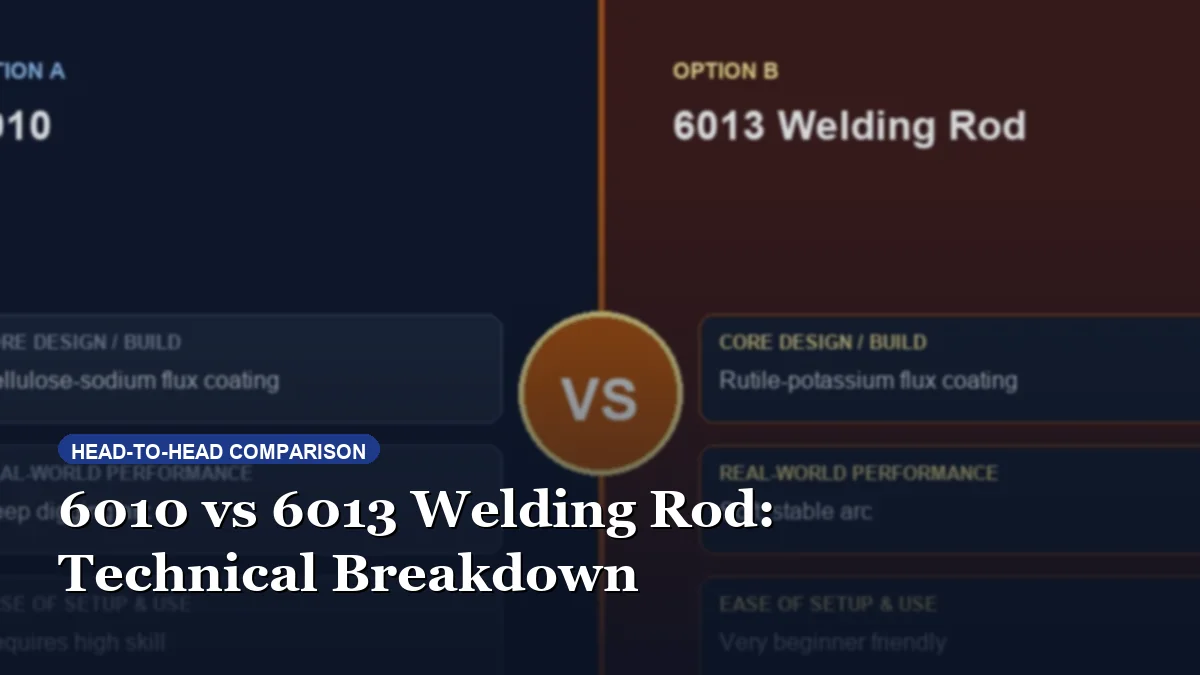
Choose 6010 for deep penetration on dirty steel, but select 6013 for smooth, aesthetic welds on clean sheet metal.
Compare all top models in our Best Welder: Top Home Shop & Jobsite Picks Tested.
Side-by-Side Breakdown
| Criteria | 6010 | 6013 Welding Rod | Edge |
|---|---|---|---|
| Core Design / Build | Cellulose-sodium flux coating | Rutile-potassium flux coating | Depends on joint |
| Real-World Performance | Deep digging arc | Soft, stable arc | 6010 for strength |
| Ease of Setup & Use | Requires high skill | Very beginner friendly | 6013 |
| Durability & Reliability | Exceptional root pass integrity | Solid fillet weld quality | Tie |
| Efficiency / Operating Footprint | High spatter, fast freeze | Low spatter, smooth puddle | 6013 |
| Maintenance Requirements | Requires moisture retention | Standard dry storage | 6013 |
| Best Ideal Use Case | Pipe welding and repairs | Sheet metal and fabrication | Application specific |
Core Design and Engineering Differences
Understanding metallurgical design helps welders select appropriate electrodes. The 6010 electrode features a heavy cellulosic sodium coating designed for aggressive arc digging.

Conversely, the 6013 variant incorporates a rutile potassium coating. This specific chemical formulation ensures extremely smooth arc ignition and stable operational parameters.
You can master these classifications by reviewing our guide on how to read stick welding rod numbers. Understanding the prefix digits ensures proper electrode selection for every structural application.
Conversely, the EXX13 electrode features a rutile-potassium flux formulation. This chemistry stabilizes the arc for exceptionally smooth deposition, making it ideal for thin sheet metal fabrication where high heat input causes destructive burn-through.
- Cellulose sodium provides forceful gas shielding.
- Rutile potassium promotes stable AC or DC operation.
- Tensile strength ratings remain identical at sixty thousand psi.
Coating Chemistry and Flux Dynamics
Flux composition dictates how the molten puddle behaves during freezing. Cellulose coatings produce minimal slag, allowing operators to manipulate the puddle easily.
Rutile coatings create a heavy, self-peeling slag layer. This protects the cooling metal while delivering an exceptionally smooth finished weld bead surface.
- Cellulose moisture requirements demand careful rod storage.
- Rutile potassium handles lower open circuit voltage machines.
Real-World Performance and Penetration Dynamics
Penetration depth separates these two popular electrodes significantly. When setting up your shop with the best starter welding machine, matching your power output to the correct rod type is essential.
On thin sheet metal, however, that aggressive digging action causes severe burn-through issues. The alternative option prevents this by providing a much softer puddle.
When joining heavy structural plates, the aggressive digging action of 6010 cuts effortlessly through mill scale and rust. Welders rely on this deep fusion capability to pass rigorous radiographic testing on critical pipe and pressure vessel joints.
Operating 6013 yields a much softer arc with shallow penetration profiles. This controlled puddle is specifically engineered for fillet welds on clean carbon steels, minimizing distortion and eliminating the risk of punching holes through thin automotive brackets.
- Deep penetration ensures structural integrity on root passes.
- Shallow penetration protects thin gauge material integrity.
- Arc force adjustments change how each rod performs.
Evaluating Joint Penetration Profiles
Structural pipe welding demands the aggressive arc characteristics of cellulosic electrodes. They bite deeply into joint margins to guarantee complete fusion.
General fabrication tasks benefit from smooth rutile puddles. Operators avoid distortion and excessive cleanup when working on lighter assembly projects.
- Root gap tolerance improves with cellulosic arc force.
- Fillet weld symmetry excels with rutile formulations.
Arc Stability and Power Source Compatibility
Machine requirements dictate which electrode you can successfully run. Choosing the best welding machine for beginners ensures you have adequate amperage adjustment for both cellulosic and rutile coated options.
Modern rutile electrodes offer superior versatility across various power sources. They run exceptionally well on both direct current and alternating current welding machines.
Successful execution with 6010 demands a constant current DC power source featuring high open-circuit voltage. Modern inverter machines must offer dedicated cellulosic settings to maintain arc rigidity during rapid manual whip-and-pause manipulation techniques.
The 6013 electrode exhibits remarkable versatility regarding power source selection, operating smoothly on both AC and DCEN polarities. Transformer-based buzz boxes easily sustain its stable arc, making it a favorite for farm repair shops and mobile service trucks.
- Direct current reverse polarity maximizes arc digging force.
- Alternating current compatibility assists budget machine users.
- Open circuit voltage limits apply to certain cellulosic rods.
Machine Settings and Voltage Demands
Running cellulosic consumables requires a power source with high voltage output. Older engine-driven welders pair perfectly with these aggressive digging electrodes.
Smaller transformer welders perform best with rutile alternatives. Their stable arc characteristics compensate for lower open circuit voltage constraints easily.
- Amperage ranges must match electrode diameters strictly.
- Arc voltage fluctuations affect bead deposition consistency.
Slag Control, Cleanup, and Bead Aesthetics
Post-weld cleanup impacts overall workshop productivity and project timelines. Cellulosic electrodes leave a thin, friable slag that chips away quickly.
Rutile consumables produce a thick, glassy slag blanket. This protective covering shapes the molten metal into an attractive, uniform bead profile automatically.
Welder cleanup after running 6010 requires mechanical chipping due to the thin, friable slag layer. The resulting bead appearance is inherently rugged, prioritizing structural integrity over smooth ripples and uniform geometry in demanding field environments.
In contrast, 6013 produces a heavy, self-peeling slag that leaves behind an exceptionally smooth weld profile. Fabricators appreciate the minimal post-weld grinding needed, achieving professional cosmetic finishes rapidly on architectural ironwork and decorative enclosures.
- Thin slag reduces chipping time on multi-pass welds.
- Glassy slag creates superior visual bead appearance.
- Spatter levels remain noticeably lower with rutile rods.
Managing Spatter and Post-Weld Finish
Cellulosic rods generate higher spatter levels due to forceful arc action. Operators spend extra time grinding away stray metallic droplets afterwards.
Rutile formulations minimize spatter for cleaner finished assemblies. This reduces preparation time before applying protective primers or industrial coatings.
- Grinding requirements decrease significantly with rutile options.
- Weld profile flatness improves structural aesthetic standards.
Maintenance, Efficiency, and Electrode Longevity
Proper storage ensures consistent electrode performance in humid environments. Cellulosic flux coatings absorb moisture rapidly if left exposed to ambient air.
Rutile coatings exhibit better resistance to atmospheric moisture absorption. Maintaining dry storage conditions prevents porosity and erratic arc behavior reliably.
Proper storage is critical for cellulosic 6010 rods, which require specific moisture retention levels to burn correctly. If the coating dries out excessively, the arc becomes erratic and unstable, degrading mechanical properties in the finished weld.
Meanwhile, rutile 6013 electrodes tolerate ambient shop humidity much better but still benefit from standard electrode ovens if stored long-term. Maintaining dry electrodes prevents porosity and hydrogen-induced cracking in structural joints operating under cyclic loading.
- Rod ovens preserve optimal cellulosic moisture levels.
- Sealed canisters protect electrodes from environmental degradation.
- Proper handling prevents flux cracking during use.
Storage Protocols and Moisture Control
Exposed cellulosic rods require controlled re-baking procedures to restore performance. Ignoring these maintenance guidelines leads to severe porosity in critical joints.
Standard storage containers suffice for general-purpose rutile electrodes. This lowers maintenance overhead for hobbyists and smaller fabrication workshops.
- Moisture checking prevents internal weld cracking.
- Shelf life extends through proper sealing practices.
Selecting the Ideal Option for Your Shop
Consulting reviews for the best welding rods for beginners helps operators avoid frustrating arc instability. Structural steel erection demands the deep penetration and toughness of cellulosic alternatives.
General repairs, farm maintenance, and sheet metal fabrication favor rutile alternatives. Evaluate your base metal thickness and power source before purchasing.
Choosing between these two rods depends entirely on your project's structural demands and base material condition. Select 6010 when welding dirty, thick steel out-of-position where maximum penetration is mandatory for safety code compliance.
Opt for 6013 when working on clean, light-gauge fabrication projects requiring smooth beads and minimal cleanup. Understanding these technical trade-offs ensures superior structural integrity and operational efficiency across all your metalworking tasks.
- Match electrode selection to structural code requirements.
- Consider operator skill level when stocking consumables.
- Assess base metal cleanliness prior to welding.
Making the Final Consumable Choice
Professional pipe welders rely heavily on cellulosic consumables for certification tests. Their unique arc characteristics remain unmatched for out-of-position structural joints.
DIY fabricators achieve professional results using forgiving rutile alternatives. Understanding these core differences ensures successful project outcomes every single time.
- Position capabilities favor cellulosic for vertical work.
- Ease of use favors rutile for flat fillet joints.
Frequently Asked Questions
Can I run cellulosic rods on an AC welder?
Most traditional cellulosic electrodes require direct current power sources. Always check manufacturer specifications for alternative current compatibility.
Why does my arc keep sticking with cellulosic electrodes?
Arc sticking usually results from insufficient amperage settings or incorrect arc length. Maintain a tight arc gap to prevent this common operational issue.
Are rutile electrodes suitable for structural steel welding?
They work well for general structural fabrication where deep penetration isn't mandatory. Always verify project engineering codes before final welding.
How should I store moisture-sensitive welding electrodes?
Keep sensitive rods in climate-controlled storage ovens or sealed containers. Proper environmental protection prevents porosity and weld defects.
What causes excessive spatter when using these rods?
Excessive amperage or incorrect polarity often causes high spatter levels. Adjust your machine parameters within recommended operational ranges carefully.