110V vs 220V Welder: Technical Comparison Verdict
Choosing the right input voltage defines your fabrication limits. This technical guide contrasts 110V and 220V machines for structural integrity.

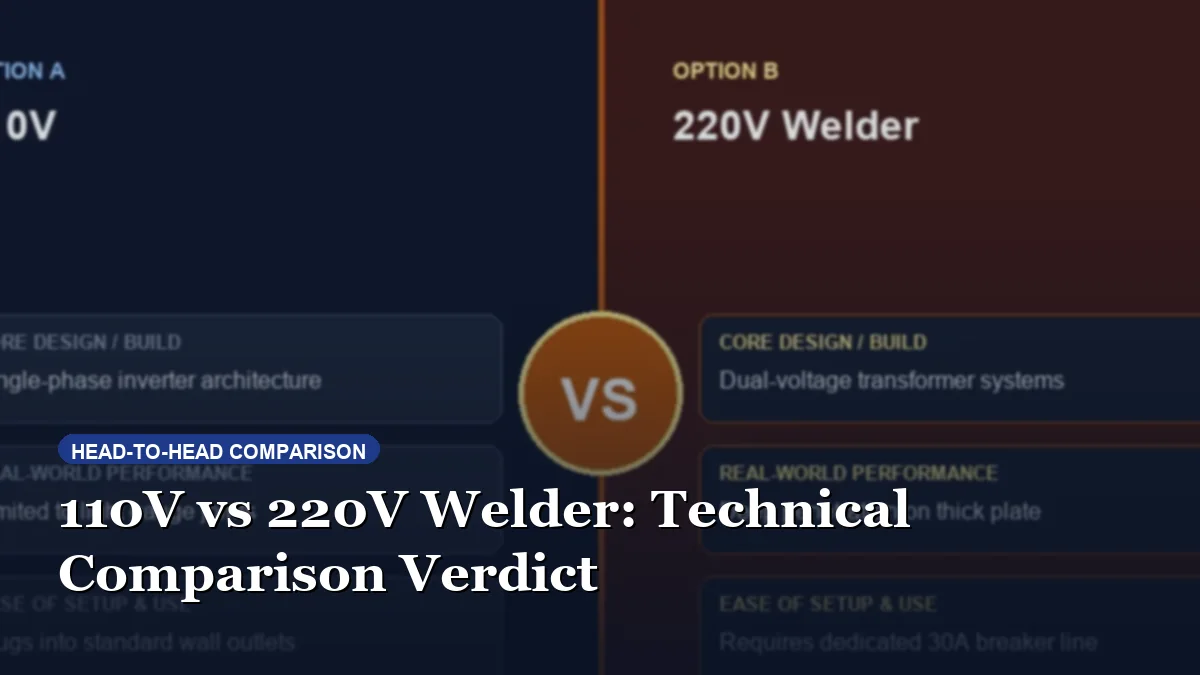
Choose the 110V machine for mobile sheet metal repairs. Select the 220V welder for heavy structural fabrication.
Compare all top models in our Best Welder: Top Home Shop & Jobsite Picks Tested.
Side-by-Side Breakdown
| Criteria | 110V | 220V Welder | Edge |
|---|---|---|---|
| Core Design / Build | Single-phase inverter architecture | Dual-voltage transformer systems | 220V Welder |
| Real-World Performance | Limited to light gauge joints | Deep penetration on thick plate | 220V Welder |
| Ease of Setup & Use | Plugs into standard wall outlets | Requires dedicated 30A breaker line | 110V |
| Durability & Reliability | Prone to thermal overload limits | Industrial duty cycles for production | 220V Welder |
| Efficiency / Operating Footprint | Compact, lightweight inverter body | Bulkier chassis with heavy wiring | 110V |
| Maintenance Requirements | Standard contact tip inspection | Rigorous breaker and terminal checks | 110V |
| Best Ideal Use Case | Bodywork and hobbyist garage projects | Structural steel and farm repairs | 220V Welder |
Core Electrical and Engineering Principles
Understanding input voltage requires examining basic electrical theory within modern welding machine architecture. Standard 110V units draw higher amperage from household circuits to deliver stable arcs on thin workpieces.
Conversely, dual-input and dedicated 220V systems utilize lower current draw at higher potential differences. This fundamental engineering design reduces resistive heat losses across internal transformer windings and heavy power cables.
Inverter technology has revolutionized how both voltage classes manage incoming AC power before rectification. Modern solid-state switches convert raw line current into high-frequency pulses optimized for stable metal transfer.
Understanding transformer efficiency requires analyzing input voltage drops under heavy arc loads. When drawing maximum current, standard 110v circuits often experience significant voltage sag that limits overall arc stability.
Operating on dual-voltage architectures allows modern machines to rectify alternating current into stable direct current. Engineers optimize primary winding ratios to ensure proper thermal dissipation regardless of the selected input supply line.
Circuit resistance plays a critical role in determining actual output amperage delivery. Following proper guidelines when sizing circuit breakers for 220v welders prevents nuisance tripping during extended fabrication sessions.
- Standard 110V circuits operate safely on 15A to 20A household breakers.
- Dedicated 220V configurations require heavy-duty 30A or 50A receptacle wiring.
- Inverter topology reduces total machine weight across both voltage categories.
Transformer Design and Circuitry
Heavy copper transformer coils dictate the physical footprint and thermal mass of traditional welding equipment. Smaller 110V units rely on compact core geometries designed for occasional use.
Industrial 220V machines incorporate massive laminated iron cores that effectively dissipate core saturation heat. This engineering approach ensures sustained electrical stability during long welding passes.
- Copper winding quality dictates overall machine electrical efficiency.
- Iron core mass prevents premature magnetic saturation under load.
Real-World Performance and Penetration Limits
Fabrication workshops demand reliable arc initiation and consistent bead profile across various joint configurations. A standard 110V machine excels on sheet metal up to one-quarter inch thickness.
Pushing a lower-voltage machine beyond its rated capacity inevitably results in cold lap and lack of fusion defects. High-amperage 220V units effortlessly penetrate thick plate without compromising structural weld integrity.
Arc stability under fluctuating line voltage remains a critical differentiator during field fabrication tasks. Larger industrial units maintain smooth globular transfer even when operating on long extension cords.
Achieving adequate root penetration on structural steel joints demands reliable heat input. Standard 110v units typically max out at three-sixteenths inch material thickness, struggling to maintain consistent puddle fluidity during multi-pass fillet welds.
Stepping up to a 220v configuration unlocks deeper weld profiles suitable for heavy fabrication work. Fabricators routinely process half-inch plate without experiencing the frustrating lack of fusion common on lower-amperage residential household circuits.
Arc initiation characteristics also differ noticeably between these two distinct power delivery methods. Higher voltage supplies provide crisp, immediate high-frequency starts that drastically reduce tungsten contamination and electrode sticking during TIG operations.
- 110V units struggle with adequate root penetration on heavy structural steel.
- 220V systems maintain stable arc force through thick oxide layers.
- Voltage drop over long cables severely impacts lower-power machine performance.
Material Thickness Thresholds
Accurate material thickness matching prevents catastrophic joint failure in load-bearing assemblies. Selecting the right best 110v mig welder model ensures adequate penetration for light-gauge sheet metal projects.
Professional fabricators rely on 220V equipment when joining structural tubing or thick plate. Adequate heat input guarantees proper metallurgical bonding throughout the entire joint cross-section.
- Keep 110V applications strictly under eighth-inch steel thickness.
- Deploy 220V systems for multi-pass structural welding projects.
Duty Cycle and Thermal Management Realities
Thermal capacity dictates how long a welding machine can operate before tripping internal safety protections. Reviewing the best 110v flux core welder options helps hobbyists select machines with manageable duty cycles for DIY projects.
Industrial-grade 220V welders offer extended duty cycles designed to support continuous production manufacturing environments. Heavy-duty internal cooling fans and oversized heatsinks prevent premature thermal shutdown.
Operator technique must adapt to the specific thermal limitations of the chosen equipment platform. Ignoring duty cycle ratings rapidly degrades internal rectifier diodes and transformer insulation.
Thermal overload protection prevents catastrophic internal component failure during extended heavy fabrication sessions. Operating machines near their maximum thresholds triggers internal thermostat switches, forcing frustrating work stoppages while cooling fans cycle continuously.
Duty cycle ratings scale dramatically when comparing standard household inputs against dedicated industrial lines. A typical 220v machine maintains a sixty percent rating at higher amperages, whereas 110v equivalents plummet rapidly under load.
Internal heat dissipation depends heavily on robust aluminum heat sinks and high-velocity cooling fans. Maintaining proper airflow ensures transformer longevity by preventing insulation breakdown on copper windings during continuous production welding tasks.
- Typical 110V hobby welders operate at a twenty percent duty cycle.
- Industrial 220V units frequently achieve sixty to one hundred percent ratings.
- Forced-air cooling systems extend operational lifespan under heavy loads.
Overload Protection Mechanisms
Modern thermal overload switches protect internal circuitry from destructive overcurrent conditions. When a machine overheated, a front panel indicator illuminates while the fan continues running.
Resetting these protective devices requires patience and adequate idling time to normalize internal temperatures. Preventative maintenance keeps cooling vents free from conductive metal dust.
- Thermal switches automatically cut output power during extreme overloads.
- Always allow cooling fans to run after completing heavy welds.
Infrastructure, Power Delivery and Safety Standards
Electrical infrastructure requirements represent a major factor when establishing a functional welding workshop. Selecting the best 110v mig welder for the money ensures reliable performance when connecting to standard residential outlets.
Installing a dedicated 220V circuit requires professional electrician services and heavy gauge copper wiring. Complying with local electrical safety codes ensures protection against fire hazards and equipment damage.
Grounding integrity remains paramount regardless of whether you choose low or high voltage equipment. Proper earth grounding safeguards the operator from dangerous electrical shock during wet conditions.
Electrical infrastructure requirements dictate where and how safely your welding equipment can operate. Installing dedicated NEMA receptacles ensures compliance with local building codes while preventing hazardous breaker trips during startup surges.
Grounding integrity remains paramount for operator safety across all mobile and stationary welding setups. Proper earth grounding paths protect users from stray voltage faults caused by compromised torch leads or internal component shorts.
National Electrical Code guidelines specify strict wire gauge sizing for high-draw workshop equipment installations. Utilizing oversized copper conductors minimizes voltage drop issues and guarantees optimal machine performance under demanding workloads.
- Standard household breakers limit maximum current draw significantly.
- Dedicated 220V lines eliminate voltage sag during heavy arc starts.
- National Electrical Code guidelines govern all workshop wiring installations.
Extension Cord Resistance and Voltage Drop
Using undersized extension cords introduces severe voltage drop that degrades welding arc performance. Long runs of light-gauge wire create resistive heat and starve the machine.
Lower-voltage systems suffer exponentially more from poor extension cord selection than industrial units. Always match extension cord wire gauge to the maximum amperage draw.
- Keep 110V extension cords as short as physically possible.
- Use heavy ten-gauge or eight-gauge wire for remote welding setups.
Maintenance, Consumables and Operational Efficiency
Routine equipment upkeep ensures consistent arc performance and extends the lifespan of internal components. Both voltage classes require regular inspection of contact tips and drive roll tensioners.
Higher-voltage industrial units experience increased arc force, which accelerates consumable wear during continuous production. Preventive maintenance schedules should account for dust accumulation on sensitive electronic boards.
Energy efficiency varies based on transformer design and power factor correction capabilities. Modern inverter welders optimize power consumption, reducing overall utility costs during extensive fabrication projects.
Routine maintenance routines extend equipment lifespans and maintain consistent arc characteristics over years of service. Clearing metal dust accumulation from circuit boards prevents electrical tracking and premature component failure in harsh environments.
Consumable lifespan varies depending on operating amperage and total heat exposure during welding operations. Higher output systems generate intense contact tip wear, requiring frequent inspections to prevent erratic wire feeding and poor fusion.
Operational efficiency improves significantly when matching machine capacity precisely to your typical fabrication projects. Choosing the right power supply reduces wasted consumable parts and eliminates costly rework associated with inadequate penetration.
- Inspect MIG gun liners monthly for accumulated metal shavings.
- Check ground clamp connections to prevent high-resistance arc anomalies.
- Clean internal inverter boards with compressed air annually.
Consumable Lifecycle Management
Worn contact tips and degraded nozzles negatively impact shielding gas coverage and arc stability. Keeping a well-stocked inventory of replacement consumables prevents costly workshop downtime.
Proper storage of welding wire prevents moisture contamination and porous weld deposits. Inspect wire spool tensioners regularly to ensure smooth, bird-nest-free wire feed operation.
- Replace contact tips immediately upon observing elliptical bore wear.
- Store mild steel wire in dry, climate-controlled storage areas.
Ideal Workshop Scenarios and Selection Framework
Selecting the correct welding machine requires careful evaluation of your specific fabrication requirements. Home hobbyists tackling light automotive restoration projects will find 110V units remarkably versatile.
Professional structural fabricators requiring deep penetration on heavy plate must choose robust 220V welding systems. Assessing your typical material thickness prevents purchasing underpowered equipment that limits growth.
Consider future workshop expansion when investing in initial welding machinery and infrastructure. Purchasing a dual-voltage machine bridges the gap between portability and industrial power capabilities.
Selecting the correct welding machine requires careful evaluation of available power and project requirements. Hobbyists working on thin sheet metal find standard 110v outlets perfectly adequate for automotive restoration and light repairs.
Professional fabricators handling structural steel and thicker plates must invest in robust 220v infrastructure. This ensures uninterrupted workflow, superior penetration profiles, and compliance with industrial standards across demanding job site applications.
Dual-voltage inverter machines offer the ultimate versatility for workshops with evolving fabrication needs. Evaluating your future project scope before purchasing guarantees long-term satisfaction without requiring costly secondary equipment upgrades down the road.
- Match machine specifications to your thickest anticipated joint configuration.
- Evaluate available electrical panel capacity before purchasing heavy equipment.
- Prioritize portability if you frequently perform mobile on-site repairs.
Making the Final Buying Decision
Weighing initial equipment cost against long-term fabrication capability ensures a satisfying investment. Avoid compromising on power if your workload demands heavy structural steel assembly.
Consult equipment specification manuals and verify local electrical supply before finalizing purchases. Investing in quality safety gear complements your new welding machine setup.
- Dual-voltage machines offer ultimate flexibility for growing workshops.
- Always prioritize operator safety and proper circuit protection.
Frequently Asked Questions
Can a 110V welder join thick steel plates effectively?
A standard 110V machine struggles with material exceeding eighth-inch thickness. You must choose a 220V system for structural penetration.
Do I need a special electrical outlet for a 220V welder?
Yes, high-amperage units require a dedicated 30A or 50A breaker installed by an electrician. Standard household outlets cannot support this heavy electrical load.
What causes a welding machine to trip thermal overload protection?
Exceeding the rated duty cycle or restricting airflow causes excessive internal heat. Allowing the cooling fan to run will restore normal machine operation safely.
Are dual-voltage welders worth the initial investment cost?
Dual-voltage units provide exceptional operational flexibility for growing fabrication shops. They allow seamless switching between standard outlets and heavy circuits easily.
How does extension cord length affect welding machine performance?
Long extension cords introduce severe voltage drop that starves the welding arc. Always use heavy-gauge wire to maintain stable power delivery during use.